

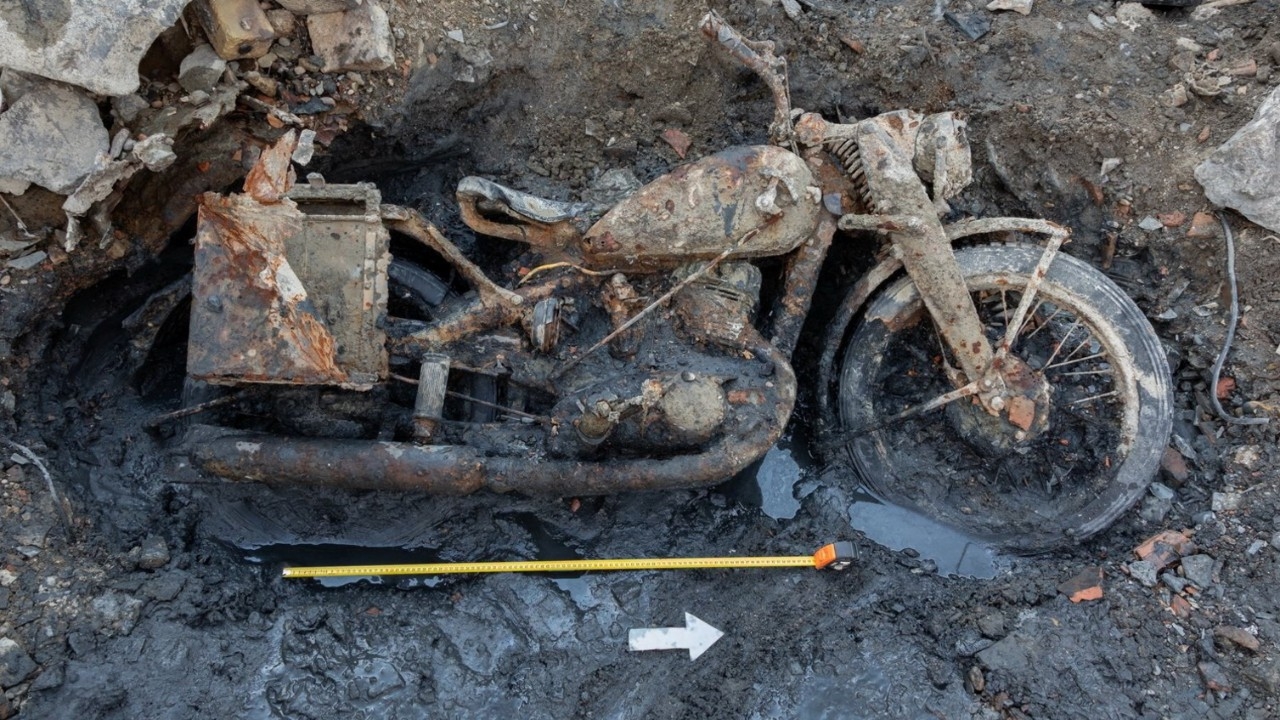
A severe drought has lowered the Danube River to a historic low, exposing the wreckage of a German military motorcycle and the bodies of two German soldiers who died during World War II in central Budapest, along with identification tags, wedding rings, and military insignia that may help solve the mystery of soldiers missing for over 80 years.
The dramatic drop in the Danube's water level caused by the recent severe drought revealed the bodies of two German soldiers believed to have died during World War II, as well as a relatively well-preserved German army motorcycle wreck in Budapest, the capital of Hungary.
The German War Graves Commission revealed that besides the two soldiers' bodies, identification tags, wedding rings, and the Kuban Shield—a decoration awarded to German soldiers who fought in the Kuban battle zone—were found. This discovery offers hope that families of some missing soldiers may learn their ancestors’ fate after more than 80 years.
Arne Schrader, an official from the German War Graves Commission, told Germany's Bild newspaper that they are beginning investigations to solve the mystery of the identities of the two deceased soldiers.
The motorcycle wreck was found on August 2 after a passerby spotted parts of the bike protruding from rocks along the riverbank in central Budapest and alerted authorities. Inspecting officials also found anti-tank mines nearby, leading to a temporary closure of the riverside area while bomb disposal units ensured the site’s safety.
The Commission stated that some items, especially the identification tags and the motorcycle, remain in good condition because they were buried in a mixture of sediment from the harbor and accumulated oil on the riverbed. Preliminary examination suggests the motorcycle is a DKW NZ 350-1, a model specifically produced for wartime use starting in 1944.
The German War Graves Commission noted that two identification tags were found: one belonging to a soldier of the German army (Wehrmacht), and another belonging to a Waffen-SS member, the armed wing of the SS organization, which was declared a criminal organization by the International Military Tribunal in Nuremberg due to its involvement in war crimes.
During World War II, German soldiers carried two-part identification tags; upon death, one part remained with the body while the other was sent to German military authorities to record the death and notify the family. However, the Commission noted that the families of these two soldiers may have never been officially informed of their deaths.
Authorities have begun processes to verify the identities of the two soldiers but cannot yet confirm whether the identification tags and Kuban Shield found actually belong to the deceased.
The Commission said that while the names on the tags may be identified quickly, this is only the start of the investigation since multiple pieces of evidence must be combined, and results remain uncertain. Bone analysis will be crucial in confirming the soldiers’ identities.
People still searching for relatives lost in the war can check lists through the German War Graves Commission’s database, which is responsible for locating, recovering, and conducting burial ceremonies for German soldiers who died in wars on behalf of the German government.
News of the discovery of the two soldiers’ bodies has attracted significant attention on social media groups following World War I and II stories. One user commented that although the low water level causes problems, this discovery gives families a chance to learn where their relatives died and ensures the fallen soldiers receive a respectful burial. The two soldiers’ remains will be interred at the German Military Cemetery in Budakeszi, near Budapest.
Budapest was one of the fiercest battle zones near the end of World War II, witnessing intense fighting between the Soviet Red Army and the German army from late 1944 through early 1945 during the battle to capture the city.
Previously, the lowered water levels of the Danube also revealed World War II artifacts and wreckage in other areas, including a shipwreck near Prahovo, Serbia.
This latest discovery not only highlights the severe drought's impact causing abnormal Danube water levels but also provides authorities an opportunity to uncover new evidence that may help families of war missing persons finally learn the fate of their loved ones after more than eight decades.
,BBC