

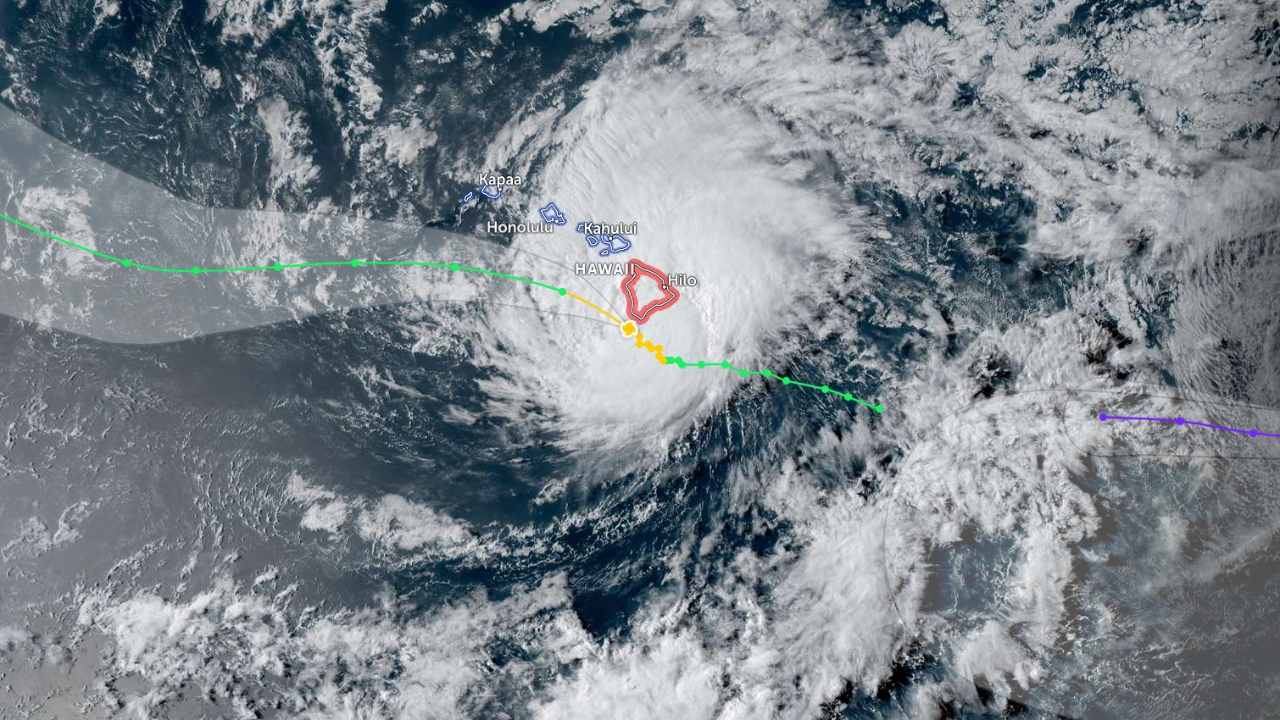
Hawaii is rushing to prepare for Hurricane Lala, a Category 1 storm moving close to the Big Island. It may become the first hurricane to make direct landfall in Hawaii since 1992. Mountainous areas face up to 63 centimeters of rainfall, with warnings of flash floods, landslides, and dangerous ocean waves. Airlines have canceled numerous flights, affecting passengers statewide.
The U.S. state of Hawaii is stepping up preparations as Hurricane Lala intensified into a Category 1 storm on Saturday, 15 Aug 2025 GMT+7, with sustained winds around 120 kilometers per hour. The storm is moving toward the southern tip of the Big Island amid heavy rain, strong gusts, and high ocean waves.
The U.S. National Hurricane Center expects the storm’s center to pass over or near the southern tip of the Big Island by evening, then move westward, likely weakening to a tropical storm afterward.
If the hurricane makes direct landfall, it will be Hawaii’s first direct hurricane hit since 1992, marking 34 years. The Big Island could face its first hurricane landfall in about 155 years. Atmospheric scientists at the University of Hawaii note that a Category 3 hurricane struck the island’s northeast in 1871.
Hawaii Governor Josh Green urged residents to stay indoors and prepare for heavy rainfall, with some areas expecting about 5 centimeters of rain per hour. He also warned of strong winds, heavy rain, flash floods, and hazardous ocean waves.
High-elevation areas of the Big Island, especially around Mauna Kea volcano, may see up to 63 centimeters of accumulated rain, while lower elevations and Maui island could receive 20 to 30 centimeters. Other Hawaiian islands may expect 10 to 15 centimeters of rain.
The U.S. National Weather Service warned that the heavy rain could cause widespread flooding requiring evacuations and assistance in many areas. Rivers and tributaries may rapidly overflow their banks. Mountainous regions face dangerous landslide risks, particularly in remote residential zones.
Authorities have issued a hurricane warning for the Big Island. Maui, Molokai, Lanai, Kahoolawe, Oahu, Kauai, and Niihau are under tropical storm warnings. Shelters have opened across the islands, and many activities have been canceled to ensure public safety.
Residents on the Big Island are actively preparing, with some stockpiling fuel, food, and essential supplies. Homeowners have placed sandbags to guard against flooding. Local officials advise people to plan evacuation routes and secure shelter before conditions deteriorate.
Residents in Hilo, on the island’s east side, reported landslides cutting off some roads, and fallen trees downing power lines causing outages. Several rivers have risen rapidly, and Hilo Bay’s waters turned reddish due to sediment carried downstream by currents.
Transportation disruptions include numerous flight cancellations. Ellison Onizuka Kona International Airport, the Big Island’s largest, canceled about 40 percent of flights, while Hilo International Airport canceled roughly 80 percent.
Data from a power outage tracking website showed that by Saturday afternoon, approximately 37,000 customers across Hawaii were without electricity, with about 32 percent of Big Island residents affected.
Beyond flooding and landslides, authorities are monitoring wildfire risks, as strong winds could cause fires to spread rapidly. Hawaii is still recovering from major flooding damage in March 2025.
Meteorologists warned that even hurricanes not making direct landfall can cause severe damage. The major wildfires in Lahaina on Maui in 2023, fueled by strong winds while a hurricane was moving south offshore, remain a stark reminder of severe weather dangers.
The last hurricane to make landfall in Hawaii was Iniki, a Category 4 storm that hit Kauai island in 1992. It caused six deaths and about 3 billion U.S. dollars in damage, approximately 100 billion Thai baht.
Recent U.S. hurricane seasons have been relatively quiet, with the most recent major storm being Category 3 Hurricane Milton, which struck Florida in October 2024.
The U.S. National Oceanic and Atmospheric Administration (NOAA) projects that the 2026 hurricane season may again see below-average storm activity, estimating a 55 percent chance of fewer storms.
Meanwhile, global ocean temperatures in July 2025 reached record highs for that month, according to the European Union’s climate monitoring agency. This was partly due to the developing El Niño in the Pacific Ocean. July was also the second hottest month globally on record, with average temperatures about 1.47 degrees Celsius above pre-industrial levels. Scientists are closely watching how rising ocean temperatures could affect Pacific storm patterns and intensity.
SourceBBC/Associated Press