

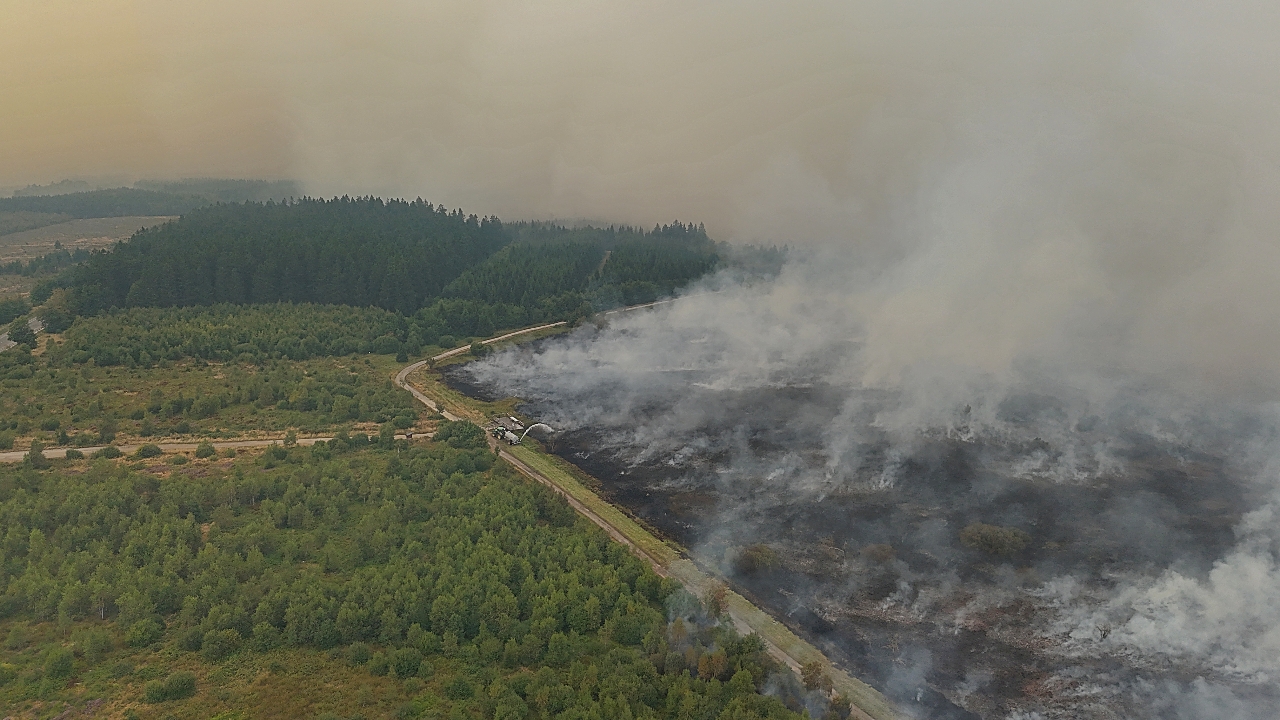
Officials are mobilizing to extinguish one of the most severe wildfires in Belgium's modern history after flames rapidly spread through the Hautes-Fagnes nature reserve in the eastern part of the country, burning over 16,800 rai. The fire approached local communities, forcing the evacuation of several hundred people, while multiple European nations deployed water-dropping planes and helicopters to assist.
Belgian firefighters are fighting a large wildfire spreading through the Hautes-Fagnes nature reserve in the eastern part of the country near the German border. Authorities describe it as one of the most intense wildfires in Belgium's modern history.
The fire ignited on Friday, 14 Aug 2024 GMT+7, and rapidly spread amid extreme heat and drought conditions. By Saturday evening, it had burned over 2,700 hectares—approximately 16,875 rai—an enormous increase from about 80 hectares on the first day.
The affected area is part of the Hautes-Fagnes nature reserve, Belgium's largest protected nature area, consisting of pine forests, grasslands, peatlands, and wetlands. These conditions make access difficult for responders and prevent the use of standard ground firefighting methods in many locations.
Nicolas Yernaux, spokesperson for the Wallonia regional authority, stated that the situation remains uncontrolled and there is a risk the flames could reach homes. However, officials are deploying all available resources to protect communities.
Authorities ordered the evacuation of approximately 600 to 650 residents from parts of the villages of Sourbrodt and Butgenbach for safety. A gymnasium in Malmedy city has been opened as a temporary shelter. Residents in other areas have been advised to stay indoors and keep doors and windows tightly closed.
Eyewitnesses reported thick smoke covering the area, with ash falling onto restaurant tables, prompting the evacuation of customers from the premises.
Firefighting efforts are challenging due to the terrain, which includes peatlands and grasslands that are difficult to access. Some firefighters had to retreat to establish containment lines at the forest edge, allowing the fire to burn some grassland areas to prevent it from spreading into pine forests and other higher-risk zones.
Gregory Melotte, a firefighter, revealed that teams managed to control part of the fire advancing from flatlands to prevent it from reaching pine forests. However, the situation is ongoing, as wind direction changed twice, altering the fire's course.
Belgium requested assistance through the European Union Civil Protection Mechanism, enabling member states to send personnel and equipment. Helicopters from the Netherlands have joined the operation, with two more helicopters and two water-dropping planes from Sweden en route to assist in firefighting.
European Commissioner Haja Lahbib stated this wildfire is the latest sign of climate change impacting Europe, noting that wildfire seasons are starting earlier and extending further north than ever before.
Meanwhile, many Belgian farmers have driven their vehicles and equipment to assist officials, with some using water trucks and agricultural tools to sprinkle water along fire lines to slow its spread.
Bernard Genant, Belgium's Interior Minister, expressed shock at the speed and scale of the damage but praised the efforts of officials, farmers, and volunteers working together to manage the situation.
Belgium has experienced a new heatwave in recent days, with temperatures reaching up to 37 degrees Celsius on Friday. Meanwhile, wildfires are also occurring in several European countries, including France, Croatia, Spain, and Serbia.
In France, authorities ordered the evacuation of about 650 people after a wildfire in the Landes region in the southwest reignited on Saturday. The fire started on Thursday, with over 500 firefighters mobilized to control the situation.
Additionally, a large wildfire in western Germany, just a few dozen kilometers from the fire in Belgium, forced the evacuation of approximately 1,800 residents as flames approached homes in the town of Hürtgenwald.
The European Union's Copernicus Climate Change Service reported that Western Europe recently experienced its hottest June to July period on record. The prolonged heat and drought have dried vegetation, making it more flammable and causing wildfires to spread rapidly and become harder to control across the region.