

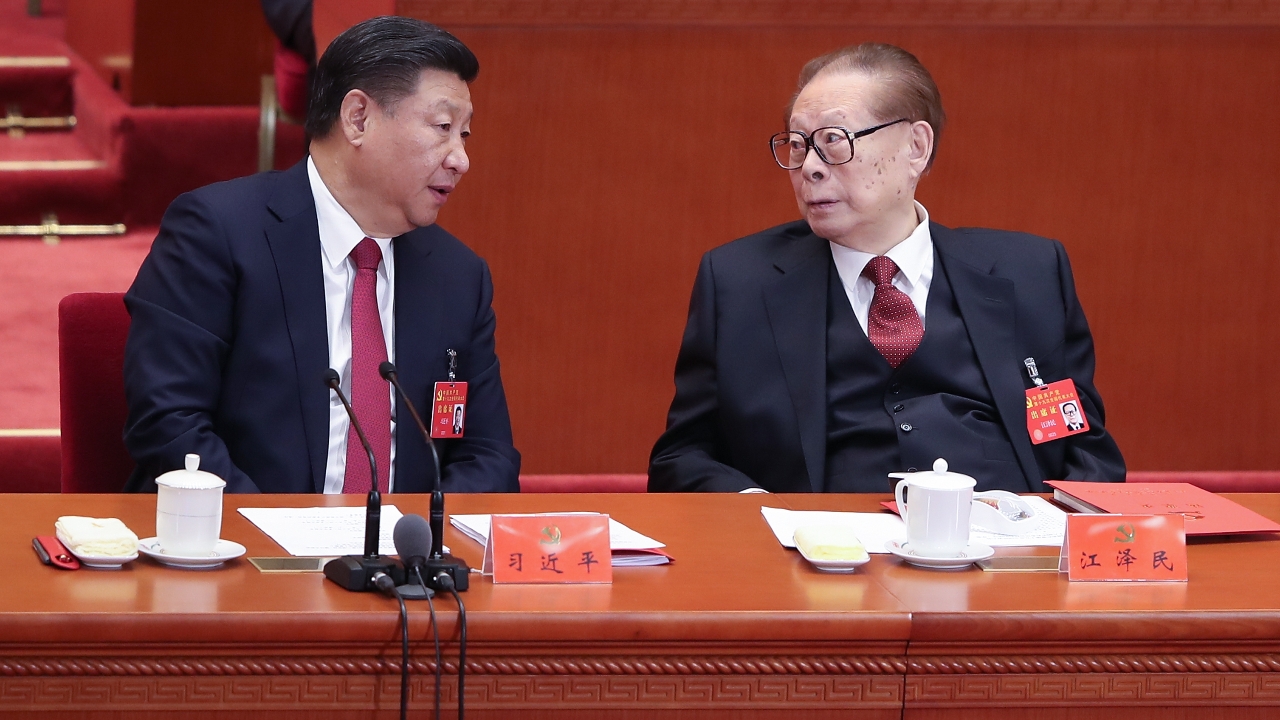
Chinese President Xi Jinping joined the ceremony commemorating the 100th anniversary of former President Jiang Zemin’s birth, praising Jiang’s pivotal role in reform and opening up the country. He called on the Communist Party of China to continue this path amid economic challenges, trade conflicts, and strategic competition with Western nations.
President Xi Jinping and other top Chinese leaders attended a meeting at the Great Hall of the People in Beijing today (17 Aug) to mark the 100th anniversary of former President Jiang Zemin’s birth. Jiang played a crucial role in guiding China through a major transition—from an economy with limited global influence to a key driver of the world economy.
Xi Jinping, who serves as both president and General Secretary of the Communist Party of China, praised Jiang’s significant contributions to China’s reform and opening-up, as well as advances in the economy, politics, society, and Communist Party development.
Xi stated that Jiang was instrumental in protecting and developing socialism with Chinese characteristics, initiating a new era of reform and opening, improving citizens’ livelihoods, and advancing Chinese-style socialism into the 21st century.
Jiang Zemin was born on 17 August 1926. He served as General Secretary of the Communist Party of China from 1989 to 2002 and as Chairman of the Central Military Commission until 2004. He passed away in November 2022 at the age of 96.
During Jiang’s leadership, China experienced rapid economic change and deeper integration with the global economy. The government pursued state-owned enterprise reforms, housing system adjustments, expanded private sector and business participation, and managed the Asian financial crisis in the late 1990s.
A key achievement was China’s accession to the World Trade Organization (WTO) in 2001, accelerating its integration into the global trading system and supporting China’s subsequent economic growth.
Xi Jinping said Jiang made decisive choices during critical historical junctures and calmly faced risks and challenges, enabling China’s modernization process to progress steadily.
However, Xi noted that China now faces new challenges including trade conflicts with the US and Europe, Taiwan tensions, economic slowdown, and demographic shifts.
The Chinese leader urged the Communist Party to heighten risk awareness and prepare for crises by balancing economic development with national security, while firmly safeguarding sovereignty, security interests, and development interests.
Xi Jinping also stated that China must continue to achieve two “miracles”: rapid economic development and long-term social stability, linking Jiang’s political legacy with China’s current goals of becoming a global power and national rejuvenation.
The memorial takes place as China confronts complex economic and geopolitical challenges. Jiang and former Premier Zhu Rongji, his key partner during the 1990s and early 2000s, emphasized market reforms, economic openness, private entrepreneurship, and wealth creation.
In contrast, the current government under Xi Jinping emphasizes stronger central control and a state-driven economy, focusing on technological self-reliance, strategic industries, and economic security.
Jiang and Zhu implemented impactful changes including closing loss-making state enterprises, ending the old housing system to open commercial real estate markets, managing the Asian financial crisis, and leading China into the WTO.
The memorial ceremony also attracted attention from China political analysts as an opportunity to observe the party’s internal power hierarchy and the status of former leaders and their political factions.
Former President Hu Jintao, who succeeded Jiang and is now 83, was initially absent from official Chinese media photos. Meanwhile, former Premier Wen Jiabao and ex-Vice President Wang Qishan, known for their roles in Xi Jinping’s anti-corruption campaign, appeared at the event.
Ahead of Jiang’s 100th birth anniversary, Chinese state television aired a 12-episode prime-time documentary series portraying his life and achievements.
Although Jiang led China after the 1989 Tiananmen Square crackdown and his government tightly controlled information, some Chinese, especially younger generations, view Jiang’s era positively.
During Jiang’s tenure, the internet began entering China in the mid-1990s before the government developed the "Great Firewall" to control and filter online information deemed potentially destabilizing to society.
Nonetheless, some Chinese remember Jiang’s period as one filled with hope and optimism, as rapid economic growth visibly improved citizens’ living standards.
On Chinese social media, where names of past and present leaders are often censored, Jiang is referred to as the “elder” and has become a figure in an online culture group that admires his personality, including his background as a former auto factory worker and Soviet-trained official.
Jiang is also known for his affable nature, love of singing, and ability to recite President Abraham Lincoln’s Gettysburg Address in English from memory.
Additionally, the People’s Bank of China announced plans to issue commemorative coins featuring Jiang’s image later this month, attracting significant interest from Chinese internet users who admire the former leader.
Thus, the commemoration of Jiang Zemin is not only a tribute to a former leader but also reflects current Chinese leadership’s effort to connect the era of reform and opening up with China’s 21st-century mission amid competition with Western powers and major global economic shifts.
. Reuters/ AP