

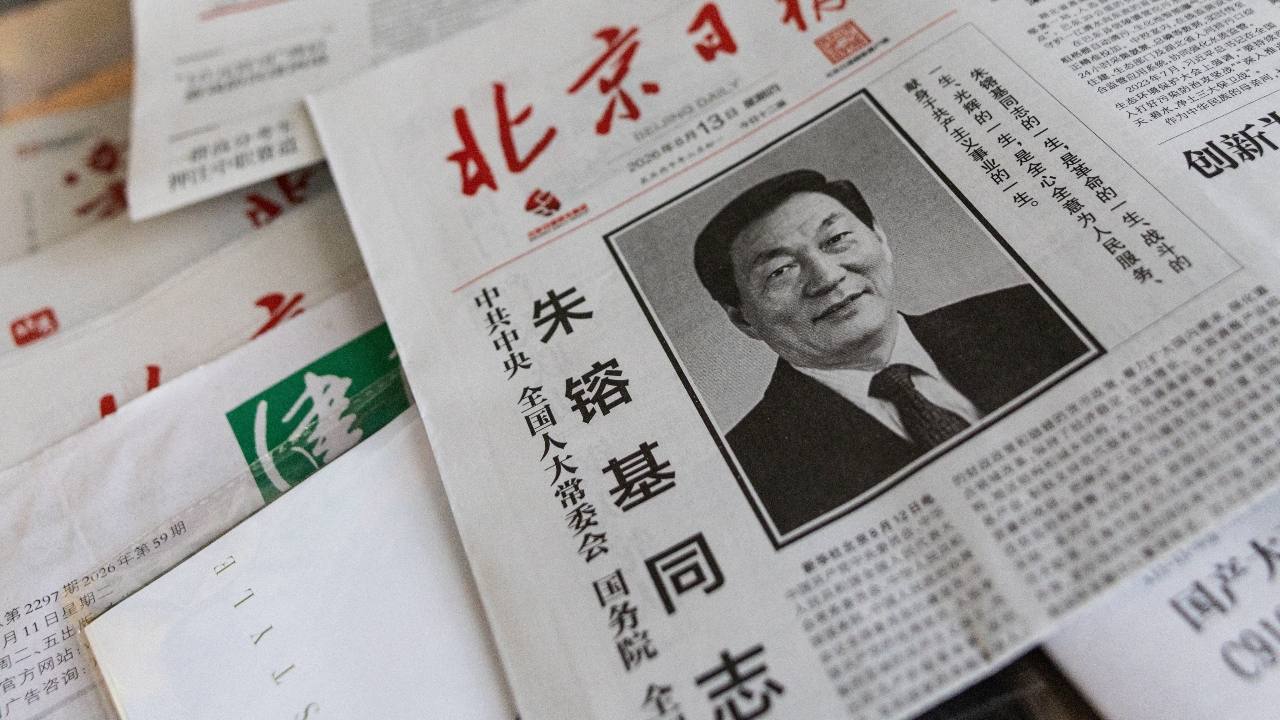
Chinese authorities officially held a funeral for former Premier Zhu Rongji in Beijing, lowering flags to half-mast and increasing security measures. Meanwhile, online expressions of mourning were heavily censored after a wave of nostalgia for an era of economic prosperity and greater freedoms, seen as implicit criticism of the current government under President Xi Jinping.
Government offices across China lowered their flags to half-mast to mourn the passing of former Premier Zhu Rongji, a key figure in China's economic reforms, who died of old age at 97. The cremation ceremony took place simply in Beijing, with no live broadcast on mainstream media, amid a heavy police presence and security personnel throughout the capital's center.
Chinese state media praised Zhu Rongji as an "outstanding Communist Party member" and a "faithful communist fighter proven by time." Zhu served as Premier from 1998 to 2003 and was behind major economic structural reforms, including opening the market system, leading China into the World Trade Organization (WTO) in 2001, and navigating the Asian financial crisis in the late 1990s.
Although crowds mourned, China's online censorship was intense, deleting posts and articles about the former premier. For example, a piece by prominent economist Zhao Jian describing Zhu's era as a time when people, though still poor, saw a clear future, felt free from social media worries, and could speak their minds, was removed from the WeChat platform just one day after publication.
The Chinese Communist Party has always feared public displays of grief for senior leaders, as past deaths, such as those of former Premier Zhou Enlai in 1976 and former Party Secretary Hu Yaobang in 1989, sparked nationwide hope and large-scale protests.
Zhu Rongji's death follows that of former President Jiang Zemin, who died in 2022, prompting widespread nostalgia among many Chinese for an era of openness, rapid economic growth, and straightforward leadership style, contrasting with the current politically strict and cautiously orchestrated governance.
Zhu Rongji was remembered for his straightforward speech, fearlessness, and subtle humor. He once called corrupt bankers "sawdust brains" and compared a dam on the Yangtze River to "fragile tofu dregs." Videos and photos of him speaking candidly with Jiang Zemin have circulated on social media, accompanied by praise that "they dared to speak the truth, took responsibility, and worked wholeheartedly for the people."
The passing of these two reform-era leaders marks the end of a period promoting the private sector and wealth creation, differing from President Xi Jinping's approach, which emphasizes centralized control, strengthening state power, and focusing on technological self-reliance.
At the recent memorial for Jiang Zemin on Monday (17 Aug), President Xi warned the Communist Party to "recognize potential dangers and prepare to face a major storm," while attempting to integrate the history of previous leaders with his current governance approach.
Experts note that citizens are comparing eras because China currently faces economic slowdown, a sluggish real estate market, and rising youth unemployment. The traditional belief that "hard work leads to a better life" has eroded, leading to feelings of isolation among the current generation despite being surrounded by skyscrapers and modern material wealth.
,BBC