

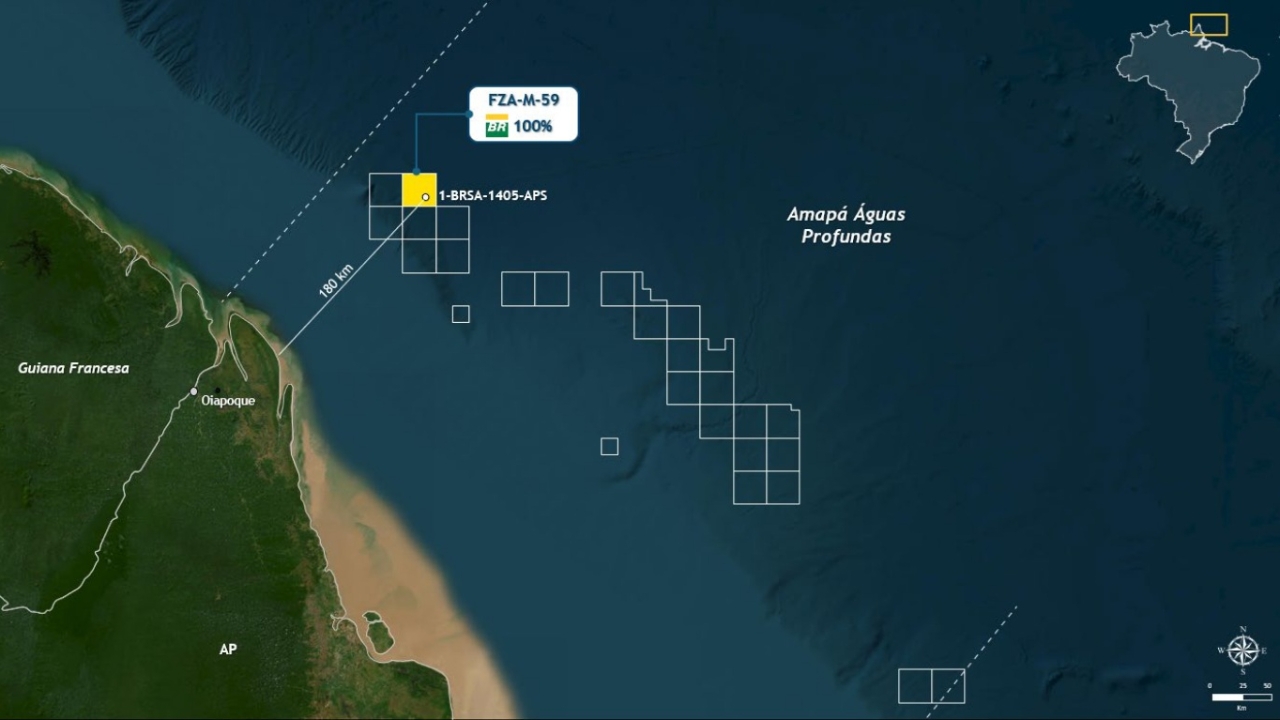
Petrobras, Brazil's government energy giant, confirmed the discovery of crude oil at the Morpho exploration well near the equator line off the coast of Amapá state near the Amazon River mouth. President Luiz Inácio Lula da Silva called this discovery a "passport to the country's future," while executives said it will take time to assess exact reserves but expressed strong confidence in its vast potential.
Magda Chambriard, CEO of Petrobras, officially confirmed the detection of high-quality crude oil from drilling at the Morpho well, located offshore near the equator line about 180 kilometers from Amapá state's coast, at the mouth of the Amazon River.
"There is indeed oil, and we have found it. Although we do not yet know the exact quantity, we view what we found with great commitment and optimism."
Drilling at the well is expected to conclude within 15 to 20 days. Petrobras plans to drill an additional three exploration wells nearby and five more in adjacent areas to thoroughly evaluate the oil field’s potential.
The coastal area near the Amazon River mouth, known as the Equatorial Margin, is believed to have high oil and natural gas potential. Preliminary assessments estimate the basin may hold up to 10 billion barrels of oil, valued around 3.8 trillion Brazilian reais, or approximately 720 billion U.S. dollars.
The need to find new oil fields arises because Brazil's current sub-salt oil fields, which supply about 80% of the country's crude oil production, are expected to reach peak output around 2034 to 2035, prompting Brazil to seek new reserves to replace declining production.
President Luiz Inácio Lula da Silva visited Petrobras's drilling ship and held a press conference in Oiapoque municipality, Amapá state. Lula held up a bottle of black crude oil and described the discovery as a "passport to Brazil's future" that will elevate Amapá's economy beyond just exporting açaí berries and dried fish.
Lula emphasized, "When I say 'passport,' I do not reject my commitment to fighting for a day when we no longer depend on fossil fuels, because Brazil will continue to lead in biofuel innovation and renewable energy."
Alexandre Silveira, Brazil's Minister of Mines and Energy, praised the discovery as historically significant and directly related to the country’s energy sovereignty.
The environmental licensing process for the Morpho exploration well was highly contentious. Previously, Brazil’s environmental protection agency Ibama recommended halting the project due to concerns about impacts on local communities, indigenous peoples, and risks from oil spills. However, the license was approved in October 2025 under Lula's government, shortly before the United Nations Framework Convention on Climate Change (COP30) conference in Belém.
Official analysts view Lula’s visit and commercial announcement as politically significant timing, as he prepares for a fourth presidential election campaign later this year. Opening the door to becoming a new global oil source may help attract votes from northern regions that have previously criticized his government.
However, energy experts note that despite the oil discovery, the exploration phase to assess commercial viability and actual drilling could take up to a decade. Petrobras, which recently reported a net profit of 52.4 billion reais, up 97%, confirmed it has applied to Ibama for permits to drill additional exploration wells and is awaiting approval.