

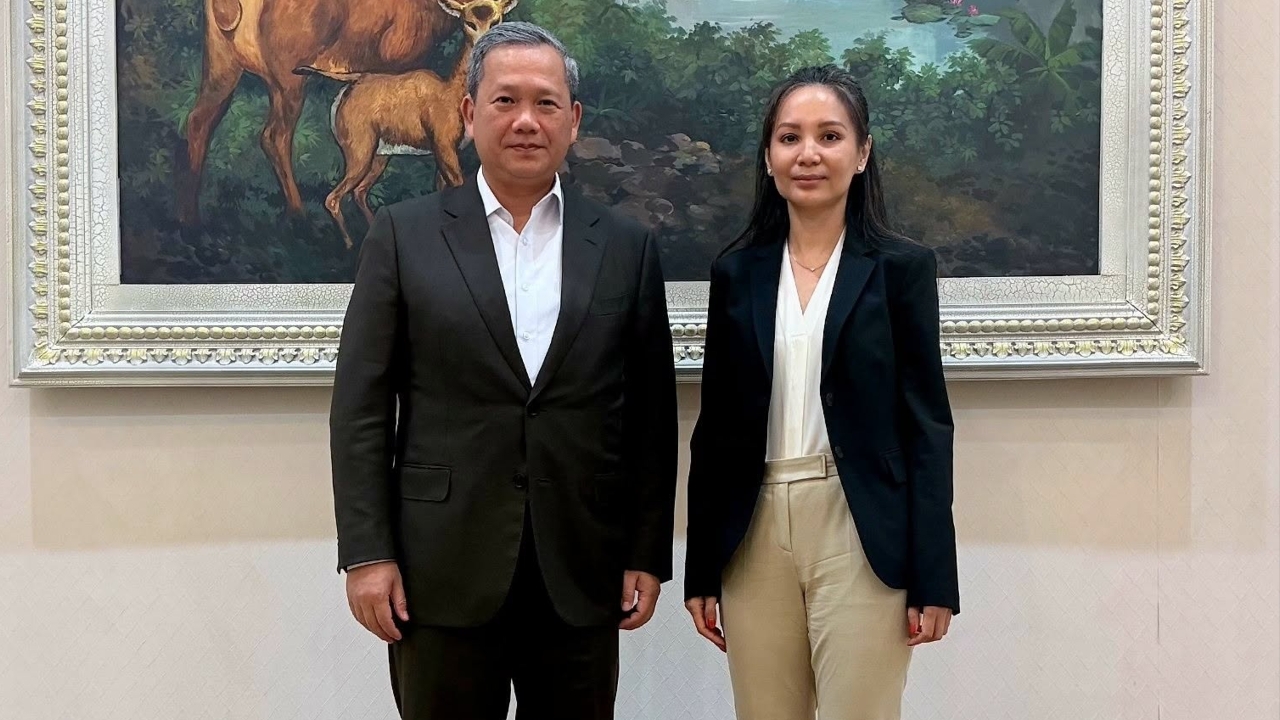
Khem Manovitaya, daughter of former Cambodian opposition leader Kem Sokha, who was sentenced to 27 years in prison for rebellion, defended her acceptance of the role as "Special Envoy" to Prime Minister Hun Manet, a position with ministerial rank. She affirmed that this decision "has no relation whatsoever" to her father, while analysts see it as a sign of the opposition's weakening and her father's diminished political role.
Khem Manovitaya, daughter of former Cambodian opposition leader Kem Sokha, defended her new government position, noting that her father was once prosecuted and sentenced to 27 years for rebellion. She emphasized that this role "is not connected to her father, the opposition, or the ruling party" after being appointed Special Envoy to Prime Minister Hun Manet on 17 Aug.
The royal decree, signed by King Norodom Sihamoni, stated that the appointment followed a request from Prime Minister Hun Manet, granting 44-year-old Khem Manovitaya a ministerial-equivalent rank, though no further details about her official duties were disclosed.
This appointment came just months after Kem Sokha received a royal pardon in May, having previously been sentenced to 27 years in prison for rebellion, charges which he denied.
Kem Sokha was arrested in 2017, accused of conspiring with the United States to overthrow the government of Hun Sen, then Prime Minister and father of Hun Manet. That same year, the Cambodia National Rescue Party (CNRP), led by Kem Sokha, was dissolved by the court, forcing many members into exile, while others faced charges and imprisonment without court appearances.
Khem Manovitaya, formerly a CNRP member, stated her new role will focus on international affairs, particularly promoting economic development and "protecting Cambodia's territorial integrity," after alleging that certain border areas have been "illegally occupied by Thai military forces."
The Cambodian government reports that over 20,000 Cambodians remain displaced from areas along the Thai-Cambodian border, currently under Thai control, following military clashes between the two countries last year.
Prime Minister Hun Manet said Khem Manovitaya will assist with international diplomacy, highlighting the Thailand-Cambodia border dispute as a key issue. Earlier, Hun Manet posted a photo on Facebook standing beside her, calling her "little sister," and noted that young politicians can collaborate for the country's benefit, especially on the international stage.
The appointment came just one day after Hun Sen, now Senate President with significant political influence, shared photos of a meeting with Kem Sokha attended by Khem Manovitaya.
Khem Manovitaya stated that political differences are one thing, but "responsibility to Cambodia is another," urging society to look beyond politics and assess her role based on her work and duties.
However, analysts view the appointment as reflecting a further weakening of Cambodia's opposition and a diminishing political role for Kem Sokha, amid the long-standing dominance of the Hun family government.
Mu Sochua, former senior CNRP leader now residing in the United States, said Khem Manovitaya's appointment could be the government's attempt to "manage international scrutiny" and demonstrate responsiveness to external concerns.
She added that Western countries, including the United States, have long called for Kem Sokha's full release and restoration of political rights. She noted that the Kem family may have negotiated this appointment in exchange for their own freedom, but local opposition members and so-called "political prisoners" still jailed were not included in such agreements.
Local human rights group Licadho estimates that about 50 opposition politicians and activists remain imprisoned in Cambodia, accused of activities related to public expression or political activism.
Thus, Khem Manovitaya's appointment is seen as a significant political development in Cambodia, especially as Hun Manet's government seeks to project a more open image, while Hun Sen continues to wield substantial influence over the country's political direction.