

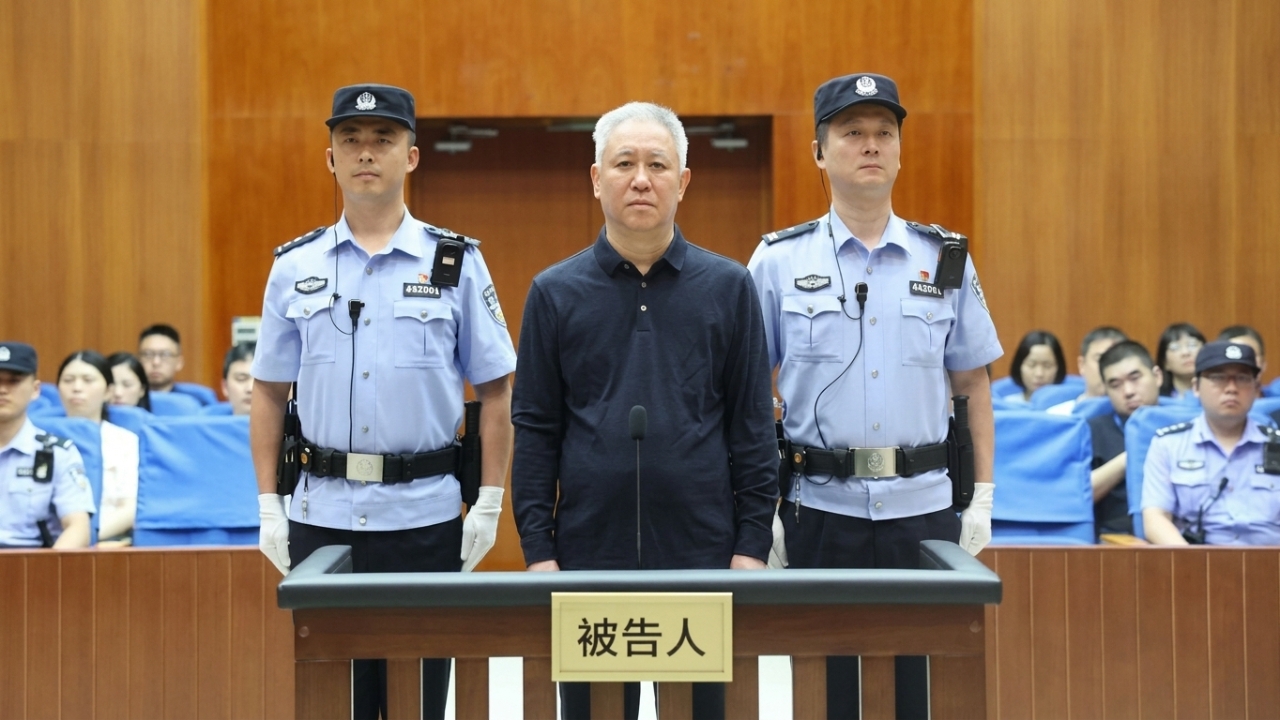
A Chinese court sentenced Xu Jiayin, also known as Hui Ka Yan, founder of the major real estate empire Evergrande, to life imprisonment. The court ordered the confiscation of all his personal assets and fined affiliated companies a total of more than 8.82 billion yuan, or over 43 billion baht, marking the end of one of China's largest financial fraud crises in history.
The Shenzhen Intermediate People's Court in Guangdong Province ruled today (20 Aug) that Xu Jiayin, founder and former chairman of Evergrande Group, is sentenced to life imprisonment on multiple charges, including major financial fraud. The court also revoked his political rights for life and confiscated all his personal assets.
The court further fined Evergrande Group and its subsidiary Evergrande Real Estate Group, a real estate business, a combined total of more than 8.82 billion yuan, equivalent to over 43 billion baht.
The Shenzhen Intermediate People's Court stated that from 2016 to 2021, Xu Jiayin and Evergrande Group violated laws by engaging in widespread and continuous financial fraud, including methods to inflate the company's asset value and conceal its debts.
The court also noted that Xu and his associates used their power and bribery to control certain financial institutions, although it did not disclose the names of these institutions.
Xu, also known by the Cantonese name Hui Ka Yan, confessed to the charges in April. Besides fraud, the charges include embezzlement and bribery.
Meanwhile, five other senior Evergrande executives were sentenced by the court on the same day to prison terms ranging from six to eighteen years for offenses including fraud.
Xu Jiayin grew up in a rural Chinese family and was raised by his grandmother before entering the real estate business and founding Evergrande in 1996.
Under Xu's leadership, the company expanded rapidly by borrowing massive amounts to invest in various projects, making Evergrande one of China's largest property developers. It once had a market value exceeding 50 billion U.S. dollars. This success made Xu one of Asia's wealthiest billionaires.
However, the heavily debt-reliant business model began to face difficulties after the Chinese government introduced measures in 2020 to control borrowing and speculation in the real estate sector. Evergrande, which could no longer easily access loans, had to quickly sell projects and properties at deep discounts to repay debts before defaulting in 2021.
During the trial in April, the court found that Evergrande received millions of dollars from homebuyers through pre-sale projects, but these funds were not used for construction as intended. Some were diverted to new property projects, resulting in hundreds of unfinished housing developments and causing losses to homebuyers and creditors.
Evergrande's collapse thus impacted not only the company and its shareholders but also shook China's real estate system, domestic banks, investors, and confidence in the overall Chinese economy.
Earlier, in March 2024, China's securities regulator fined Xu approximately 6.5 million U.S. dollars and barred him from the Chinese capital markets for life after finding that Evergrande had overstated its revenue by about 78 billion U.S. dollars.
Evergrande's crisis caused its stock value to plummet by 99% from its peak before being delisted from the Hong Kong Stock Exchange in August 2025 after over 15 years of trading. The company's collapse became a key symbol of China's real estate crisis, which continues to pressure the country's economy.
The real estate sector was once a major engine of China's economy, but after home prices and sales slowed, many developers faced debt problems, construction delays or halts, and consumer confidence declined.
The life sentence for Xu Jiayin is a significant conclusion to the Evergrande crisis and a clear message from the Chinese government that executives who commit fraud and distort information to expand heavily indebted businesses will face criminal responsibility, even if they were once among the most influential figures in the country's real estate sector.