

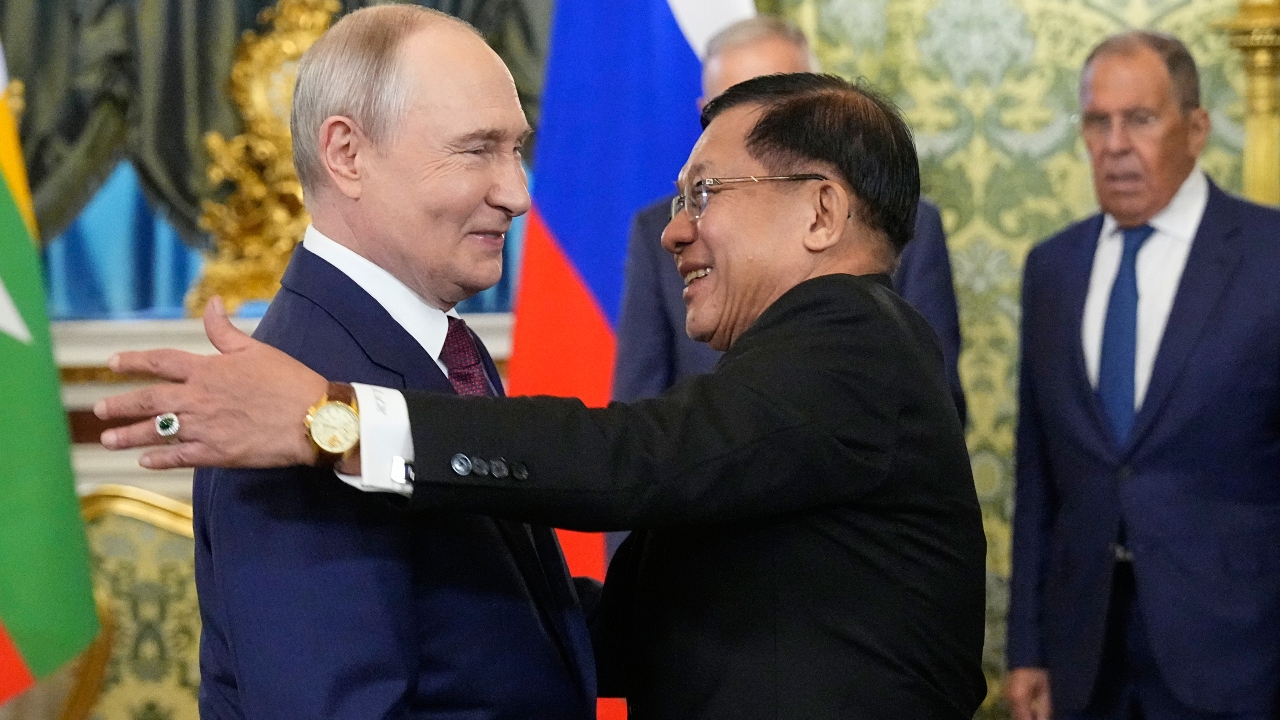
The Myanmar military has launched a clearance operation, deploying troops to sweep through and burn villages in the southern region to forcefully clear land for the Dawei Special Economic Zone (Dawei SEZ), supported by Russia. The goal is to develop it as a new strategic transport route to replace the Strait of Malacca amid heavy clashes with opposition groups and rising death tolls.
The Myanmar military has sent several hundred troops into the southern region, which hosts the Dawei Special Economic Zone and plans for a deep-sea port and power plant on the Andaman coast, according to opposition fighters and local activists with direct knowledge of the situation.
This operation is occurring in the Tanintharyi region, bordering Thailand, and is one of the clearest signs that the military-backed government is willing to use force to revive the Dawei project, promoted as an alternative strategic trade route connecting Southeast Asia with South and West Asia without relying on the Strait of Malacca.
Since July, the Myanmar military has deployed several hundred soldiers into the area, engaging in combat with local opposition groups, forcing the opposition to withdraw from some locations.
Saw Da Ko from the Tanintharyi People’s Defense Forces said the military is advancing into the area conducting clearance operations, with reports that some villages and homes have been burned.
An anonymous opposition fighter from Dawei Battalion 1, under the National Unity Government (NUG), reported that soldiers burned at least three village homes and killed three aid workers who were assisting displaced communities.
The local civil society group MAGGA Initiative stated that the three aid workers were detained and killed by advancing military forces in Ye Boo town on 9 July.
However, Reuters could not independently verify this information, and neither the Myanmar government nor the Russian embassy in Myanmar responded to requests for comment.
The military operation intensified after Lt. Gen. Toe Swar Lin, deputy commander of the Myanmar military, visited the southern region in late June and urged troops to protect the “strategic project,” including the Dawei Special Economic Zone.
Conflict monitoring group ACLED reported in August that about 700 military personnel subsequently entered the surrounding areas, conducting village raids and with reports of civilian killings.
Opposition forces say the operation to seize the areas around the Dawei SEZ was supported by air and naval attacks, leaving loosely organized local resistance unable to effectively repel the military.
Min Lwin Oo from the Committee for the Movement for Democracy Assembly said the military, reinforced by naval forces, launched attacks on villages within the deep-sea port project area, resulting in frequent clashes.
The advance into Dawei is part of a broader Myanmar military strategy to reclaim strategic and border areas lost to opposition groups since the 2021 coup, which ignited a civil war causing around 100,000 deaths and over 3.5 million displaced.
The military government also held elections between December 2025 and January 2026, heavily criticized because key opposition groups were barred from participation, enabling military leader Min Aung Hlaing to assume the presidency.
The Dawei Special Economic Zone project began in 2008 as a collaboration between Myanmar and Thailand, aiming to facilitate international trade between Southeast Asia and East and West Asia.
However, the project stalled in 2013 due to local opposition and funding issues. In January 2021, just weeks before the coup, the Dawei SEZ supervisory committee terminated agreements for nine initial projects, stating it would seek new partners to advance the project’s potential.
Currently, Myanmar’s government is trying to revive the project with support from Russia, a key ally of Min Aung Hlaing and the Myanmar military.
At a business forum in Moscow last Wednesday, Saw San Naing Oo, governor of Tanintharyi region, said the Dawei project could reduce shipping times by about 4 to 6 days compared to the Strait of Malacca, highlighting the port’s proximity—approximately 45 kilometers—to Myanmar’s important offshore natural gas fields.
Russian Prime Minister Mikhail Mishustin said Russian companies plan to collaborate with the Dawei SEZ to expand trade, create new jobs, and support small and medium enterprises.
Sources familiar with Russia’s government plans indicated the Dawei project could provide Russia greater access to Southeast Asian markets and enhance Russia’s port infrastructure role in the Indian Ocean region.
However, sources warned that investment risks in Myanmar remain high, and Russian investment would need to be connected to transport links to Thailand to make the Dawei project economically viable and worthwhile.