

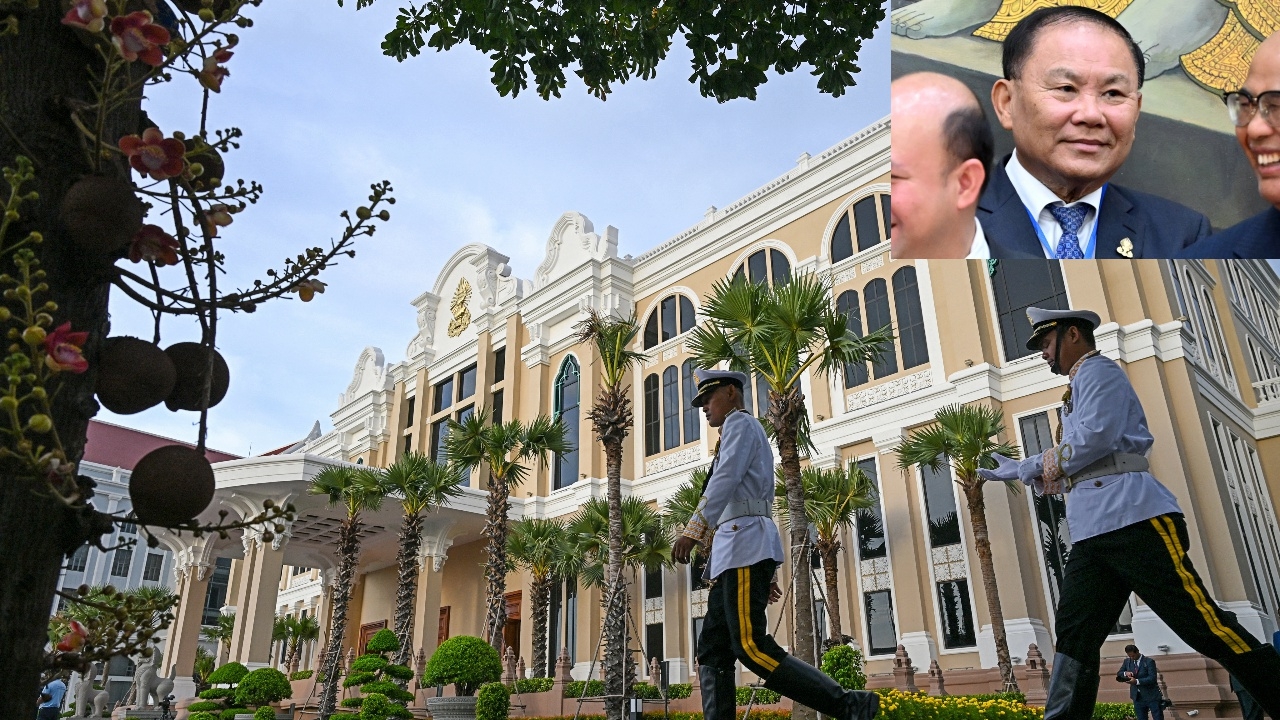
Cambodia officially opened its new Senate building in Phnom Penh, with King Norodom Sihamoni presiding over the ceremony. The list of donors for the construction included the country's major billionaires, notably Li Yong Phat, who is sanctioned by the U.S. for alleged connections to scam gangs and human trafficking operations.
Cambodia officially inaugurated the new Senate building, called "Samaki Palace," today (21 Aug) in Phnom Penh. King Norodom Sihamoni presided over the ceremony, attended by senior officials, Senate members, diplomats, and foreign guests.
King Norodom Sihamoni cut the ribbon to open the building, joined by Hun Sen, Senate President and former Prime Minister of Cambodia, and Hun Manet, Prime Minister and son of Hun Sen, along with other senior officials present at the event.
King Norodom Sihamoni expressed great pleasure in presiding over the opening of Samaki Palace, describing it as a national success and a source of pride for Cambodia.
The building, initiated by Hun Sen, is approximately four and a half stories tall, featuring a rooftop helipad. It will serve as a venue to host important foreign visitors, as well as the workplace for senior Senate executives and a site for welcoming guests from both domestic and international spheres.
Cambodia's Ministry of Foreign Affairs stated that the building measures about 79 meters by 47 meters. Construction began after the foundation stone laying ceremony on 9 Aug 2024 and was completed by late 2025.
The Cambodian authorities did not disclose the construction cost, but a donor plaque inside the building lists 11 contributors. At the top is Li Yong Phat, a Senate member and major businessman in Cambodia, who also attended the opening ceremony.
Li Yong Phat was sanctioned by the U.S. in 2024, accused of his company’s involvement in serious human rights abuses related to the exploitation of trafficked persons forced to work in online scam centers.
However, Li Yong Phat denies the allegations linking him to cybercrime networks and money laundering, stating that the accusations are false and damaging to his reputation.
Cambodia has become a key hub for transnational scam industries in Southeast Asia. Criminal networks exploit both willing and trafficked individuals to deceive victims worldwide out of billions of dollars annually through tactics such as fake romantic relationships and fraudulent cryptocurrency investments.
Also listed among the building’s donors is Hun To, a businessman and cousin of Prime Minister Hun Manet. In May, Hun To disclosed that he once held a 30% stake in the digital payment platform "Huayuan Pay," which has since ceased operations and was linked to cyber scams and money laundering.
Hun To asserted that although he held shares, he did not manage the platform’s operations and "never received profits, dividends, or any assets" from Huayuan Pay.
The U.S. government alleged last year that the "Huayuan Group," owner of the platform, along with several other companies, was involved in laundering money for transnational criminal groups conducting internet scams from Southeast Asia.
Li Song, former chairman of the Huayuan Group, was extradited to China in April after Chinese authorities accused him of a major role in a large cross-border gambling and fraud network. Meanwhile, the National Bank of Cambodia revoked Huayuan Pay’s business license.
Regarding the new Samaki Palace building, the Cambodian Senate stated that Hun Sen initiated the project to support the Senate's expanding duties and enhance long-term operational efficiency. It will serve as the office for Senate leaders and support diplomatic, parliamentary, and community engagement missions.
Meanwhile, the Chom Charyman Palace, known as the "Red Building," a historically significant site related to former King Norodom Sihanouk’s heritage, will continue to be used as the Senate's meeting place.
The Senate noted that full sessions will remain the forum for reviewing bills, laws, and issues based on principles of reconciliation, unity, and harmony. The new building reflects Cambodia’s efforts to modernize and develop parliamentary institutions while preserving historically important sites significant to the nation’s political heritage.
/sourceAFP/Kampucheathmey Daily