

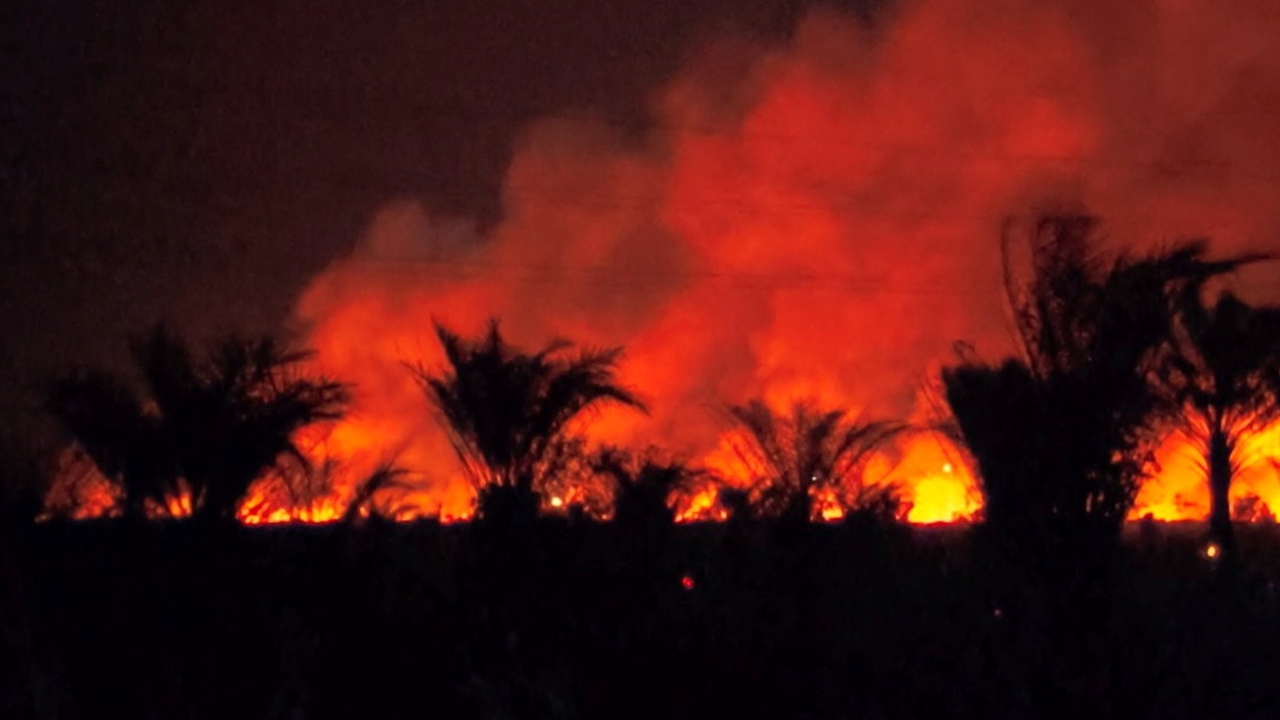
Indonesia is accelerating measures to tackle wildfires and fires in agricultural and peat swamp areas after the situation worsened in many parts of Borneo Island, with dense haze covering the region and drifting across the border into Malaysia.
The latest data shows more than 11,900 hotspots detected across Indonesia within 24 hours, with West Kalimantan and Central Kalimantan having the highest numbers. Approximately 1.78 million rai of forest and land have burned since early 2026, an area comparable to the U.S. state of Rhode Island.
The situation has prompted the Indonesian government to increase personnel to control the fires. Police in Central Kalimantan have arrested 12 suspects on charges of arson and illegally clearing land for agriculture.
Authorities stated they will prosecute those who set illegal fires seriously, while disaster management agencies and wildfire suppression units are conducting ground and aerial operations in areas with numerous hotspots.
Indonesia’s Ministry of Forestry said the government is intensifying operations in West Kalimantan, Central Kalimantan, and South Kalimantan by coordinating forestry agencies, the Disaster Management Agency (BNPB), the Meteorology, Climatology, and Geophysical Agency (BMKG), police, military, and wildfire suppression unit Manggala Agni to control the situation.
A concerning issue is that haze from West Kalimantan has crossed the strait into Malaysia’s Sarawak state, causing air quality in some areas to become unsafe. More than 600 schools have closed, affecting around 200,000 students, due to hazardous air quality levels harmful to health.
Earlier reports indicated over 4,000 hotspots in West Kalimantan, and Pontianak city declared a wildfire emergency. Meanwhile, air quality indices in some areas soared to 191, classified as unhealthy.
Indonesia’s wildfire suppression forces have stepped up monitoring along the West Kalimantan border to track wind direction, smoke density, and air quality, while trying to mitigate the haze’s impact as it potentially drifts further into Malaysia.
In many parts of Kalimantan, dense haze has severely reduced visibility to as little as 1 to 10 meters, disrupting transportation including road travel and flights. Some residents have reported breathing difficulties and concern about health effects from prolonged smoke exposure.
Experts and regional media reports note that wildfires have intensified amid dry weather and the influence of El Niño, which has caused extended dry periods and arid ground conditions conducive to fire spread.
West Kalimantan is among the hardest-hit areas, with reports of some places experiencing no rain for up to 40 consecutive days, while the number of hotspots surged rapidly in August.
Wildfires also threaten ecosystems and wildlife. Fires have approached an orangutan rehabilitation center in West Kalimantan, forcing officials to relocate about 60 orangutans to safe areas to protect them from the fires.
Indonesia continues to mobilize personnel, aircraft, and helicopters to control fires in critical areas, reaffirming its commitment to prosecute those who illegally ignite fires or clear land unlawfully to prevent the haze crisis from worsening and impacting neighboring countries further.
. Source :abcnews
Click to read more aboutInternational News