

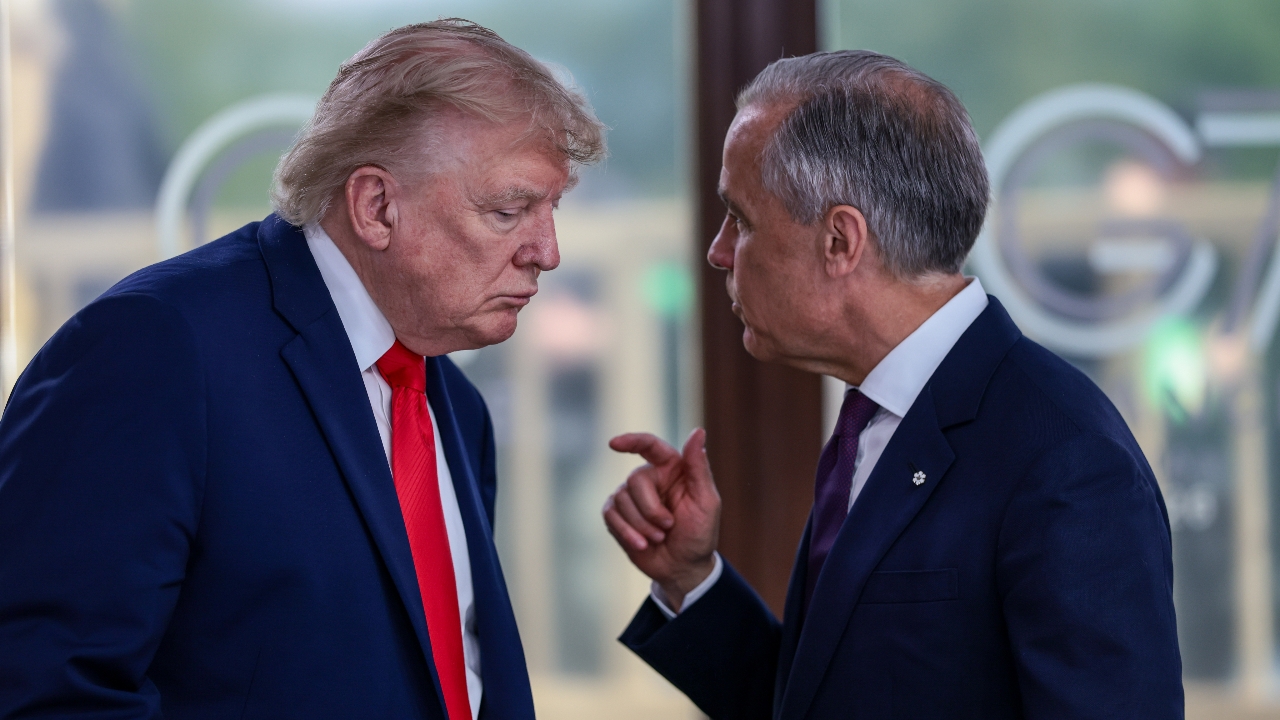
President Donald Trump accused Canada of wanting "the benefits of being a U.S. state without actually becoming one" after trade negotiations between the two countries collapsed. This led the U.S. to impose a 50% tariff on Canadian imports. Meanwhile, Prime Minister Mark Carney announced a "dollar-for-dollar" retaliation and stated that the two countries are entering a "trade war."
U.S. President Donald Trump said Canada is seeking "the benefits of being a U.S. state without actually becoming one" after trade talks between the U.S. and Canada failed last Friday (21 Aug).
Trump told Fox News that Canada was "stupid" to start a trade war with the U.S. and believed it could "beat" America. He also accused Canada of imposing high tariffs on American farmers for many years.
The failed negotiations resulted in the U.S. starting to impose an additional 50% tariff on a variety of Canadian imports such as wine, dairy products, cement, clothing, and hockey equipment. This new measure covers imports valued at about $20 billion, roughly 5% of all Canadian imports, and adds to existing U.S. tariffs on Canadian steel, aluminum, automobiles, and lumber.
Prime Minister Mark Carney described the new U.S. tariffs as a "miscalculation" aimed to "harm and divide" Canada. He announced that Canada will retaliate with tariffs of equal value, or "dollar for dollar," starting 8 September. These will cover multiple products including steel, dairy, electrical appliances, and electronics.
Carney stated, "When attacked, that is war. We have been attacked." He affirmed that Canada cannot accept the U.S. proposals because they include stringent conditions that would affect Canada’s ability to negotiate trade deals with other countries.
The latest round of talks followed hopes that an agreement could be reached earlier in the week, but negotiations collapsed amid mutual accusations of last-minute changes. The U.S. accused Canada of submitting new demands and backtracking on previously agreed terms, while Canada denied making new proposals and said it was only clarifying existing ones.
U.S. trade officials said there are currently no plans to reopen negotiations, although the U.S. had been prepared to reduce some tariffs for Canada if a deal was reached.
Many Canadian political and provincial leaders have supported Carney, including opposition leaders and provincial premiers. Ontario Premier Doug Ford said Trump "cannot be trusted," while British Columbia’s premier said the U.S. conditions would reduce Canada’s economic status to that of a "51st state," which Canadians cannot accept.
This dispute arose after over a year of trade negotiations between the U.S. and Canada, with tensions increasing in recent weeks. Meanwhile, the U.S., Canada, and Mexico are reviewing the United States-Mexico-Canada Agreement (USMCA), which Trump pushed to replace the old NAFTA during his first presidential term.
The USMCA forms the basis for trade among Canada, the U.S., and Mexico, totaling about $1.6 trillion annually. Carney acknowledged that the collapse of the latest talks "is certainly not good news" and it remains unclear how this tariff dispute will affect the future of the North American free trade agreement.
,BBC