

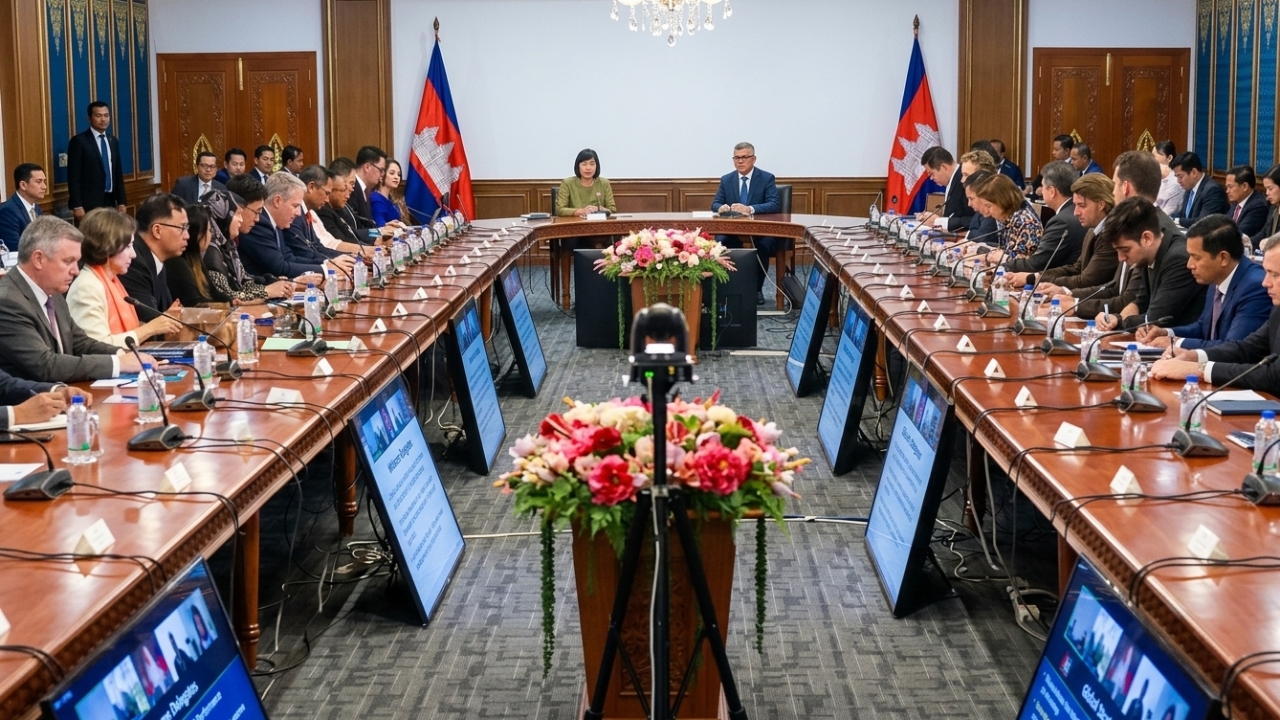
Cambodia announced that no large-scale online scam centers remain in the country after conducting raids on 793 suspected locations nationwide, arresting nearly 30,000 suspects of 39 nationalities, and deporting over 58,000 foreigners. However, authorities warned that criminal gangs are adapting by shifting to smaller, more concealed locations.
Cambodia declared success in suppressing large-scale online scam gang centers nationwide, stating that no large operational centers remain after the government launched a continuous nationwide crackdown from July 2025 to 20 August 2026.
Chay Sinarith, Senior Minister attached to the Ministry of Culture and Fine Arts and Chair of Cambodia's Special Task Force Secretariat for Combating Cybercrime, revealed this information during a meeting with officials from nearly 50 embassies and international organizations in Phnom Penh on 27 August.
Cambodian authorities inspected all 793 suspected locations, taking action against 624 that were still operating, and collecting forensic evidence from 169 sites abandoned by suspects who had fled.
The operation resulted in the detention of nearly 30,000 suspects from 39 nationalities, while Cambodia assisted and deported 58,266 foreigners, including 7,282 women. Among them, 22,045 foreigners from 38 nationalities were directly involved in online scam operations.
On the legal front, Cambodian authorities have initiated judicial proceedings in 408 cases, leading to the arrest and detention of 3,477 suspects from 29 nationalities during trial, including Chinese, Bangladeshi, Vietnamese, Myanmar, Cambodian, Laotian, Malaysian, Pakistani, Indonesian, Filipino, Nepalese, Yemeni, Swiss, South African, Kenyan, Cameroonian, Moroccan, Sri Lankan, Australian, Ukrainian, French, Japanese, South Korean, Singaporean, and Thai nationals. Meanwhile, authorities continue to pursue 855 suspects with outstanding warrants.
However, Cambodian authorities admit that the crackdown is not over, as criminal networks are changing tactics by moving from large scam centers to smaller, more easily concealed locations such as rental houses, condominiums, guesthouses, vehicles, and cafes.
Sinarith affirmed that officials will continue to investigate and suppress such operations regardless of the size of the location, noting that criminal networks continually change their venues, technologies, and scam methods.
In addition to combating online scam gangs, the Cambodian government is also tackling unauthorized online and sports gambling. The Commercial Gambling Management Committee inspected 27 casinos, revoked licenses of 18, and suspended licenses of 9, while continuing investigations and prosecutions.
The government also declared a firm stance against corruption among state officials involved with criminal networks. The anti-corruption unit has prosecuted four major cases and arrested 15 high-ranking officials and law enforcement officers, including a deputy prosecutor, deputy director of immigration, deputy commander of Phnom Penh municipal police, a former director of a ministry department, as well as police and military personnel.
Simultaneously, Cambodia is fast-tracking legislation to strengthen cybercrime prevention measures, including draft laws on cybersecurity, information technology offenses, and virtual asset regulations. The government stated these legal frameworks demonstrate its political commitment to preventing criminal networks from resuming operations in the country.
Nonetheless, Cambodia emphasized that online scams are a transnational threat no single country can resolve alone. Therefore, it is preparing to host an international conference on combating technology-based fraud from 23-24 September under the theme "Collaborating to Cut the Cycle and End Technological Scams."
The conference will bring together government representatives, international organizations, law enforcement, financial institutions, tech companies, and research institutes to exchange experiences and best practices, as well as to enhance international cooperation to prevent criminal online networks from reestablishing operations.
. SourceThe Phnom Penh Post/Khmer Times