

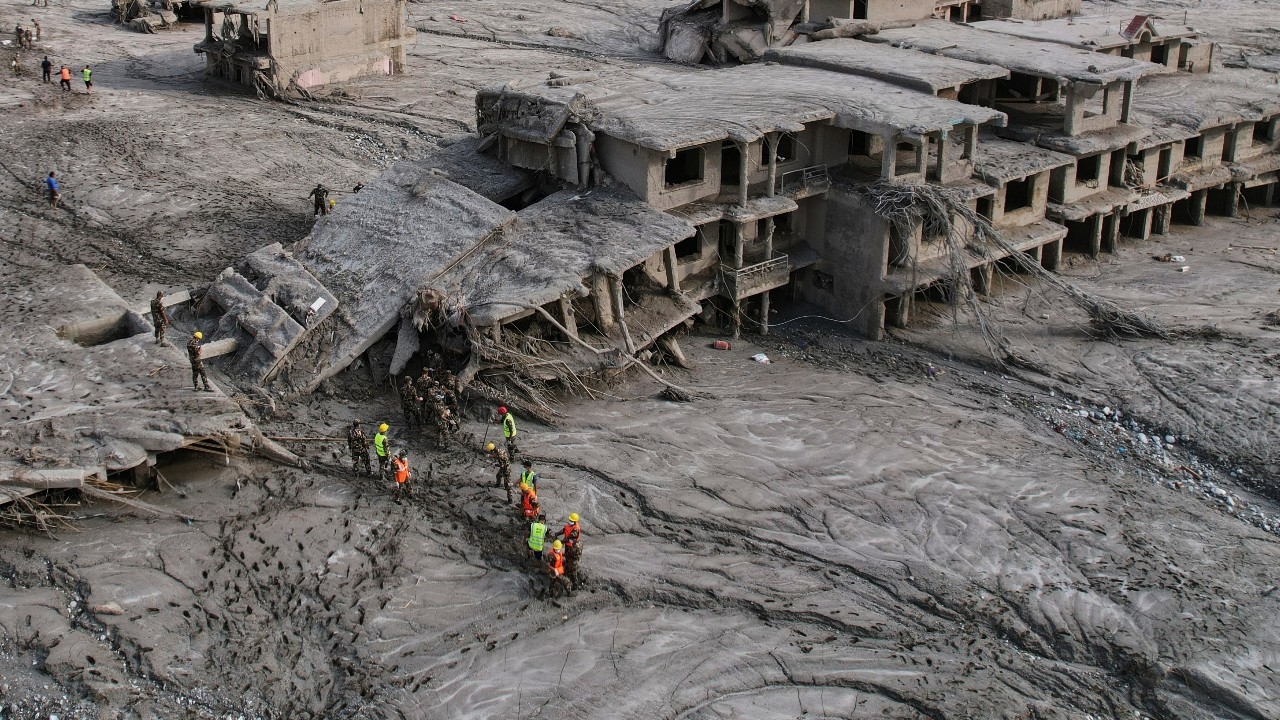
The flash flood and massive landslide situation at the Nepal-Tibet border remains critical, with total confirmed deaths rising to at least 750 and over 3,000 people missing, including several hundred foreign nationals still unaccounted for. Recently, a secondary landslide formed a new dammed lake, forcing rescue teams to evacuate the hazardous area. Meanwhile, international efforts are intensifying to aid in searching for workers trapped inside a hydropower plant tunnel.
Updates on the flash floods and mudslides that struck the border area between Nepal and China's Tibet Autonomous Region, which began on 26 August, show that confirmed deaths have now exceeded 750. Nepalese authorities report 734 fatalities, while Chinese official media confirm 16 deaths in Tibet.
Additionally, the total number of missing persons across both countries has surpassed 3,000. Nepal has reported 2,498 individuals unaccounted for and out of contact for over two days. Officials from Tibet stated in a press conference that the largest group of missing foreigners are 104 Nepalese, followed by 49 Indians, 33 Latvians, 18 Americans, and 15 British nationals still missing. The Gyirong border crossing is a key route for tourists traveling from Kathmandu to Mount Kailash, a sacred pilgrimage site in Tibet.
Rescue operations have been extremely difficult due to continuous heavy rain and thick muddy terrain. China's CCTV reported that on the evening of 29 August, drones detected a new landslide occurring about 2.8 kilometers downstream from the original dam, causing debris to block the river and form a "new dammed lake". This posed a risk of bursting and further flooding, prompting officials to immediately evacuate rescue teams near the Gyirong border to safer areas.
At the same time, Nepalese authorities have issued a highest-level alert to residents along the Phote Koshi River after detecting rapidly rising water levels.
One of the most critical challenges is rescuing over 100 hydropower workers trapped inside an underground tunnel blocked by mud and debris. The Nepalese army has attempted to insert tubes into the Trishuli 3A hydropower project tunnel to pump fresh air and sustain survivors inside, but rising river water levels have intermittently halted these efforts.
This disaster has resulted in up to 933 missing workers from hydropower projects, prompting the Indian and Chinese governments to deploy specialized tunnel drilling and rescue expert teams to join the urgent life-saving operations.
Experts and the United States Geological Survey (USGS), along with Xinhua News Agency, agree that the catastrophic event was triggered by a "glacier collapse" on the southern slope of Mount Lirung in Nepal. Massive ice and rock fell combined with large volumes of water, creating mud and debris flows traveling over 20 kilometers downstream. Simon Stiell, head of the United Nations Climate Change body, noted this as a dangerous warning sign of global warming's severe impact on mountain ecosystems.
Nepal's Foreign Minister estimated that restoration costs alone could reach "several billion US dollars" and called for international aid including DNA testing kits, body coolers, and heavy-lift drones. Countries have already accelerated aid delivery, with the US and Canada each providing $3.6 million in humanitarian aid, the UK contributing $6.8 million, the European Union $2.3 million, and the United Nations releasing $2.5 million in emergency funds to support over 93,000 severely affected Nepalese people.