

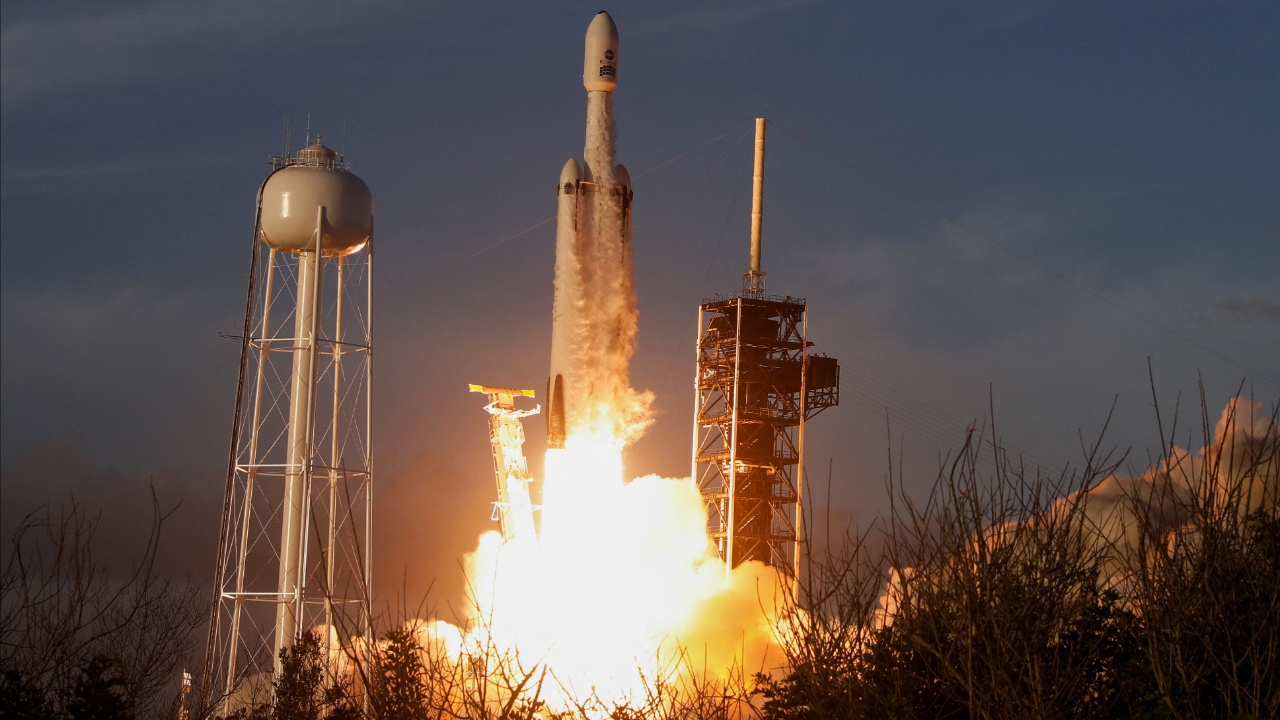
NASA has launched the "Roman" space telescope into orbit to conduct a space exploration mission aimed at solving cosmic mysteries, including dark matter and dark energy.
On Sunday, 30 Aug 2026 GMT+7, the United States National Aeronautics and Space Administration (NASA) launched the "Nancy Grace Roman" space telescope into orbit using SpaceX’s Falcon Heavy rocket from Kennedy Space Center in Florida.
The Roman space telescope project is valued at around 4 billion US dollars. It originated from repurposing a former US National Reconnaissance Office (NRO) spy satellite, which had been canceled, and was transferred to NASA in 2012.
Roman will be stationed at Lagrange Point 2, about 1.6 million kilometers from Earth, to carry out its primary mission for 5 years (with a possible extension of another 5 years). It is expected to send back its first high-resolution images before the winter holiday season later this year.
If the James Webb telescope is like a zoom lens focusing deep into space, the Roman telescope is like a wide-angle lens, with sharpness comparable to the Hubble telescope but capable of surveying space much faster. It can scan the entire Milky Way galaxy in just one month, whereas Hubble would take a century.
Roman will create the most comprehensive 3D map of the universe in history, surveying over 2 billion galaxies to help scientists study cosmic mysteries such as dark matter, which may make up 27% of the universe, and dark energy, possibly accounting for 68% of the universe.
Roman also has a major mission to explore exoplanets, one of the largest in history, with expectations to discover thousands of new planets beyond our solar system.
Previously, Donald Trump attempted to cancel or reduce the Roman project’s budget during his first and current second presidential terms, but the US Congress maintained funding. This support enabled the rocket launch for the telescope to occur nine months ahead of schedule.
Follow international news:https://www.thairath.co.th/news/foreign
Source:cna