

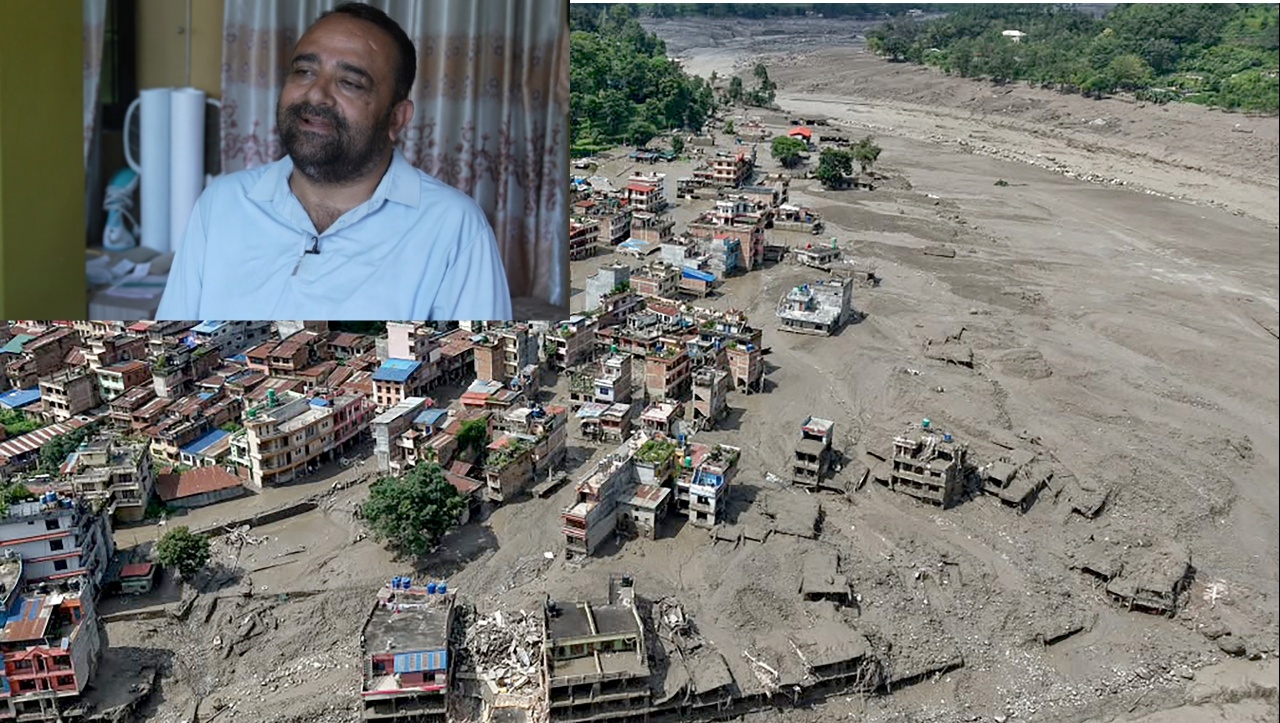
A high school principal in Nuwakot district, Nepal, saved around 900 students after receiving four flash flood warnings. He ordered classes to stop and evacuated the children to higher ground just 10 minutes before floodwaters and mudslides struck. The disaster has resulted in nearly 800 deaths and thousands still missing or unaccounted for.
Rachendra Tawadi, principal of Triphuvan Trishuli Secondary School in Nuwakot district, Nepal, told BBC News that he believes his swift decision to evacuate saved the lives of approximately 900 students after a major flash flood struck northern Nepal.
Tawadi, responsible for a school with about 1,600 students, said that at around 09:10 local time on 26 August, he received four flood warnings from different people within minutes. One warning came from Betrawati town, located upstream from the school area.
The multiple warnings led him to quickly assess the situation was worsening rapidly. He immediately halted classes and instructed all students to run to higher ground. Meanwhile, buses carrying students were ordered to turn back to avoid flood-affected routes.
Tawadi said that if he had delayed the decision by just 10 minutes, the outcome could have been catastrophic. "If we had waited 10 minutes longer, none of us, including the students and myself, would be here talking to you today," he said.
He added that receiving multiple simultaneous warnings made him unwilling to wait for further confirmation, especially after a parent arrived at the school saying "a major flood is coming" and requested to take his daughter home.
Tawadi reasoned that parents would not come to pick up their children without a serious cause, so he decided not to waste a second. "I decided not to wait any longer. Even if the flood didn't occur, the worst case would be losing just one day of classes. I feel proud we saved many lives," he said.
Shortly after students and teachers evacuated, a massive surge of water mixed with mud and debris rapidly inundated the area. Tawadi described how the dormitory building, about 100 meters from the river, was almost immediately swallowed by the floodwaters, while the local market was swept away before their eyes.
Initially, many students did not grasp the severity of the situation. 16-year-old female student Unisha Amatya recounted narrowly escaping with only 10 seconds to spare. She said students were still in their classrooms while teachers gathered elsewhere and were initially unaware of the danger. About five minutes later, teachers informed students of the flood and told them to go home.
Some students fainted upon hearing the news, while others underestimated the danger and waited for friends still in math class. Unisha and her friends ran up a hill via an escape route behind the school. Because she couldn't run fast, friends helped support her up to higher ground. They all aimed for the safest spot, climbing narrow stairs at the back of the school to flee. "Not long after, the market was swept away right before my eyes," she said.
She said her shoes helped her maintain footing; without good grip, she might have fallen. Many students and locals crowded to reach safety, while some who fled by other routes were swept away by the floodwaters.
After reaching higher ground, students and teachers traveled on to nearby villages. However, many roads were cut off and transportation was disrupted, leaving many victims stranded for up to two nights before help arrived.
Eventually, Tawadi and Unisha, who both live across the river from the school, were airlifted to their villages. Meanwhile, many families tried to contact missing children.
Sabina Kumari Seth, Unisha's mother, said she repeatedly called her daughter and husband without success. Unisha’s father, Ubarash Amatya, rushed to the school after hearing about the flood. He said he felt terrified when his calls to his daughter went unanswered, and he hurried on a motorcycle to the school but found the Trishuli Bazaar market nearly completely washed away.
For almost an hour, he did not know if his daughter was alive and kept calling her continuously until finally the line connected and Unisha answered. He said hearing her voice brought him to tears, while two relatives with him also cried and embraced in relief.
The family had to wait three days before seeing her again. Unisha’s mother said her youngest daughter couldn't sleep during the wait and that she felt immense happiness and relief when her daughter was safely reunited with them.
Although Unisha survived, the event left her worried about her future, especially her education. She said if she needs to transfer schools, she will have to leave old friends and might struggle to adjust and make new ones.
Save the Children reported that the floods destroyed or damaged at least 69 schools, impacting nearly 19,000 students.
In Dhading district, one of the hardest-hit areas, several groups of students survived after leaving classrooms during the lunch break. Some were saved by teachers who urgently ordered evacuation before the floodwaters arrived.
A mother of one student told AP News that teachers warned children of the flood, telling them to leave their bags and lunch boxes behind before fleeing, which helped save the children’s lives.
So far, more than 3,700 people have been rescued from affected areas in Nepal. On Sunday, 30 August, Nepalese authorities reported that 2,502 people, including 592 foreigners, remain unreachable.
Another data set indicated at least 781 deaths from the disaster, while other sources at the same time estimated nearly 800 dead and thousands missing.
The disaster struck on the morning of 26 August near the Nepal-Tibet border in the Himalayas. The US Geological Survey (USGS) said the cause was a glacier collapse, unleashing massive flows of water and debris downriver with great force.
Amid severe damage, Nepal’s Foreign Minister called on the global community to urgently address the climate crisis, stating that Nepalese people have become "major victims of climate change" disproportionately, despite Nepal’s minimal contribution to global fossil fuel emissions.
Tawadi remains convinced that his decision to evacuate students without waiting for further confirmation prevented a major tragedy at the school.
He said that if he had waited until classes ended to close the school, all that might remain now would be "the school bell ringing at 09:30 a.m." only.
. SourceBBC