

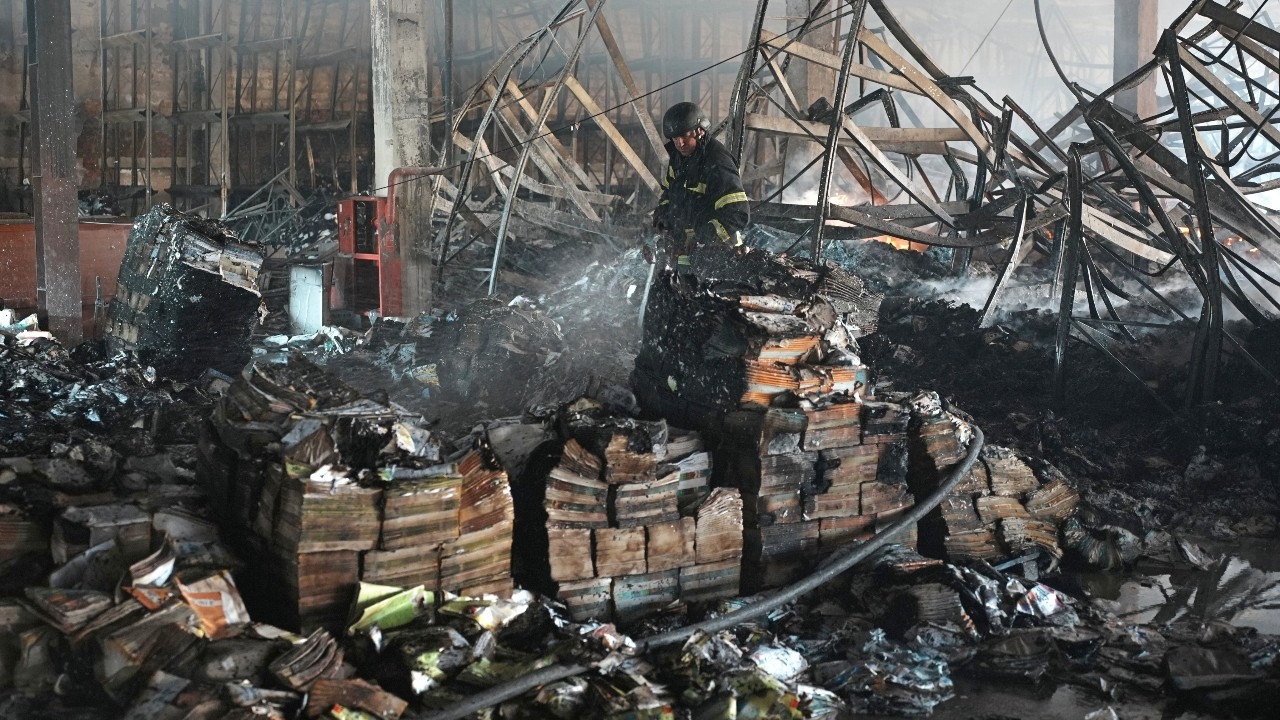
Russia has launched missile and drone attacks on printing houses, warehouses, book markets, as well as ancient sites and cultural institutions throughout Ukraine. This has resulted in the destruction of more than 12 million textbooks and general books, accounting for one-third of all books printed this year, amid condemnation from Ukrainian authorities and UNESCO, who view this as an attempt to erase the nation's identity and culture.
Victoria Haidai, Commercial Director of the Konvi publishing company, surveyed the ruins of a printing house destroyed in the outskirts of Kyiv, Ukraine, which had been rushing to print textbooks for the upcoming school term.
This printing house was struck by Russian missiles overnight while working at full capacity to deliver 1.3 million books, about 10% of all textbooks used in Ukraine. Haidai said the printing house is beyond recovery; even pages that survived the flames were damaged by firefighting water, rain, and weather entering through the collapsed roof.
She believes the attacks on printing houses and book warehouses are deliberate. "I believe this is something the Russian Federation intentionally did. Over the past two months, many major publishers have lost their logistics warehouses that stored vast quantities of books. Russia is destroying printing houses in an effort to erase Ukraine as a nation, but frankly, they will not succeed."
Reports state that in recent weeks, more than 35 printing factories and facilities across the country have been attacked, while local media report that Russia has destroyed about one-third of all books printed in Ukraine this year.
The damage is not limited to new books being prepared for printing but has extended to old books with sentimental value. Kyiv’s Pochainy secondhand book market was also attacked, destroying hundreds of book stalls along with vast collections accumulated by sellers and readers over many years.
Before firefighters fully controlled the blaze, 28-year-old book blogger Liliya Velyka was found using a rake to sift through the still-smoldering debris, searching for books that might be saved. She tightly hugged a soaked science fiction novel.
Besides printing houses and publishers, museums, art galleries, film studios, libraries, and opera houses across Ukraine have also been damaged by the war. The Kyiv Pechersk Lavra, a large medieval monastery and important cultural heritage site in Kyiv, had its golden domes damaged in an attack.
Officials moved religious artifacts to safe locations, but after a drone attack, much of the roof was burned. Repair costs are estimated at $11.2 million USD (approximately £8.2 million) and could take around two years. The site also houses the Ukrainian Museum of Books and Printing.
UNESCO registered this group of buildings in 1990 and, in September 2023, added the site to the list of World Heritage in Danger.
During celebrations marking the 975th anniversary of the monastery’s founding, UNESCO Director-General Khaled El-Anani expressed deep regret over the damage. "UNESCO strongly condemns all attacks on cultural property protected under international law."
El-Anani toured the cathedral with Ukraine’s Minister of Culture, Tetyana Berezhna, who sees the cultural and wartime impacts of Russia’s actions as inseparable. Berezhna said the war threatens Ukraine’s existence as a nation, and attacks on cultural sites are part of efforts to destroy Ukrainian identity.
"This is a war for national survival. Russia wants to destroy us as a nation, to erase us as if Ukrainians never existed," she said. Because of this, Russia targets cultural heritage, symbols of Ukrainians’ longstanding presence in this land.
"They understand these are important to us because we protect our identity and culture, and Russia wants to destroy everything it cannot occupy or claim as its own," Berezhna stated. She noted that Russia has attacked over 1,900 cultural heritage sites and more than 2,000 cultural institutions in Ukraine.
One method Ukraine uses to protect art, books, and historical documents is accelerating their digitization, ensuring these works are preserved and accessible to children even though physical books have become targets.
The issue of Russian and Ukrainian identity has been part of the long-standing political conflict between the two countries. In a 2021 article titled "On the Historical Unity of Russians and Ukrainians," Russian President Vladimir Putin claimed that Russians and Ukrainians are one people and questioned the legitimacy of Ukraine’s independent state and culture.
However, the Russian Embassy in the United Kingdom has accused the Ukrainian government of destroying its own cultural heritage, alleging removal of monuments and street renaming, and claiming that some cultural sites were used to hide military structures or facilities.
The Russian government has consistently denied deliberately targeting civilian sites throughout the more than five years since launching its full-scale invasion of Ukraine, despite ongoing missile and drone attacks on residential and civilian infrastructure across the country during the war.
Amid the ongoing war, the destruction of printing houses, books, libraries, and cultural heritage sites represents not only a loss of property but also poses a long-term risk to the history, language, literature, and identity of current generations.
/sourceBBC