

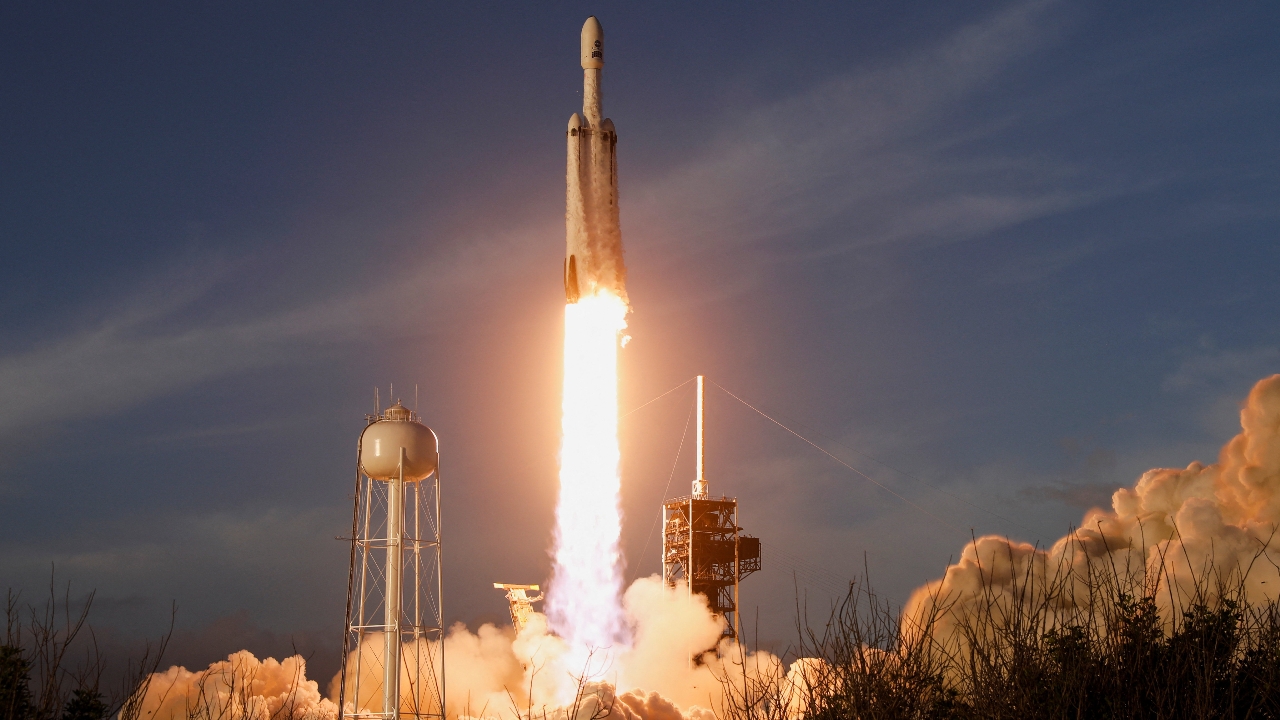
NASA launched the "Nancy Grace Roman" telescope into space aboard SpaceX's Falcon Heavy rocket, heading toward an observation point 1.5 million kilometers from Earth. This marks the start of the largest cosmic survey in history, aiming to solve the mysteries of dark matter and dark energy that make up 95% of the universe.
The United States National Aeronautics and Space Administration (NASA) successfully launched the "Nancy Grace Roman Space Telescope" on Sunday (30 Aug) from Kennedy Space Center in Florida at 07:26 local time using SpaceX's Falcon Heavy rocket. This launch begins a multi-year cosmic exploration mission to create an unprecedentedly large space map and study some of the most significant puzzles in physics and astronomy.
Standing over 12 meters tall, the telescope was developed over more than a decade with a budget exceeding 4 billion U.S. dollars. It is named after Nancy Grace Roman, a pioneering American astronomer known as the "Mother of Hubble" for her key role in advancing the Hubble Space Telescope program.
NASA administrator Jared Isaacman said the telescope will help create a "new map of the universe" and offer scientists the chance to push the boundaries of astronomical discovery further than ever before.
A major feature of the Nancy Grace Roman Telescope is its sky survey field of view, which is more than 100 times wider than the Hubble Space Telescope and broader than the James Webb Space Telescope, despite Webb's superior capability to observe fine details.
The telescope will travel to the Sun-Earth system’s second Lagrange point (L2), about 1.5 million kilometers from Earth. The journey is expected to take around three months. From this vantage point, the telescope can efficiently survey vast areas of the sky using infrared observation to detect light from celestial objects that has traveled billions of years to reach Earth. This allows scientists to look back into the universe's past and study how it formed and evolved.
The Nancy Grace Roman Telescope is designed to work alongside other telescopes and observatories, including the James Webb Space Telescope. One of its missions is to discover thousands of exoplanets. It also aims to detect tens of thousands of supernovae, the massive explosions that occur at the end of a massive star’s life cycle.
One of the telescope’s most important goals is to study phenomena that scientists still do not fully understand: dark matter and dark energy. Researchers believe these two components together account for about 95% of the universe, but their exact nature and origins remain unknown.
Dark matter is thought to act like a gravitational "glue" that holds the universe’s structures together, while dark energy is believed to be the force driving the accelerating expansion of the universe.
The telescope will use infrared observations to study distant objects that date back billions of years. This data will help scientists examine the universe’s development over time and better understand the roles of dark matter and dark energy.
A few weeks after departure, the telescope’s primary instrument, the Wide Field Instrument, will begin operation. It is an infrared camera with a resolution of 300 million pixels, comprising 18 detectors each with 4K resolution.
NASA expects the Roman telescope to send back about 1.4 terabytes of data per day, the highest data transmission rate among current NASA astronomy missions.
Given the enormous data volume, scientists will rely on machine learning, artificial intelligence, and citizen scientists to filter and identify important signals or objects before astronomers conduct detailed analysis.
The Nancy Grace Roman Telescope is NASA’s fourth major mission launched aboard a Falcon Heavy rocket. The project is managed by Goddard Space Flight Center and involves collaboration with the Jet Propulsion Laboratory, Caltech/IPAC, Space Telescope Science Institute, and scientists from numerous research institutions.
Additionally, key industry partners include BAE Systems, L3Harris Technologies, and Teledyne Scientific & Imaging, with support from the European Space Agency (ESA), Japan Aerospace Exploration Agency (JAXA), France’s CNES, and Germany’s Max Planck Institute for Astronomy.