

Chinese authorities have punished 10 individuals for spreading rumors and false information about the massive flash flood and landslide at the Jilong checkpoint in the Tibet Autonomous Region, bordering Nepal. Several punished parties circulated death and missing person figures exceeding official data. Meanwhile, rescue efforts continue amid concerns over rainfall and challenging terrain.
Chinese authorities revealed that police have taken action against 10 people in a major case involving the online dissemination of rumors and false information about a severe landslide at the Jilong checkpoint in Ri’kaze city, Tibet Autonomous Region, southwestern China, near the Nepal border.
China's Ministry of Public Security’s Cybersecurity Department stated via its official WeChat account that police nationwide are intensifying efforts to crack down on online rumors, especially false information related to this disaster.
Officials said most of the 10 individuals created or spread untrue death toll figures and have been administratively punished. Authorities explained this action is necessary to maintain order online and prevent false information from affecting rescue operations.
In one case, an internet user surnamed Liu was administratively punished by police in Lhasa, Tibet’s capital, after spreading a message claiming over 3,000 deaths from the disaster.
Another user surnamed Zhou in Hunan province was penalized after posting a short video falsely claiming the landslide caused over 10,000 deaths.
Reports also noted a user surnamed Qiu posted that although 1,400 deaths were reported, previously 3,000 people were missing; another user surnamed Liu claimed over 3,000 deaths in China from the landslide. However, Chinese authorities have not disclosed the specific penalties imposed on each person.
China’s Ministry of Public Security stated that under Chinese law, anyone deliberately spreading rumors or false information about emergencies, epidemics, disasters, or public safety causing social disorder may face administrative detention of 5-10 days and fines up to 1,000 yuan (about 4,930 baht). Severe social impact may lead to criminal prosecution and imprisonment.
The Chinese government also rejected foreign allegations that it is controlling disaster scene images and underreporting death tolls.
Foreign Ministry spokesperson Geng Shuang said information about the disaster is shared "openly, transparently, and promptly," warning that slander or exaggeration exploiting the disaster will not gain public support. However, Tibet remains a region with limited foreign journalist access, making independent verification and damage assessment challenging.
This disaster occurred after massive water, mud, rocks, and debris surged through mountainous areas along the Nepal-Tibet border last week, severely damaging several villages.
Nepal’s disaster authorities reported at least 903 dead and 4,247 missing, while Tibet’s side in China recorded at least 16 dead and 546 missing. Among Tibet’s missing are 261 foreigners: 104 Nepalese, 49 Indians, 33 Latvians, and 18 Americans.
Chinese official media reported the landslide destroyed about 0.7 square kilometers—equivalent to approximately 98 football fields. President Xi Jinping stated China is making full efforts to locate missing persons on the Chinese side.
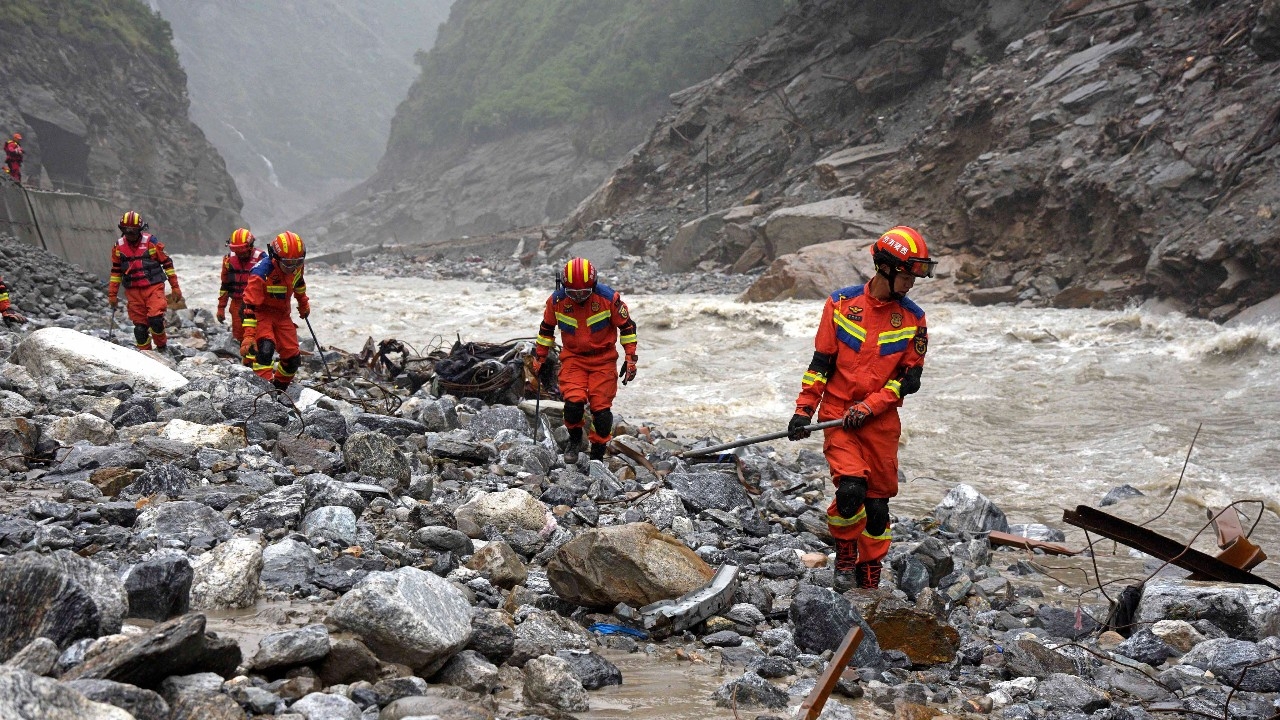
Xinhua News Agency reported rescue teams racing against time to find survivors despite harsh high-altitude terrain, steep valleys, and rapidly changing weather. Missions include clearing mud from roads, searching and rescuing victims, risk assessments, disinfection and disease prevention, and repairing damaged transport routes.
Footage from China’s CCTV shows rescue workers with search dogs navigating damage in valleys swept by the landslide. In some areas, officials wade through thick mud, while others repair power lines. Authorities remain alert for rain in coming days, which could cause slippery roads and hinder access to affected areas.
A new lake formed from landslide debris near the border after soil and rocks blocked waterways, raising concerns of further flooding if the lake overflowed. However, China’s Ministry of Emergency Management said the lake has almost completely overflowed and drained naturally, reducing this risk.
Although conditions have eased in some areas, search and rescue continue due to hundreds still missing, especially near border checkpoints and hard-to-reach locations.
This disaster remains a major emergency on both Nepal and Chinese sides, while Chinese authorities continue controlling unverified information and advancing search and recovery efforts.
/sourceChina Daily/CNA