

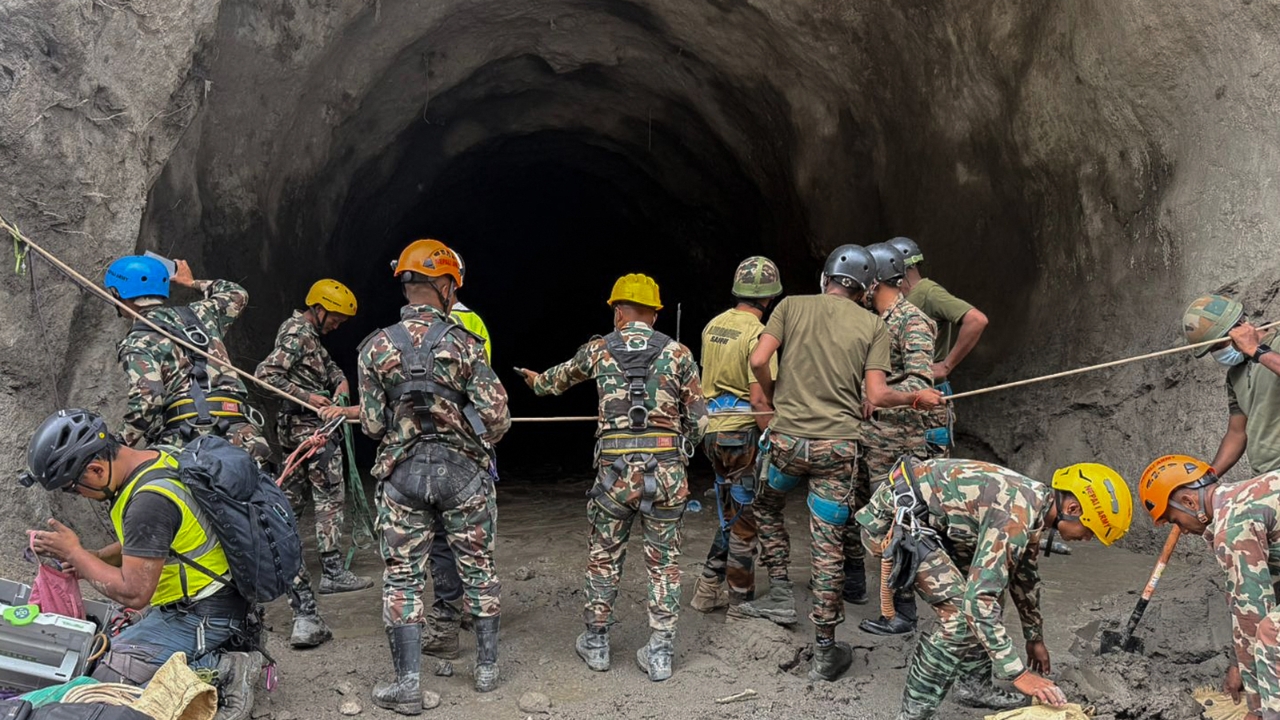
The death toll from the severe flash floods in the Himalayan region of Nepal and Tibet, China, has surpassed 1,000, with over 4,400 people missing. Rescue teams are intensifying efforts to find survivors, especially hundreds of hydropower plant workers believed trapped inside tunnels filled with mud and debris.
The death toll from the major floods near the Nepal-China (Tibet) border has risen above 1,000, as rescuers continue racing against time to find survivors, particularly hundreds of hydropower plant workers thought to be trapped inside multiple tunnels along Nepal's Trishuli River.
This disaster occurred on 26 Aug after a glacier collapse in the highlands released massive volumes of icy water, rocks, mud, and debris that surged downstream, devastating several communities and leaving widespread destruction across Nepal's mountainous areas.
Nepalese authorities reported nearly 3,916 people missing, while China reported 546 missing in Tibet, totaling 4,462 missing across both countries.
Nepalese officials confirmed recovery of 987 bodies, while Chinese state media reported 16 deaths in Tibet, bringing the combined death toll to at least 1,003.
Rescue operations have focused on the hydropower plant area along the Trishuli River, where many workers remain trapped in tunnels blocked by mud and debris. Nepalese rescue teams are using excavation, drilling, and controlled explosions to clear access, while engineers pump air into tunnels to improve survival chances for those trapped underground.
Rescuers reached one tunnel connected to the hydropower plant on Monday but had to withdraw after finding no survivors inside. Nepal Army spokesperson Raja Ram Basnet said search and rescue efforts continue around the tunnels, with military personnel dispatched to recover bodies and prevent disease outbreaks.
Nepal's Prime Minister, Balendra Shah, stated on Monday that 279 disaster victims have been rescued from the hydropower project area but acknowledged this is an extraordinary event requiring accelerated rescue operations.
Arnold Dix, an Australian engineer advising Nepalese officials on underground search efforts, said locating the tunnels is extremely challenging because the landscape has been completely altered by floodwaters and debris. He likened the terrain to a "lunar landscape" since almost no traces of the original structures remain.
Dix explained that once the hydropower plant's location is confirmed, officials can plan appropriate access methods, which may involve both excavation and blasting of massive boulders. He noted some boulders are larger than houses and said he has never witnessed such operations before. He remains hopeful for those trapped underground, as the subterranean structure might protect them from the floodwaters above.
The flood damage has overwhelmed Nepal's mortuary capacity, forcing authorities to begin temporarily burying unidentified bodies after collecting DNA samples for later identification. Nepal's Ministry of Health reported that of approximately 900 bodies recovered, only 4% have been identified.
In Chitwan district, located downstream from the initial flood site, officials found nearly 300 bodies carried by the river. Images from the area show personnel in protective gear and masks transporting unidentified bodies onto vehicles, while health workers and volunteers collect DNA samples. At least 17 bodies were also found downstream in India.
In Kathmandu, Nepal's capital, many people have visited hospitals searching for missing relatives. Photos of unidentified individuals are posted on large walls in hopes of receiving clues or confirming loved ones are alive.
In Chitwan, some relatives have begun funeral rites for the deceased, while military personnel airlift victims' bodies in Nuwakot and Rasuwa districts.
The demand for aid in the disaster zones has surged tremendously. Entire communities were swept away, leaving many families homeless and reliant on temporary shelters amid ongoing heavy rains. Floodwaters destroyed dozens of roads and bridges, and several hydropower plants suffered damage.
Police in Nuwakot, one of the hardest-hit areas, reported facing many obstacles reaching affected communities and providing assistance. Footage from Nuwakot shows residents digging through mud and debris to salvage usable items. Many families are clearing mud and erecting plastic tarps to create temporary shelters amid the ruins.
The missing persons list includes foreigners from over 30 countries, with 583 missing in Nepal and 261 in China. This group includes tourists visiting the Himalayas for trekking and Hindu pilgrims traveling to Mount Kailash, a sacred site in Tibet.
Scientists note that the Himalayas are melting faster due to rising global temperatures, while Nepal has limited resources to handle such large-scale disasters. The government warns that recovery costs could reach billions of U.S. dollars.
On the Tibetan side, Chinese state media reported 16 deaths and 546 missing. Rescue workers, soldiers, local officials, and residents held memorial ceremonies for the deceased. Xinhua News Agency reported over 2,000 rescuers working around the clock to find survivors, repair roads, set up temporary communication stations, and restore power systems.
However, most of Tibet remains closed to foreign journalists, making official Chinese sources the main reference for information on the situation there.
Exiled Tibetan rights groups question China's reported casualty figures, warning that the death toll may be underreported. China's Foreign Ministry denies allegations of covering up fatalities, affirming that information release has been open, transparent, and timely.