

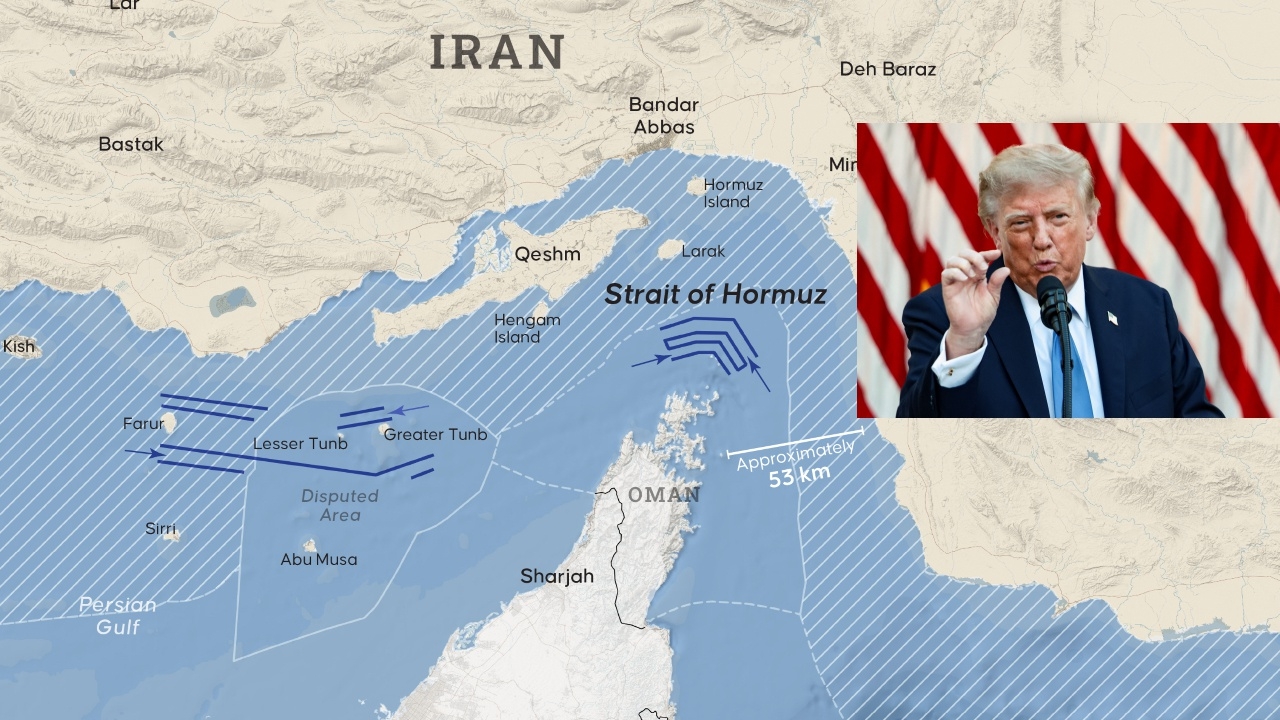
U.S. President Donald Trump proposed renaming the "Hormuz Strait" as the "Trump Strait," claiming the U.S. now fully controls this critical shipping lane, while Iran continues attacks on U.S. ships and bases in the region amid tensions entering their seventh month.
U.S. President Donald Trump proposed renaming the "Hormuz Strait" to "Trump Strait" amid renewed conflict between the U.S. and Iran, reaffirming that the U.S. controls this strategic maritime route.
On Wednesday, 2 Sep, Trump posted on social media, "We now control this strait under the United States. Should we rename the Hormuz Strait to 'Trump Strait'? Like America itself, it will be 'hotter' than ever!"
This proposal came less than 24 hours after U.S. Central Command (CENTCOM) launched strikes on multiple Iranian targets, with the U.S. military stating they hit air defense systems, radar, ships, maritime facilities, mine-laying capabilities, and communication systems linked to the Islamic Revolutionary Guard Corps (IRGC).
Iran's Foreign Ministry stated that the U.S. strikes affected civilian areas and infrastructure across several provinces including Khuzestan, Sistan and Baluchestan, Hormozgan, and Kerman, noting that a wedding ceremony in Kuhestak, Sirik district in the south, was hit causing casualties. Iranian media reported at least four deaths, including two children.
However, CENTCOM spokesman Tim Hawkins acknowledged the Iranian government media reports but affirmed that the U.S. military never targeted civilians.
Iran retaliated by firing missiles and deploying drones against U.S. bases in the region. The IRGC stated it attacked U.S. bases in Jordan, Kuwait, Bahrain, and another U.S. target in Iraq.
The latest clashes followed about a month of apparent ceasefire, but tensions escalated again after the U.S. military struck two Iranian missile launch sites on Larak Island on Sunday, suspecting preparations to launch rocket-propelled mines into the Hormuz Strait.
Although Trump and U.S. officials repeatedly claimed the Hormuz Strait is operational again and that millions of barrels of oil pass daily, oil prices have not declined in recent weeks.
Data from commodity market analyst Kpler showed that on Tuesday only six vessels passed through the Hormuz Strait, down from 19 on 28 Aug, whereas before the Iranian conflict began on 28 Feb, about 138 vessels typically transited the strait every 24 hours.
Meanwhile, the United Kingdom Maritime Trade Operations (UKMTO), which monitors maritime security related to the Royal Navy, reported nearly daily attacks on vessels in the Hormuz Strait.
On 2 Sep, UKMTO reported an oil tanker was attacked while transiting the strait, resulting in two deaths. Saudi Arabia's Foreign Ministry said a Saudi oil tanker was targeted by Iran.
Uncertainty over navigation through the strait also affected energy prices, with oil prices rising about 4% following the latest attacks. U.S. gasoline prices rose to around $4.12 per gallon (about 3.8 liters) on Wednesday, up from under $3 before the conflict began.
Despite no immediate signs of resolution, Trump continues to declare U.S. victory and insists Iran has been militarily defeated, while Iran retains the capability to retaliate against U.S. bases and interests in the region.
After the 1 Sep strikes, Trump sternly warned the Iranian government that any retaliation would be met with "far greater and more severe" U.S. attacks, but hours later Iran launched missiles and drones against U.S. bases in Bahrain, Jordan, and Iraq.
Members of the Gulf Cooperation Council (GCC)—Bahrain, Kuwait, Oman, Qatar, Saudi Arabia, and the United Arab Emirates—condemned Iran’s retaliatory attacks on U.S. bases as "highly reprehensible," pledging to stand by affected countries and support measures to protect sovereignty, security, and the safety of residents.
Previously, Trump described the Hormuz Strait as "American territory," and last week he renamed Lake Ontario, the border between the U.S. and Canada, as "Lake America" amid trade tensions between the two countries.
Meanwhile, the U.S. continues to increase economic pressure on Iran, including sanctions and military measures, with no clear path to ceasefire talks, keeping the risk of a prolonged war impacting oil transport through the Hormuz Strait high.