

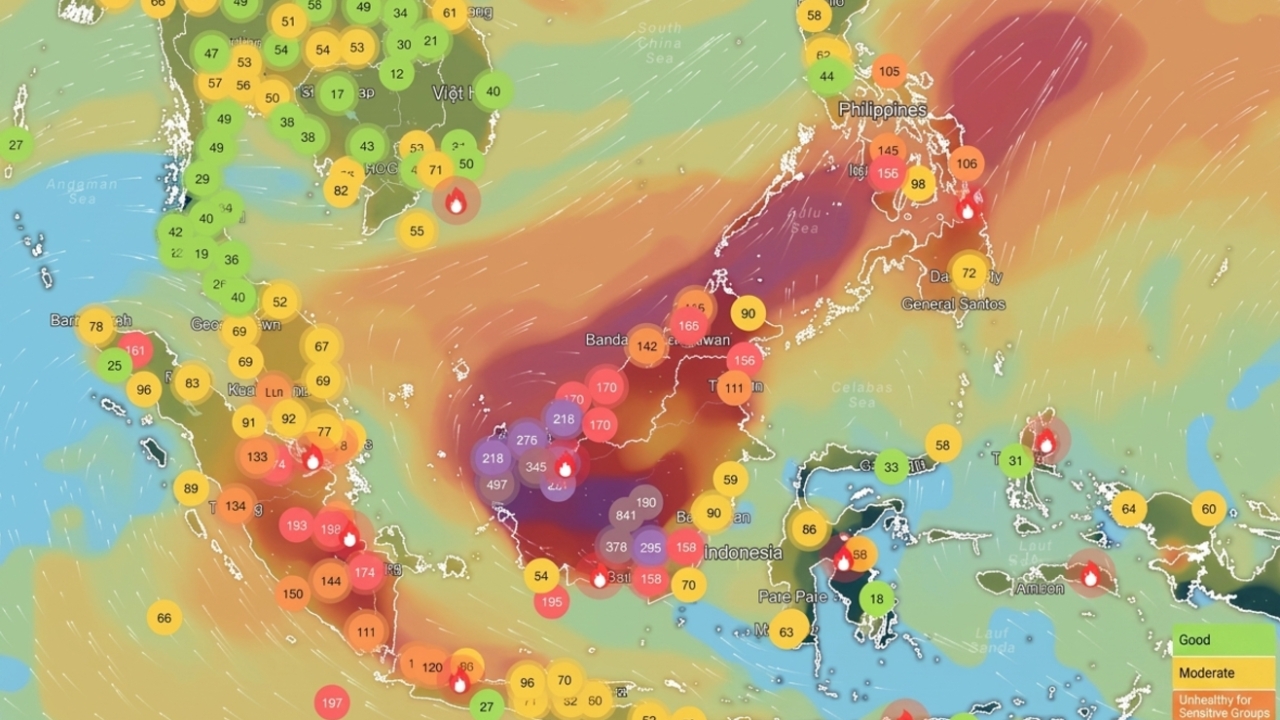
Smoke from wildfires and land burning in Indonesia has been carried by winds across borders into Malaysia, the Philippines, and Brunei, resulting in hazardous air quality levels in many cities. Philippine authorities have ordered classroom suspensions, while experts warn that pollution could spread to southern Thailand, Cambodia, and Vietnam if wildfires continue to intensify.
Toxic smoke from wildfires and land burning in Indonesia is spreading across borders to neighboring countries. Recently, haze has been detected over Malaysia and the Philippines. Experts predict the air pollution could move further into mainland Southeast Asia, including southern Thailand, Cambodia, and Vietnam.
According to the Philippines’ Department of Environment and Natural Resources (DENR), on the morning of 2 Sep, seven air quality monitoring stations across Metro Manila detected PM2.5 levels classified as "unhealthy." DENR stated that the haze is likely linked to smoke and transboundary haze from wildfires burning in Indonesia's Kalimantan province, carried by winds to the Philippines.
The situation is severe enough that the administration of Quezon City, the most populous area in Metro Manila, announced on Tuesday a suspension of in-person classes in both public and private schools, switching to remote learning until further notice.
Beyond Manila, air quality has worsened in several Philippine regions, including Central Luzon, Calabarzon, Mimaropa, and Central Visayas. Philippine meteorologists said the haze is being blown from Indonesia northward to the Philippines by the "Habagat," the local term for the southwest monsoon winds that blow from the southwest of the equator at this time of year.
The spread of haze to the Philippines followed forecasts from the European Copernicus Atmosphere Monitoring Service (CAMS), a global observation platform, which predicted the pollution from Indonesian wildfires would likely cross the South China Sea toward the Philippines.
Mark Parrington, senior scientist at CAMS, said some forecasting models indicate the haze could reach southern Thailand, Cambodia, and Vietnam. He warned that if smoke emissions from wildfires continue to rise as expected from September through October, air quality impacts could persist for several weeks across the region.
Data from CAMS' wildfire emissions tracking system estimates that between August and September, Indonesia released approximately 46 million tons of carbon from wildfires, equivalent to the annual emissions of about 45 coal-fired power plants. This level is the highest recorded for this period since 2003, with Kalimantan alone responsible for around 38 million tons of carbon emissions from fires.
Indonesia's Ministry of Health reported that from July to August, more than 50,000 cases of respiratory infections linked to wildfires and land burning were recorded, including over 12,000 children under five years old. The ministry deployed hundreds of medical personnel to the worst-affected provinces and distributed aid such as face masks and oxygen tanks.
Meanwhile, Malaysia reported increased cases of asthma and conjunctivitis amid worsening air quality nationwide after smoke from Indonesian fires crossed its borders.
Indonesia’s National Disaster Management Authority (BNPB) stated that the first transboundary haze incident was detected in early August when smoke from wildfires in West Kalimantan moved into Malaysian territory on Borneo island. Since then, Malaysia has experienced growing impacts as Indonesia’s land burning expanded.
Indonesia’s Ministry of Forestry reported that from January through late July, more than 200,000 hectares nationwide were burned, with about 100,000 hectares burned in July alone. Some wildfires were caused by deliberate land clearing for agriculture, combined with El Niño-induced drought conditions making Indonesia’s dry season drier than usual.
On 3 September, Kuching, the capital of Sarawak state in Malaysia, was ranked the most polluted major city globally with an Air Quality Index of 277, classified as "hazardous," according to IQAir, a Swiss air quality monitoring company.
The Malaysian government plans to conduct cloud seeding operations to increase rainfall, particularly in Sarawak, the area most affected by heavy haze. The initial plan is to carry out the operations from 3 to 5 September, depending on weather conditions.
Malaysia’s Communications Minister Fahmi Fadzil said the severe haze has forced the relocation of the National Day celebrations scheduled for 16 September in Kuching to indoor venues for public safety.
Brunei’s Ministry of Health issued health advisories as the haze situation worsened. The southwest winds bringing smoke from Kalimantan have carried haze into Bandar Seri Begawan, Brunei’s capital. On Wednesday afternoon, air quality was classified as "unhealthy," with PM2.5 concentrations about 13 times above the World Health Organization’s safety limits, according to IQAir.
Singapore is also monitoring the situation closely. The National Environment Agency (NEA) warned on Tuesday of the likelihood that haze will move into the country in the coming weeks, following low rainfall and an increase in regional hotspots.
/sourceBBC/The Jakarta Post