

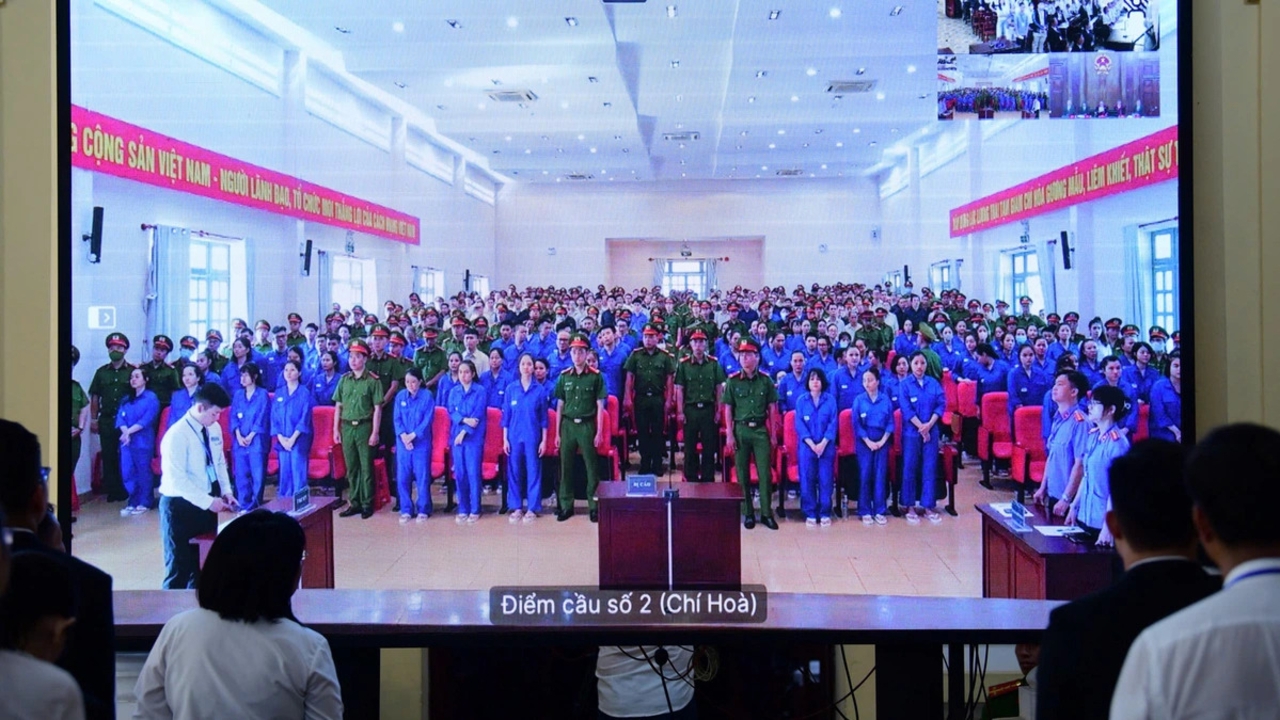
The Ho Chi Minh City People's Court of Vietnam sentenced 11 people to death and 19 others to life imprisonment in the country's largest transnational drug trafficking network case, known as "VN10," involving 227 defendants with financial transactions nearing 29 trillion dong, approximately 36.7 billion baht.
On 3 Sep 2025 GMT+7, the Ho Chi Minh City People's Court sentenced 11 defendants to death for drug trafficking offenses in the "VN10" case, which Vietnamese authorities described as one of the largest dismantled drug networks. Another 19 defendants received life imprisonment, while the remaining defendants were sentenced to prison terms ranging from 18 months suspended to 29 years.
Among those sentenced to death is Ha Danh Nam, 52, from Nghe An province, whom the court identified as the network leader. He was also fined 100 million dong, about 126,500 baht. The other 10 sentenced to death were fined between 50 and 100 million dong each.
The 19 defendants sentenced to life imprisonment include Hoang Sy Tang, 39, and Bui Van Anh, Tang's nephew-in-law. Both are from Nghe An province and managed the network's main drug storage sites. The court found them guilty of illegal drug transportation.
Since the amended Vietnamese Penal Code took effect on 1 Jul 2025, the maximum penalty for drug transportation is life imprisonment, as the death penalty was abolished for this offense. However, the death penalty remains applicable for drug trafficking.
Among the defendants are well-known Vietnamese individuals, including singer Chi Dan, real name Nguyen Trung Hieu, sentenced to 7 years for facilitating illegal drug use, and Nguyen Do Juk Phuong, a social media personality known for charity work, sentenced to 6 years on the same charge.
Spanish model Andrea Aybar Carmona, working in Vietnam under the name An Tay, was sentenced to 8 years in prison: 7 years for facilitating illegal drug use and 1 year for drug possession.
The indictment covers eight offenses including drug trafficking, possession, use of forged documents, failure to report crimes, concealment of crimes, and embezzlement. Most defendants confessed and showed remorse, while Nam and three others who remain fugitives, including Vu Hai Anh, denied the charges.
The trial began on 17 Aug 2025 GMT+7, presided over by Vu Thanh Lam, head of the criminal division of the court. Six prosecutors and over 120 defense lawyers participated. The indictment exceeded 350 pages.
Parts of the trial were conducted via video link with Chi Hoa Detention Center, where most defendants were held. The trial concluded nine days ahead of schedule. The court acknowledged some investigative record inconsistencies, such as discrepancies in times and places of recorded interrogations, but ruled these did not affect the case's substance.
The network began in early Jan 2023 when Ha Danh Nam hired Tang, a driver from the same province, to receive parcels from abroad. Drugs were concealed inside toothpaste tubes and mixed with consumer goods to avoid detection. Tang then recruited his nephew-in-law, Bui Van Anh, to help receive and forward parcels. Before the network's March 2023 arrest, six drug shipments had arrived at Tang's drop-off point in Dong Nai province.
Tang divided the drugs and instructed Anh to deliver them to distributors in Ho Chi Minh City and the former Binh Duong province areas. Couriers were paid between 6 million and 50 million dong per trip, approximately 230 to 1,900 US dollars.
Nam smuggled drugs into Vietnam via international express parcel services, sending packages from France to Hanoi, then distributing them elsewhere. He also used bank accounts opened under his son's name to transfer and circulate drug money. Voice analysis and identification of other defendants allowed authorities to confirm Nam as the mastermind, despite his denial.
Nguyen Huy Hoang, also sentenced to death, managed a branch of the network that received drugs from Nam for large-scale distribution and sale.
The court found the network concealed drugs inside everyday items and transported them via parcel delivery companies. Network members used encrypted messaging apps for coordination and made payments through bank accounts opened under other people's names.
The VN10 case drew officials' attention on the morning of 16 Mar 2023 when customs officers at Tan Son Nhat International Airport noticed irregularities on the baggage scanner of Vietnam Airlines flight VN10 arriving from Paris.
A search of four flight attendants' luggage revealed 327 toothpaste tubes, 157 of which contained drugs, including approximately 8.3 kilograms of MDMA (ecstasy) and nearly 3 kilograms of ketamine. The attendants were paid 6.5 euros per kilogram to bring general goods from France to Vietnam, totaling about 60 kilograms.
However, investigations found insufficient evidence to prosecute the four flight attendants criminally, as they were uninvolved with Nam or Tang and unaware of the concealed drugs. Ho Chi Minh City police used the flight number VN10 as the case code for the subsequent major drug network investigation.
Vietnamese authorities described the VN10 case as one of the largest drug trafficking cases in the country's history, with financial transactions traced to nearly 29 trillion dong (about 1.1 billion US dollars). The network connected to nearly 500 branches and sub-networks across 34 provinces and cities in Vietnam.
During investigations, authorities seized nearly 600 kilograms of drugs, along with 12 firearms, 67 rounds of ammunition, and 3 hand grenades. The expanded investigation identified over 2,700 suspects in 477 subsidiary cases. The 3 Sep 2025 GMT+7 verdict covered 227 defendants, making it among Vietnam's largest drug trafficking trials.
. . .VnExpress