

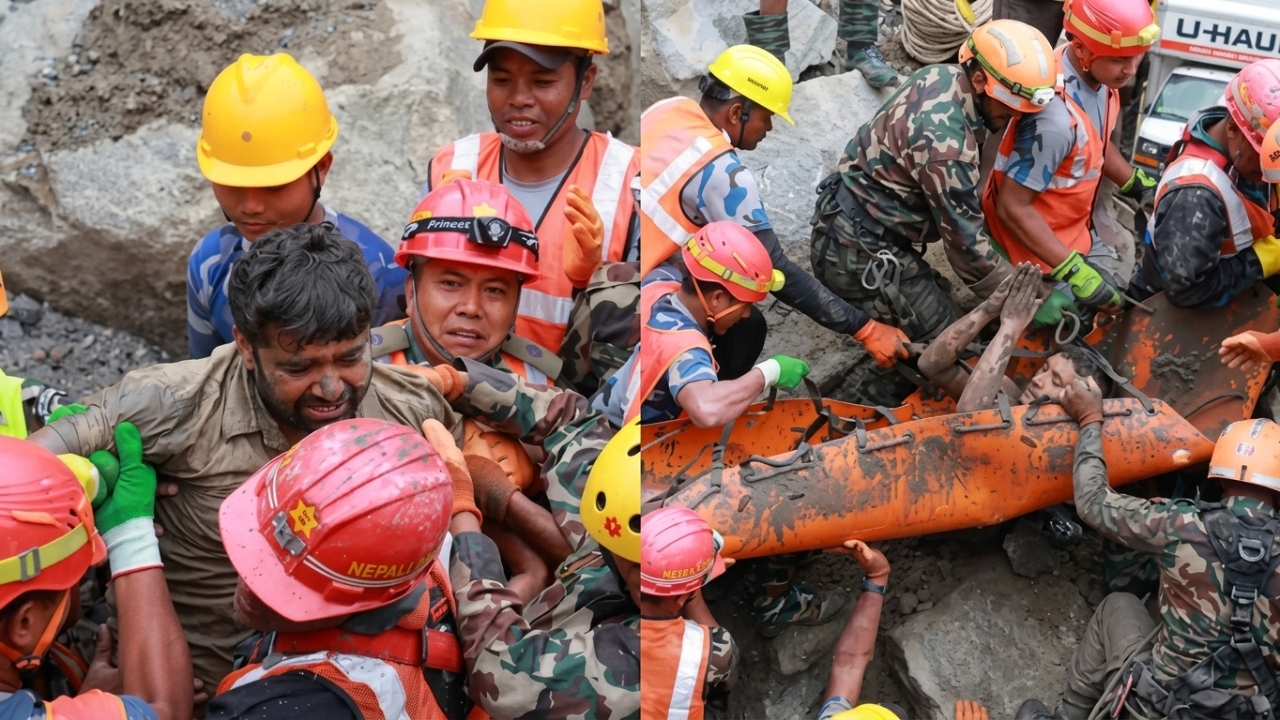
Nepalese officials safely rescued two hydropower plant workers from a tunnel after they had been trapped under mud and debris for nine days following a massive flood that claimed over 1,250 lives and left more than 5,000 missing, as rescue missions continue to search other tunnels where people might still be trapped.
Nepalese rescue teams successfully extracted two hydropower workers from the Trisuli 3A hydropower project tunnel today (4 Sep) after the pair had been trapped inside for nine days due to the massive flood that occurred on 26 August.
The survivors were identified as Sanjay Shah, 30, mechanical works supervisor, and Kabir Maharajan, 45, mechanical work chief; both are employees of Nepal Electricity Authority (NEA).
Images released by Nepal's Ministry of Energy showed the rescue team pulling a man out of a mud-filled tunnel opening amid cheers from officials, and another image showed a second man covered in mud with hands clasped together as he was carried out on an orange stretcher.
Officials said Shah was the first to be rescued from the tunnel. After receiving aid, rescue teams gave him oxygen before airlifting him by helicopter to Battar city, northwest of Kathmandu. Maharajan’s wife is traveling to meet him at the Chauni Military Hospital in Kathmandu.
Suresh Chaudhari, a colleague of Shah, told media he felt very relieved by the successful rescue and expressed hope that other workers still trapped inside the tunnels might also be saved alive.
The flood occurred after a massive landslide of mud and boulders, triggered by avalanches of snow and ice from the mountainous area along the China-Nepal border, swept violently down rivers and surrounding areas, resulting in more than 1,250 deaths and over 5,000 missing.
Among the missing are hundreds of workers inside the extensive tunnel networks of multiple hydropower projects along the river. Authorities continue search and rescue operations in at least six tunnels, where more than 150 people are believed to be trapped.
At the Trisuli 3A project, rescue teams pumped water and air into the tunnel and dug through 50-60 meters of mud and debris blocking the entrance to reach those trapped inside.
Before rescuing the two workers, Australian tunnel rescue expert Arnold Dix, who advised the operation remotely, revealed that rescue teams at Trisuli 3A believed they heard faint responses from inside the tunnel.
Dix said officials shouted into the tunnel to reassure those trapped not to be afraid and that help was coming, after which they heard the word “huncha,” meaning "yes" or "okay" in Nepali, in response.
Dix, president of the International Tunneling and Underground Space Association, added that after continuous 24-hour work for over a week, this success has renewed hope for the mission.
However, search and rescue efforts continue, as authorities believe more survivors may still be trapped in several hydropower tunnels. Teams are working to pump air and clear mud and debris to improve chances of saving those possibly still alive.
This disaster is among Nepal’s worst recent catastrophes, and the rescue of these two workers after nine days trapped under tunnel debris has given hope to many families of the missing that survivors may still await rescue in the affected areas.
,BBC/ AFP