

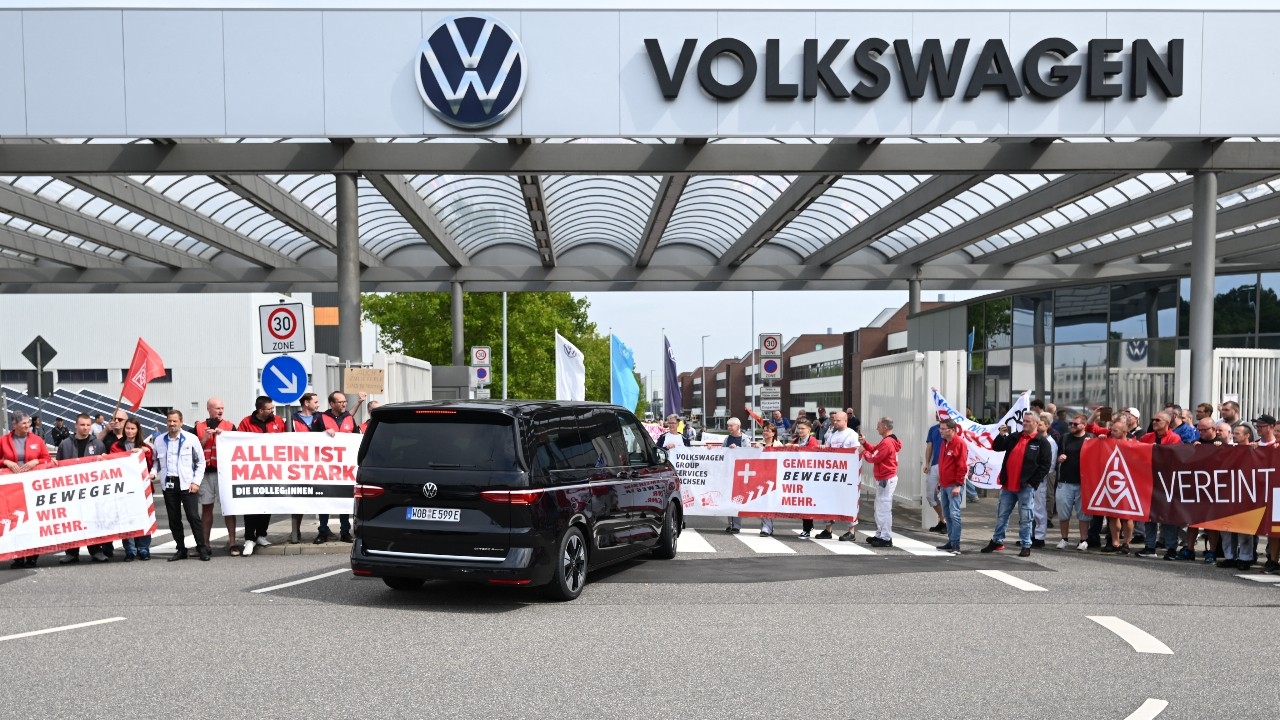
Volkswagen, Europe's largest automaker, has approved the biggest restructuring plan in its 89-year history, preparing to cut an additional 50,000 jobs worldwide. Combined with previous plans, the total job reductions will reach around 100,000 positions by 2030.
Volkswagen's supervisory board has approved a restructuring and operational improvement plan that will lead to an additional reduction of approximately 50,000 jobs worldwide by 2030.
Together with a previously agreed reduction of about 50,000 jobs, Volkswagen will reduce a total of around 100,000 positions, equating to roughly 15% of its global workforce. This marks the largest restructuring in the global automotive industry's history, surpassing General Motors' 50,000 job cuts following its 2009 bankruptcy.
Volkswagen, which owns ten car brands including Audi and Porsche, is facing severe pressures from various fronts: U.S. import tariffs, uneven demand for electric vehicles, excess production capacity, and especially fierce competition from Chinese automakers both in China and globally.
The company stated it needs to align its workforce with economic realities and business conditions. Beyond job cuts, management and labor unions agree to explore alternative options for four German plants—in Hannover, Emden, Zwickau, and Neckarsulm—that may gradually cease production of certain models starting in 2031. If these closures happen, it would be the first time Volkswagen shuts large-scale plants in its home country.
However, Volkswagen and the labor unions have not officially approved any plant closures and are still considering alternative uses for these facilities.
If major car plants in Germany do close, it would be the first full factory shutdowns in Volkswagen's home country. Martin Lehmann, a Zwickau plant worker since 2012, warned the closures would have widespread economic impacts on the region, as the plants and supplier businesses are key economic drivers.
Approval of the plan has eased tensions between management and labor unions after weeks of tense negotiations. Previously, the IG Metall union accused management of lacking transparency with employees after news of the 100,000 job cuts leaked to the media before official notification.
Furthermore, reports that management might try to circumvent the supervisory board's authority to push through restructuring plans angered IG Metall, which called such ideas "nonsense and rubbish."
Volkswagen CEO Oliver Blume said the supervisory board unanimously approved the future plan proposed by management, describing it as a strong signal for Volkswagen's future. He emphasized the company’s responsibility to employees, business partners, and industrial jobs worldwide.
The new agreement simplifies the corporate group’s structure and reduces the supervisory board’s influence over certain key decisions, particularly diminishing the power of labor representatives and the state of Lower Saxony, a Volkswagen shareholder with six plants in the state.
Under the 1960 law governing Volkswagen’s restructuring, establishing or relocating plants requires a two-thirds majority of the supervisory board, effectively giving labor representatives—who hold half the seats—the power to block plant closures. The new agreement aims to adjust approval criteria and decision-making structures to align with common practices.
Labor union representatives and supervisory board members describe the agreement as a good compromise, with labor and Lower Saxony jointly preventing conflicts from escalating. They confirmed no plant closures have been approved at this time.
Following the restructuring plan approval, Volkswagen shares in the Frankfurt market rose by as much as 7.9%, reflecting investor relief after concerns that management’s disputes with labor and Lower Saxony might escalate into one of Europe’s largest automaker crises.
However, industry analysts note that conflicts are not fully resolved. Discussions about the future of the four plants will continue over the next approximately 10 months, with production of some models expected to phase out starting in 2031.
Volkswagen stated the new job cuts are part of adjusting production capacity and workforce globally to suit business conditions, but has not yet detailed the timing or distribution of reductions across brands or regions.