

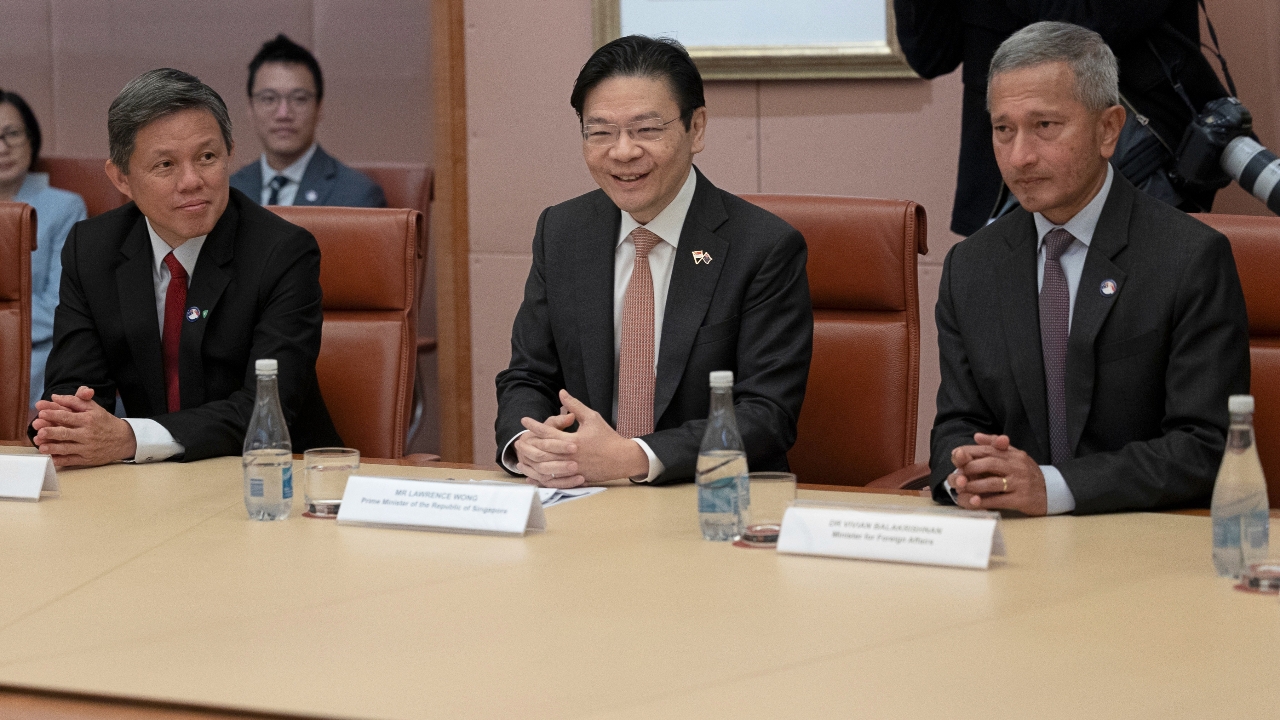
Senior ministers in Singapore are scheduled to explain to Parliament on 8 Sep the proposal from the political officeholders' salary review committee. This is a sensitive issue in Singapore, which pays its political leaders the highest salaries worldwide to attract talented individuals and reduce corruption incentives. First-time ministers earn SGD 1.1 million annually, approximately 28.5 million baht, while the Prime Minister receives SGD 2.2 million per year, about 57.1 million baht.
Singapore's Parliament will consider proposals to restructure and adjust the salaries of political officeholders, including ministers, during this week's session. Prime Minister Lawrence Wong and Coordinating Minister for Public Service Chan Chun Sing will present the government's position on the salary review committee's proposals on 8 September, before parliamentary debate begins on 10 September.
This issue has attracted significant attention because Singapore pays its political leaders some of the highest salaries worldwide. Currently, entry-level ministers earn about SGD 1.1 million per year, roughly 28.5 million baht including bonuses, while the Prime Minister receives approximately SGD 2.2 million annually, around 57.1 million baht.
These salaries have not been adjusted since 2012, after the then-government accepted the review committee's recommendation to reduce entry-level ministers' pay by more than one-third, about 36%, to ease public dissatisfaction with the very high salary levels.
The latest review occurs amid changing economic and living cost contexts. Singapore's median monthly income is SGD 5,775 (about 149,875 baht) in 2025, while inflation rose to 2% in July. The Monetary Authority of Singapore expects price pressures to remain elevated through the second half of 2027.
Singapore's government reviewed the salary framework again in 2017-2018 but chose not to implement pay increases, citing that the existing compensation structure was still appropriate and the economy was uncertain at that time.
The next scheduled review was originally set for 2023 but was postponed due to the government's need to manage multiple uncertainties, including geopolitical tensions, conflicts in the Middle East and Ukraine, and global economic unpredictability. In May, the government noted that the Middle East conflict that began in February increased economic uncertainty and clouded Singapore's economic outlook.
The current review committee is chaired by Gan Siow Huang, Chairperson of Singapore LNG Corporation and alternate member of the Presidential Council for Minority Rights. The committee was tasked with assessing whether current salary levels remain appropriate and recommending compensation framework improvements if necessary to reflect current conditions.
Singapore's compensation system uses the income of the country's top 1,000 earners as a benchmark. The government argues that the qualifications and capabilities of this group reflect the level of personnel required for effective national administration.
This top-earner group includes senior executives such as chief executive officers, chief operating officers, and chief financial officers, as well as professionals in financial services and occupations like lawyers, doctors, and accountants.
However, ministers' salaries are not directly equivalent to the top earners' incomes but apply a 40% discount from the median income of that group to embody the principles and spirit of public service.
Ministerial compensation consists of a base salary and variable components. The base includes monthly salary and a 13th-month bonus. Variable pay includes performance bonuses set by the Prime Minister, annual bonuses linked to national economic performance, and a "national bonus."
The national bonus is set at an amount equivalent to three months' salary if the government meets four economic and social targets: real median income growth, income growth of the bottom 20% earners, unemployment rate, and real gross domestic product (GDP) growth.
The Singapore government has consistently justified high pay as necessary to attract talented private-sector individuals into politics and deter corruption. Over recent years, corruption cases among senior officials in Singapore have been rare.
Nevertheless, this remains a sensitive topic among the public due to the large income gap between political leaders and ordinary citizens. Data from PoliticalSalaries.com indicates Singaporean political leaders receive the highest compensation globally, followed by Hong Kong's senior executives and the President of Switzerland. By contrast, the UK Prime Minister earns about USD 230,000 annually, and former US President Donald Trump earned USD 400,000 per year.
/sourceThe Straits Times/Reuters