

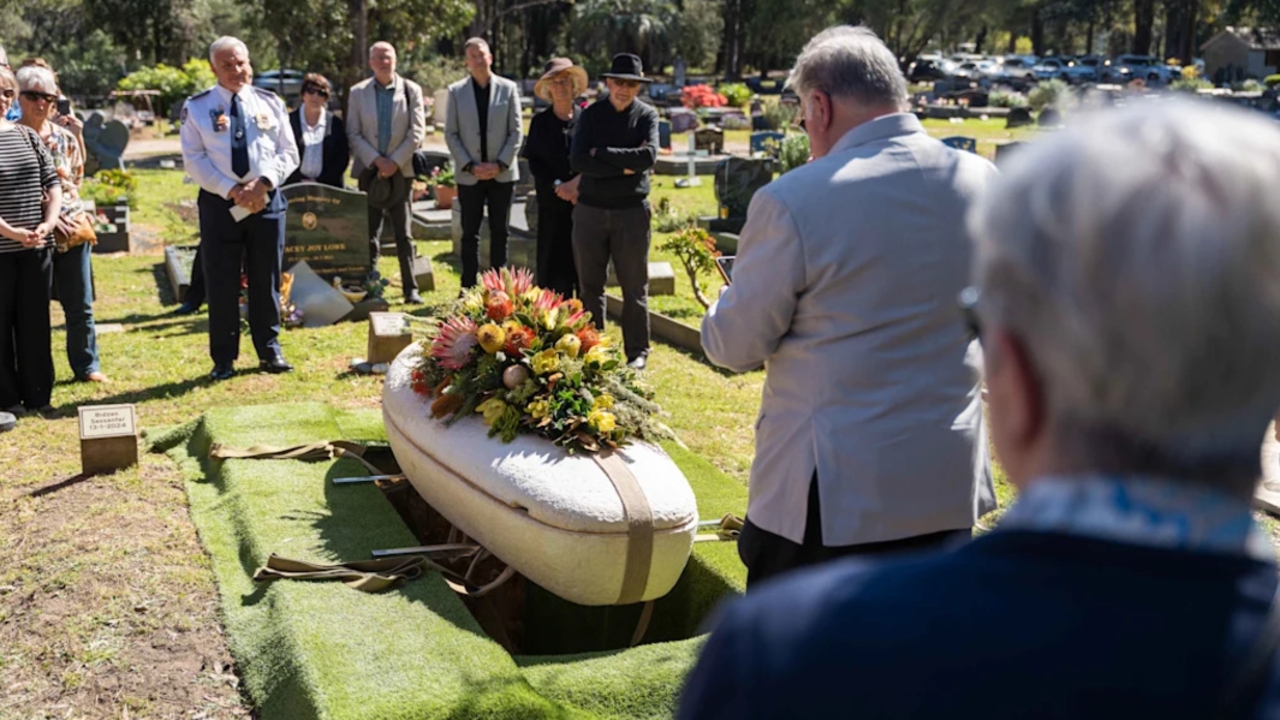
A 70-year-old Australian woman was buried in a "mushroom coffin" made from fungal mycelium for the first time in Australia. This coffin can decompose and become part of the soil within just 45 days, unlike traditional wooden coffins which may take up to 50 years. This reflects a growing trend toward environmentally friendly funerals.
Australia held a new type of funeral focused on environmental care after Caroline, a 70-year-old woman, became the first in the country to be buried in a coffin cultivated from mushrooms. Caroline's funeral took place on 4 Sep at Springwood Cemetery in the Blue Mountains area of New South Wales, attended by family and close friends.
The coffin was produced by Loop Biotech, a company from the Netherlands, using mycelium — the root-like network of fungal fibers — combined with hemp fibers derived from agricultural waste. The manufacturing process involves shaping the material in molds within temperature- and environment-controlled rooms, taking about one week to grow into a ready-to-use coffin.
Once buried, this type of coffin can decompose and integrate with the soil within approximately 45 days, whereas traditional wooden coffins may take as long as 50 years to break down. Actual decomposition times depend on environmental conditions and soil characteristics.
This process resembles composting, where both the body and coffin gradually break down and return to nature, transforming into nutrients that enrich the soil instead of leaving behind slow-decomposing or polluting materials.
Donald, Caroline's husband, said choosing the mushroom coffin aligned with his wife's lifelong values of helping others and giving back to nature. He said he feels that even after death, Caroline can still contribute to others and restore what she received from nature.
Bob Hendricks, founder and CEO of Loop Biotech, said the coffin was designed to fully decompose and, rather than polluting the soil, it enhances soil quality. Hendricks explained the key idea is to create a biodegradable "shell" for the body that, under appropriate conditions, becomes part of the soil within about 45 days.
Each mushroom coffin weighs around 30 kilograms, and Hendricks hopes this technology will make the Australian funeral industry more sustainable by reducing the time materials and bodies take to decompose.
Hendricks began developing this concept about five years ago during a research project at Delft University of Technology in the Netherlands. The product attracted Australian customer interest early on, but introducing it to the country took time due to Australia's strict biosecurity regulations before appointing a local distributor.
Although Caroline was the first in Australia to use this coffin, Hendricks noted that thousands of people in Europe and the United States have previously used mushroom coffins.
Dr. Hannah Gold, a cultural anthropologist from the University of Melbourne, said interest in eco-friendly funerals is rising in Australia. She observed that as fewer people maintain strong ties to institutional religion, other values, including environmental and community concerns, gain greater importance.
The concept called "eco-death," which manages death with environmental consideration, is becoming popular. It views death not only as a journey to heaven but also as a return to the earth to become part of the natural cycle.
Asha Dooley, managing director of Grace Funerals and national chair of Funerals Australia, which managed Caroline's funeral, said that over 15 years in the funeral industry, she has seen a clear increase in families' interest in sustainability, especially in the past four to five years.
She said that about five years ago, only a few families inquired about environmentally friendly options, but now people seek farewells that reflect the deceased's lifestyle and values. She believes this may mark the beginning of a major transformation in Australia's funeral industry.
Christine, Caroline's close friend, said seeing her friend lie on a moss-covered floor during the funeral felt "almost like being in a fantasy world" and gave the impression that Caroline was becoming one with the earth even during the ceremony.
Currently, Australia holds about 200,000 funerals annually, with cremations outnumbering burials roughly 7 to 3. This is partly because burial plots are expensive, especially in major cities like Sydney and Melbourne. However, cremations impact the environment by releasing greenhouse gases, with estimates suggesting over 100 kilograms of carbon dioxide emitted per body, though figures vary by calculation methods and sources.
In recent years, Australia has seen more diverse funeral options, such as alkaline hydrolysis — a water-based dissolution process using alkaline solutions instead of flames — natural burials without embalming chemicals, and shallow burials. Some natural burials use cardboard coffins with lifting straps, estimated to emit less than 10 kilograms of carbon dioxide equivalents.
There is also the concept of human composting, where bodies are decomposed together with organic materials like wood chips and straw over several weeks to produce a soil-like material.
In June, Alex Greenwich, a member of the New South Wales Legislative Assembly, introduced a bill to legalize human composting in the state. If passed, New South Wales would become the first Australian state to permit this method.
Caroline's case not only represents a new form of funeral but also reflects changing attitudes toward death in Australia, where more people seek farewells aligned with sustainability, reducing environmental impact, and returning to nature.