

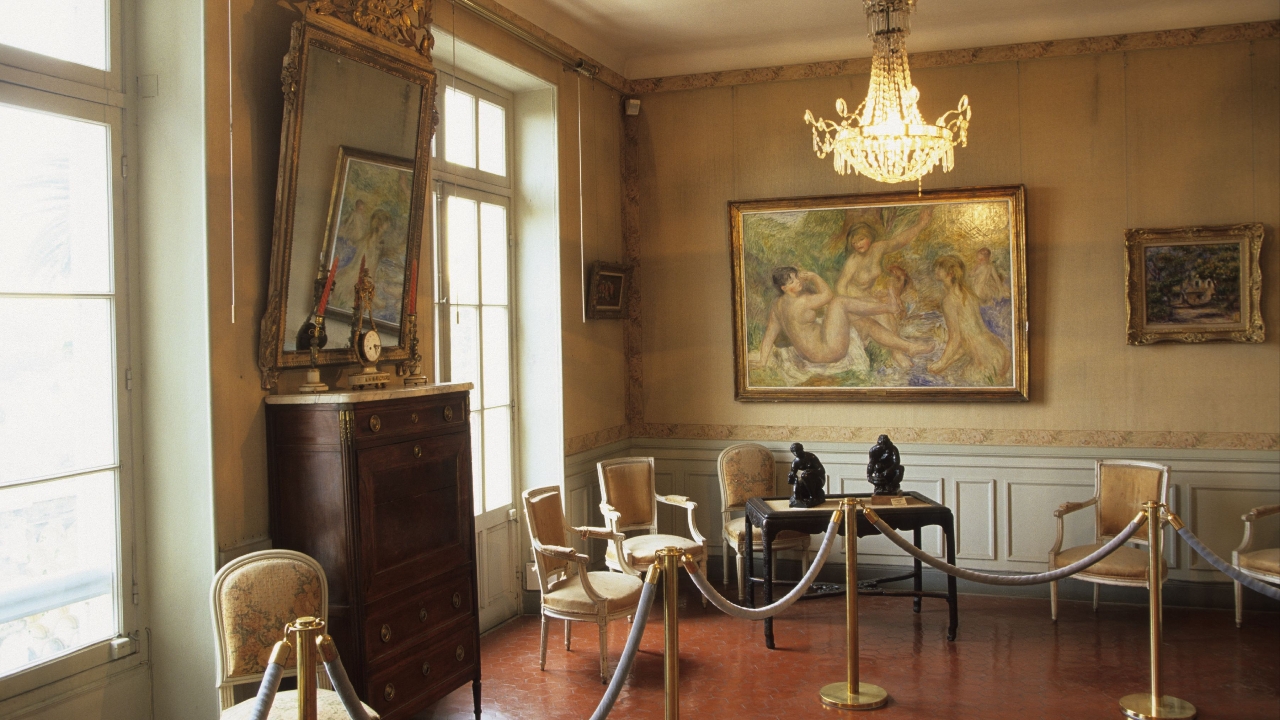
Two criminals broke into the Renoir Museum in the town of Cagnes-sur-Mer in southern France early this morning, stealing at least four artworks valued at about 9 million euros, equivalent to approximately 344 million baht. However, they dropped one painting while fleeing. Police are intensifying their pursuit and have launched an investigation into the theft.
A theft occurred at the Auguste Renoir Museum in Cagnes-sur-Mer, Alpes-Maritimes province, southern France, earlier today (8 Sep), when at least two thieves broke into the museum and stole at least four pieces of artwork.
Brian Masson, mayor of Cagnes-sur-Mer, revealed that the museum's alarm system was triggered at 05:48, and just five minutes later, at 05:53, municipal police arrived at the scene.
City surveillance cameras captured images of the two suspects. During the incident, the thieves were seen cutting paintings from their frames before removing the artworks from the museum. However, while escaping, one of the stolen paintings was dropped, allowing authorities to recover it.
The mayor stated that the stolen artworks are estimated to be worth around 9 million euros, or approximately 344 million baht. Both municipal and national police have been deployed to the area to track down the perpetrators, and the investigation is ongoing.
Mayor Masson said the raid on the Renoir Museum was not merely theft but an act of destroying part of the town's history and cultural heritage. He emphasized the urgent need to implement plans to enhance museum security and protect artworks, which are a heritage belonging to all citizens.
The Renoir Museum was established in 1960 inside the last residence of Pierre-Auguste Renoir, a renowned French painter of the Impressionist movement, who died in 1919.
The museum displays Renoir’s furniture and personal belongings, including his easel and wheelchair, along with his artworks such as portraits, landscapes, and nudes created by the artist.
This latest theft happened less than a year after a shocking incident at the Louvre Museum in Paris, where thieves stole eight important pieces of French royal regalia and jewelry from the Apollo Gallery. To date, the stolen items have not been recovered despite extensive searches and coordination with police in Belgium, Italy, and other countries.
Authorities have arrested four suspects in the Louvre case but have yet to recover the stolen artworks and jewelry.
Following multiple incidents, the French Ministry of Culture has elevated museum security to a top priority. In July, it unveiled a 33-measure action plan, including proposals to temporarily remove certain exhibits from display cases to store them in more secure locations until security systems can be improved.
In late July, an ancient gold necklace from the "Treasure of Vix," a Celtic-era artifact about 2,500 years old, was stolen from a museum in Châtillon-sur-Saône in eastern France. This museum had already been targeted by attempted thefts twice before.
Earlier in July, thieves also broke into the Lalique Museum in Wingen-sur-Moder, north of Strasbourg, stealing several pieces of jewelry estimated to be worth over 4.5 million euros.
The continuous thefts have prompted the French government to urgently review museum security measures, focusing on protecting highly valuable artworks and artifacts that constitute the country’s historical and cultural heritage.