

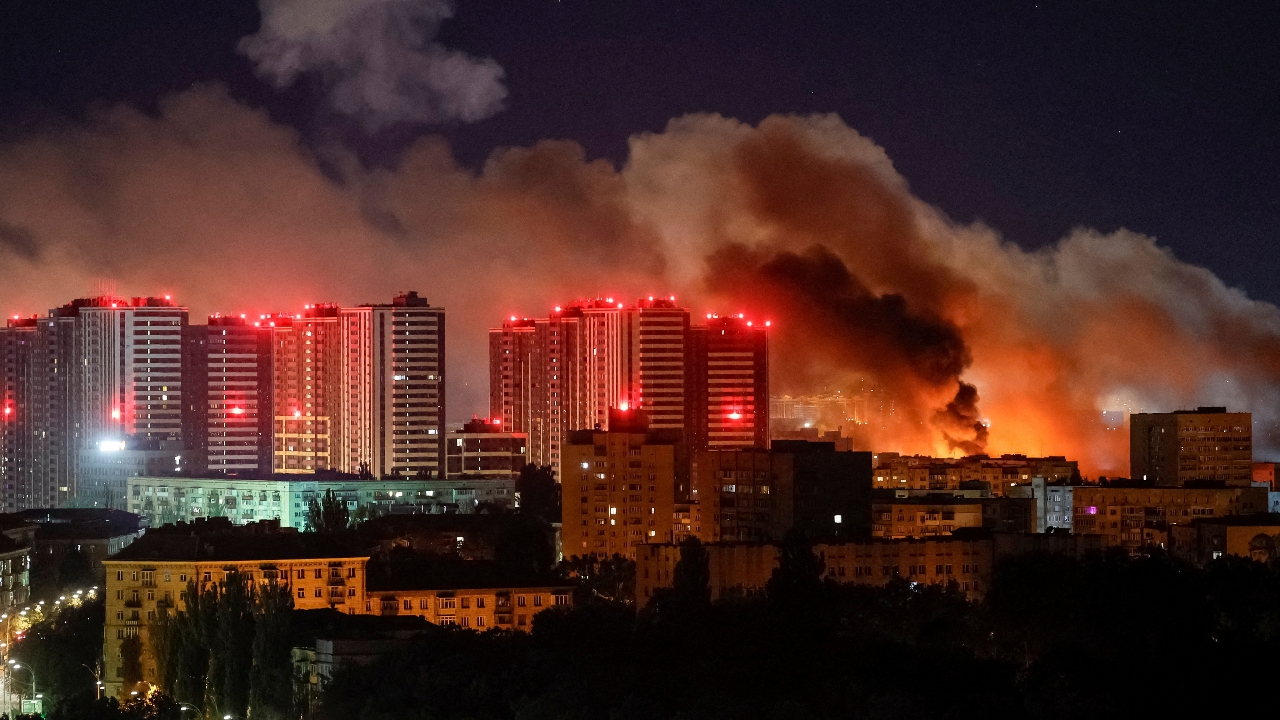
Russia resumed a large-scale missile and drone attack on Kyiv in the early hours today, resulting in two deaths, at least ten injuries, and fires in multiple locations. This followed President Vladimir Putin's order to temporarily halt attacks on Kyiv for three days while a special envoy of President Donald Trump visited Russia and Ukraine to promote peace talks.
Ukrainian authorities revealed that Russia launched numerous missiles and drones against Kyiv, Ukraine's capital, overnight into the early morning of Tuesday, 8 September, causing at least two deaths and at least ten injuries. Explosions were heard throughout Kyiv at dawn, while fires and smoke covered several areas. Many residents sought shelter in basements and subway stations for safety.
This attack occurred after Russia paused assaults on Kyiv for three days over the weekend, during which Steve Biegun and Jared Kushner, special envoys of President Donald Trump, visited Moscow and Kyiv to advance efforts to end the war between Russia and Ukraine.
Ukraine's Foreign Minister Andriy Yebih said on social media that immediately after the US president's peace envoys left Ukraine, President Vladimir Putin launched another major attack on Kyiv, adding, "His guided missiles speak louder than diplomatic words."
The Ukrainian Air Force reported that the main targets were Kyiv and the southern Odesa region. Ukrainian forces intercepted or destroyed two guided missiles, 31 cruise missiles, and 142 drones. Meanwhile, 29 sites across the country were found damaged by the attacks.
President Volodymyr Zelensky stated that the attack was complex and appeared to be planned to cause maximum damage, involving guided missiles, cruise missiles, anti-ship missiles, and Shahed attack drones. Zelensky noted that residential buildings and civilian infrastructure in Kyiv were heavily damaged. Reports also indicated attacks on critical infrastructure in several Ukrainian regions.
In Odesa, a market was attacked; in Kharkiv, two people were injured and several multi-story buildings damaged. In the Sumy region, a diesel locomotive on the Kyiv-Sumy railway line was struck at a station. The Zaporizhzhia and Dnipropetrovsk regions were also targeted.
Ukraine's State Emergency Service reported damage and fires in at least five districts of Kyiv. The Kyiv military administration reported damage to at least 16 civilian infrastructure sites.
One damaged area was the Holosiivskyi district, where a 26-story non-residential building was hit, causing fire to spread to a nearby building. Rescue teams evacuated many people, including residents from a 16-story residential building.
In the Solomianskyi district, residents were trapped inside a five-story residential building; officials rescued at least ten people. Fires were also reported in the Darnytskyi and Podilskyi districts.
Biegun and Kushner visited Moscow on Saturday, meeting President Putin, then traveled to Kyiv to meet President Zelensky on Sunday. This marked their first official visit to Ukraine in the Trump administration's renewed efforts to end the more than four-and-a-half-year conflict.
After discussions, Biegun said the talks showed "substantive progress" and expressed hope to revive tripartite peace talks among the US, Russia, and Ukraine. Via platform X, he stated that President Trump is working hard to stop the bloodshed and promote lasting peace.
The Kremlin stated Russia has not ruled out resuming tripartite negotiations, but Kremlin spokesman Dmitry Peskov said it is too early to specify a location or exact timing for talks.
Zelensky told US media that the US is pushing all parties to de-escalate the conflict before the long winter, especially as Russia tends to attack Ukraine's energy networks during winter. Since Russia's invasion in February 2022, millions have faced electricity and heating shortages during temperatures that can drop as low as minus 20 degrees Celsius.
Zelensky revealed that weekend talks also covered US proposals concerning energy plants and infrastructure, grain transport, and oil and gas exports, though no further details were disclosed.
However, Russian Foreign Minister Sergei Lavrov expressed opposition to Turkey's ceasefire proposal for attacks in the Black Sea, calling it "unrealistic" and "unverifiable."