

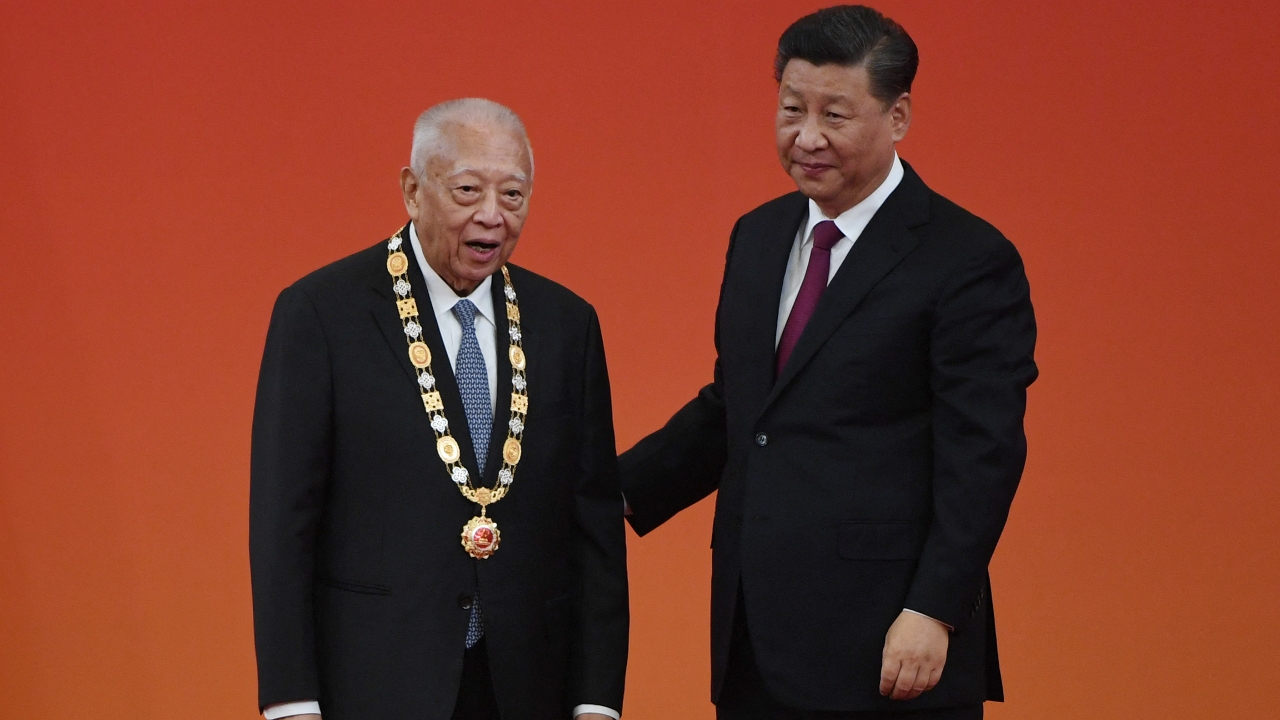
Tung Chee-hwa, the first Chief Executive of Hong Kong after Britain handed the territory back to China, has died at age 89. He served amid economic crises, disease outbreaks, and major protests in 2003, which became a pivotal moment in Hong Kong–China relations.
Hong Kong local media cited a statement from Tung Chee-hwa’s office, confirming that the former first Chief Executive of the Hong Kong Special Administrative Region passed away peacefully on the night of Tuesday, 8 Sep 2023 GMT+7, at age 89. While no official cause of death was disclosed, the statement praised him as a person who "truly devoted himself to the nation and the people."
Tung Chee-hwa made history by becoming Hong Kong's first Chief Executive on 1 Jul 1997 GMT+7, succeeding Chris Patten, the last British governor. This marked the end of over 150 years of colonial rule under the principle of "one country, two systems." In his legendary inauguration speech, he said, "For the first time in history, we Hong Kong people will determine our own destiny."
Born in Shanghai in 1937, Tung was the son of Tung Chao-yung, a shipping magnate owning Orient Overseas. He graduated in mechanical engineering from the University of Liverpool, England (making him a devoted Liverpool football fan), and worked for General Electric in the U.S. before returning to manage the family business in Hong Kong in 1979.
His political career began as an advisor to Hong Kong's colonial government cabinet in 1992. In 1996, he was selected by a 400-member committee appointed by the Chinese government to be Hong Kong’s first leader, receiving full backing from then-Chinese President Jiang Zemin. Historically, Chinese state banks had helped rescue his family’s shipping business during the 1980s crisis.
Tung’s tenure was turbulent, facing the 1997 Asian financial crisis that caused Hong Kong property prices to plummet, followed by major disease outbreaks including avian flu (1997–2002) and SARS in 2003.
His greatest political challenge came in July 2003 when his government attempted to push through the National Security Law, or "Article 23," sparking over 500,000 Hong Kong residents to protest in black attire, fearing the law would undermine freedoms and civil rights. This massively damaged his popularity, forcing withdrawal of the bill and leading to his resignation in March 2005 before completing his second term, citing health reasons, though many believed it was due to pressure from China.
After stepping down as Chief Executive, Tung remained politically influential as vice-chairman of the Chinese People's Political Consultative Conference (CPPCC), China’s top advisory body, and served as an important intermediary in China–U.S. relations due to his family’s close ties with former U.S. Presidents George H. W. Bush and George W. Bush.
During the large pro-democracy protests in Hong Kong in 2019, Tung strongly criticized the protesters, calling them "troublemakers opposing China," and defended China’s new National Security Law implemented in 2020.
In recent years, Tung appeared less in public, last seen at the 100th anniversary celebration of the Chinese Communist Party in July 2021 before undergoing heart surgery. He was married with three children.