

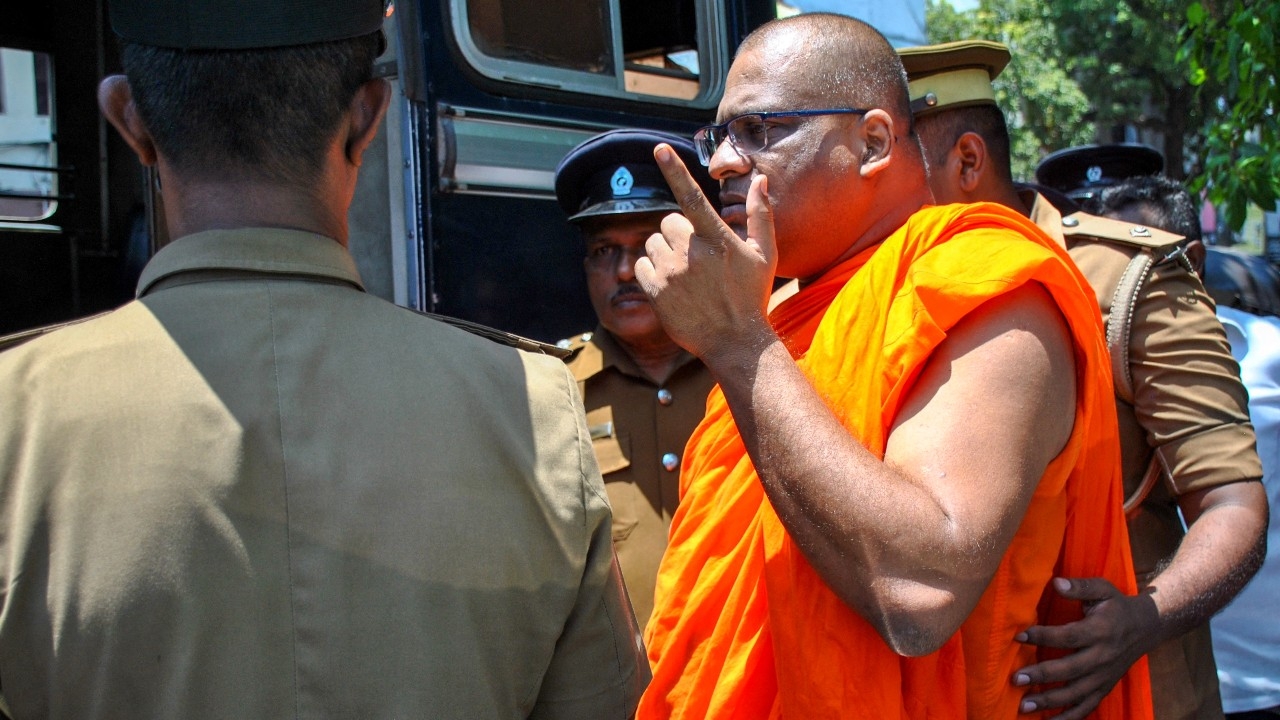
The Sri Lanka Supreme Court has ruled to revoke the presidential pardon previously granted to "Galagoda Aththe Gnanasara," an extremist nationalist monk sentenced to six years for threatening the wife of a missing political cartoonist. The court ordered him to return to prison to serve the remaining sentence, stating the pardon was an arbitrary and unlawful use of power.
On 10 Sep 2023 GMT+7, the Sri Lanka Supreme Court revoked the pardon granted by former President Maithripala Sirisena to Galagoda Aththe Gnanasara, a senior leader of the Buddhist Power Force (BBS), a nationalist Buddhist group. The court ordered Gnanasara to return to prison to serve the remaining six years.
A three-judge panel of the Supreme Court, chaired by Justice Janak de Silva, ruled that the pardon granted by former President Sirisena in May 2019 was "arbitrary and unlawful." The court annulled the pardon and reinstated Gnanasara's original prison sentence.
The case originated from a fundamental rights petition filed by the Centre for Policy Alternatives (CPA) and Sandhya Eknaligoda, wife of political cartoonist and journalist Prageeth Eknaligoda, who disappeared in 2010 and remains missing.
Gnanasara was sentenced to six years for contempt of court and threatening behavior during proceedings at the Homagama Magistrate's Court, related to the investigation into Prageeth Eknaligoda's disappearance. Gnanasara appeared in court to support military intelligence officers accused of involvement in the abduction.
Prageeth Eknaligoda was known for political cartoons criticizing former President Mahinda Rajapaksa. During intense court disputes, Gnanasara accused Prageeth and his wife of supporting Tamil extremist groups and defaming the military.
In August 2018, the Sri Lanka Court of Appeal sentenced Gnanasara to a total of 19 years, to be served concurrently as six years, for contempt of court during the Homagama Magistrate's Court proceedings. On 5 October 2018, the Supreme Court upheld this verdict, confirming his guilt for contempt from the incident on 25 January 2016.
However, on 23 May 2019, Gnanasara was released from Welikada Prison after former President Maithripala Sirisena exercised presidential pardon powers, despite Gnanasara having served less than one year. This decision drew heavy criticism from human rights groups, who viewed it as undermining the rule of law.
This latest ruling marks a major setback for the 51-year-old nationalist Buddhist monk, who wields significant political and social influence. Critics accuse him of fueling anti-Muslim sentiment and escalating religious tensions in Sri Lanka.
Despite his release, Gnanasara maintained political influence; in 2020, then-President Gotabaya Rajapaksa appointed him chairman of a committee to study legal reforms.
Gnanasara later served an additional nine months in prison in a separate case involving statements perceived as contemptuous of Islam and inciting religious hatred in Sri Lanka, where the majority of the population are Buddhists. He is also alleged to have close ties with Wirathu, an extremist nationalist monk from Myanmar, criticized for fueling religious conflict there.
Wirathu visited Sri Lanka at Gnanasara's invitation following anti-Muslim riots in 2014 that left four dead. Both monks portray themselves as defenders of Buddhism against what they call the "extremist ideology of Islam." However, Gnanasara denies involvement in those riots.
In the latest proceedings, CPA and Sandhya Eknaligoda filed petitions opposing the pardon granted by former President Sirisena, arguing that the exercise of this power was unlawful.
This ruling requires Gnanasara to return to prison to serve the remainder of his six-year sentence. It is a landmark decision reinforcing the principle that presidential pardon powers must be exercised within legal and rule-of-law frameworks.