

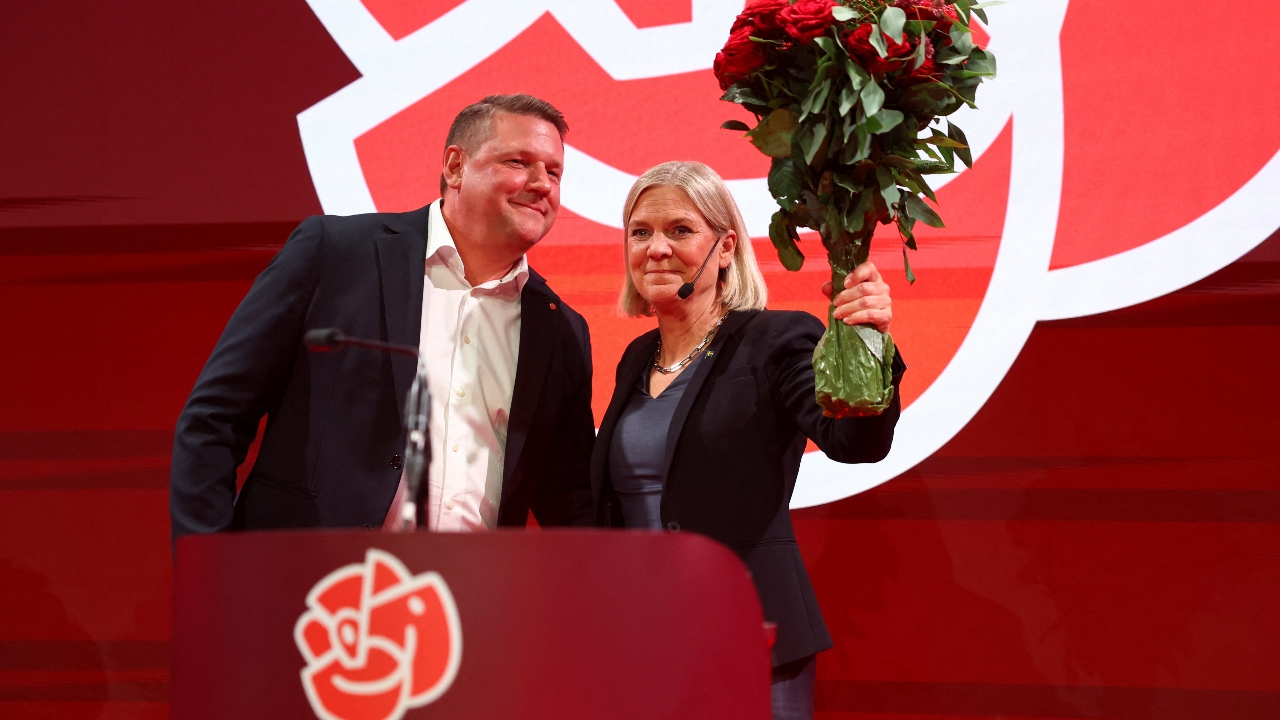
Sweden's general election remains very close, with no clear indication yet of who will form the government. Unofficial results with over 90% of votes counted show the left-wing bloc led by the Social Democratic Party holding a slight lead over the right-wing bloc, while the right-wing Sweden Democrats have lost popularity for the first time since entering parliament in 2010.
Sweden's general election remains highly competitive. After counting more than 90% of votes, the left-wing opposition bloc of four parties, led by Magdalena Andersson, head of the Social Democratic Party, holds a lead of about three seats over the right-wing bloc, led by Prime Minister Ulf Kristersson, out of 349 seats in the Swedish parliament, the Riksdag.
Forecast data from the Swedish Election Authority indicates the Social Democratic Party is likely to form a government with a narrow majority. With 94% of votes counted, the left-wing bloc holds 176 seats, while the right-wing bloc has 173 seats.
However, neither side has declared victory yet, and major Swedish media outlets have not officially announced a winner. Kristersson told supporters that although the public has voted, the final result remains uncertain, and the question of which government will lead the country in the coming years remains open.
Meanwhile, Andersson, Sweden's first female prime minister who served from 2021 to 2022, stated that if current results hold, Sweden will have a new government.
Although the Social Democratic Party remains the largest party in the country, preliminary results suggest it may receive only about 28% of the vote, its worst performance in over 100 years. Meanwhile, the Sweden Democrats, known for their anti-immigration stance and neo-Nazi roots, have lost popularity for the first time since entering parliament in 2010, dropping to approximately 17.6% from 20.6% in the 2022 election.
Other left-wing parties, including the Left Party, the Green Party, and the Centre Party, have seen increased support. However, government formation remains complex because these four parties have differing positions, especially conflicts between the left-wing parties and the Centre Party. Kristersson noted that although the left holds more seats, it remains to be seen whether they can agree on forming a government and setting joint policies.
Kristersson leads a minority coalition government that has been supported by the Sweden Democrats for the past four years. He has promised to give key ministerial positions to the Sweden Democrats if the right-wing bloc retains power.
Key election issues included security, gang crime, immigration, healthcare, welfare, and cost of living. Kristersson highlighted his record on combating organized crime and controlling asylum applications, which are at historic lows. Andersson proposed raising taxes on banks and high earners, reducing waiting times for healthcare services, and improving educational outcomes.
Voter turnout was about 80%, down roughly 4 percentage points from the 2022 election.
Official results may take several more days because local election authorities will begin counting some ballots that arrived late on election night on Wednesday. All votes will then be automatically rechecked by county election officials, a process that typically takes about one week before final results can be announced.