

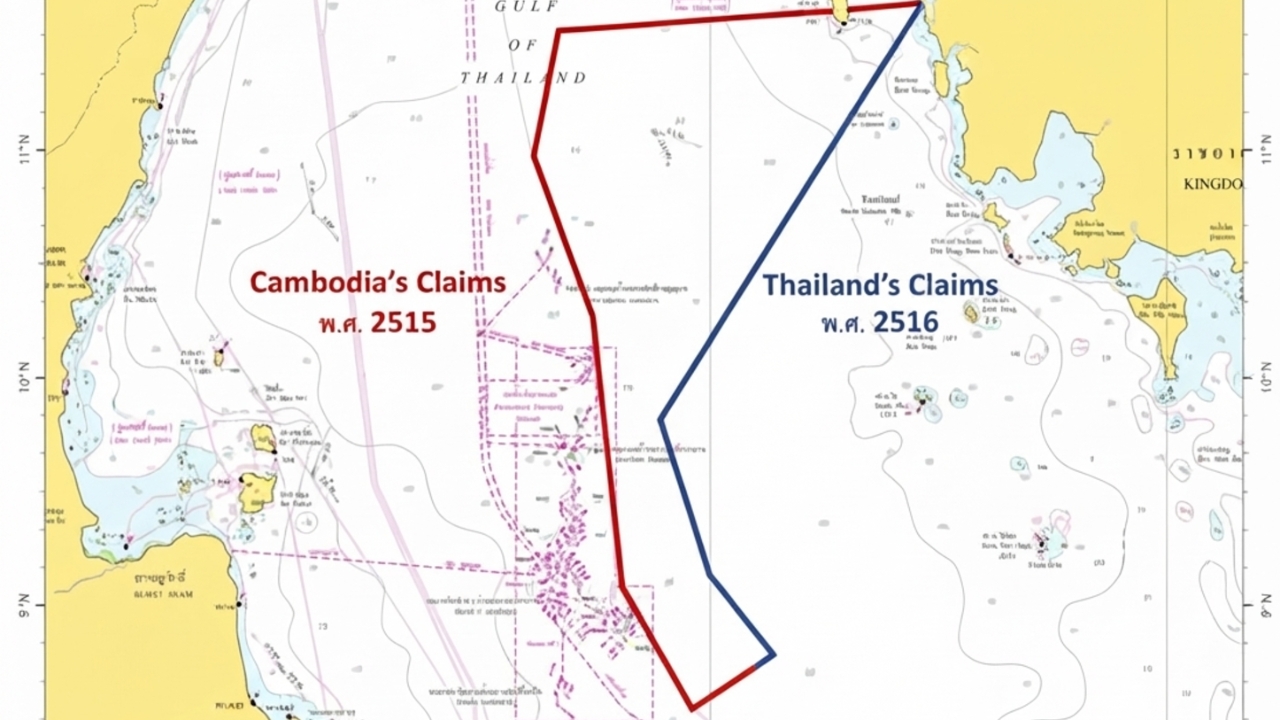
Thailand and Cambodia are preparing to present their cases to the Permanent Court of Arbitration (PCA) mediators in Singapore this week to seek resolution of a maritime dispute lasting over two decades, particularly involving overlapping areas in the Gulf of Thailand believed to contain oil and natural gas resources worth around $300 billion, following Thailand's unilateral withdrawal in May from the 2001 Memorandum of Understanding between Cambodia and Thailand, known in Thailand as MOU 44.
Cambodia and Thailand plan to send representatives to present their positions to the international mediation panel at the Permanent Court of Arbitration (PCA) office in Singapore on 15 Sep, aiming to resolve the dispute over overlapping maritime claims in the Gulf of Thailand.
Cambodia initiated the mediation process with United Nations support after Thailand withdrew from the bilateral framework that both sides had used to negotiate joint development of offshore energy resources.
The dispute concerns the 2001 Memorandum of Understanding (MOU 44), covering approximately 27,000 square kilometers in the Gulf of Thailand, an area rich in natural resources over which both Cambodia and Thailand claim sovereignty.
The Thai government announced its unilateral withdrawal from the framework in May, with the prime minister and foreign ministry stating that the bilateral cooperation under MOU 44 had lasted over 25 years without tangible progress.
Prime Minister Anutin Charnvirakul affirmed that Thailand's withdrawal was unrelated to the Thai-Cambodian border conflicts that erupted in two rounds last year, resulting in dozens of deaths and over one million displaced people before a ceasefire agreement was reached.
Cambodia's Ministry of Foreign Affairs stated last week that Cambodia decided to enter the mediation process after Thailand's unilateral termination of the bilateral cooperation framework, which had been used for over 20 years to negotiate overlapping maritime claims.
Cambodian Prime Minister Hun Manet said the move aims to protect Cambodia’s sovereignty and maritime rights under international law.
Representatives from both countries are scheduled to deliver opening statements before the five-member mediation panel, composed of international law experts, at the PCA office in Singapore. Cambodian Deputy Prime Minister and Foreign Minister Prak Sokhonn is expected to open, followed by Thailand’s Foreign Minister Sihasak Phuangketkeow.
The PCA, established in 1899, is the world’s oldest intergovernmental organization for dispute resolution, facilitating settlement between states and private parties based on treaties, agreements, and international conventions including the United Nations Convention on the Law of the Sea (UNCLOS). The PCA’s Singapore office is its first established in Asia.
However, the mediation panel’s recommendations are non-binding, and the process is expected to take about one year to reach a conclusion.
Both Thailand and Cambodia have expressed satisfaction at entering the mediation process. Cambodia’s foreign ministry described the upcoming meeting as an important step in the peace process it initiated to resolve maritime boundary differences between the two nations.
Cambodia hopes the process will lead to a fair and sustainable resolution to the maritime dispute and open opportunities for joint exploration of the area's significant oil and natural gas potential.
Thailand’s Ministry of Energy estimates future revenues from oil and gas resources in the overlapping area could reach approximately $300 billion. The Thai Foreign Ministry affirmed full cooperation and support for the mediation committee’s work while committing to protect national interests.
William Jones, an international politics expert at Mahidol University’s International College, analyzed that Thailand’s withdrawal from MOU 44 and Cambodia’s move to mediation are closely linked to domestic politics and recent border conflicts.
Jones stated that Thailand’s withdrawal partly aims to demonstrate a firm stance and signal to voters the official end of former Prime Minister Thaksin Shinawatra’s political legacy, who was responsible for the 2001 MOU.
Meanwhile, Jones views Cambodia’s initiation of the mediation process as a "shrewd political move" by Hun Manet, given Cambodia’s military disadvantages and subordinate position relative to Thailand; using international legal channels offers a low-cost, high-potential strategy for political gains and long-term benefits.
This maritime dispute thus encompasses not only territorial and resource rights but also sovereignty, energy interests, and the long-term trajectory of Thai-Cambodian relations.
/sourceAFP