

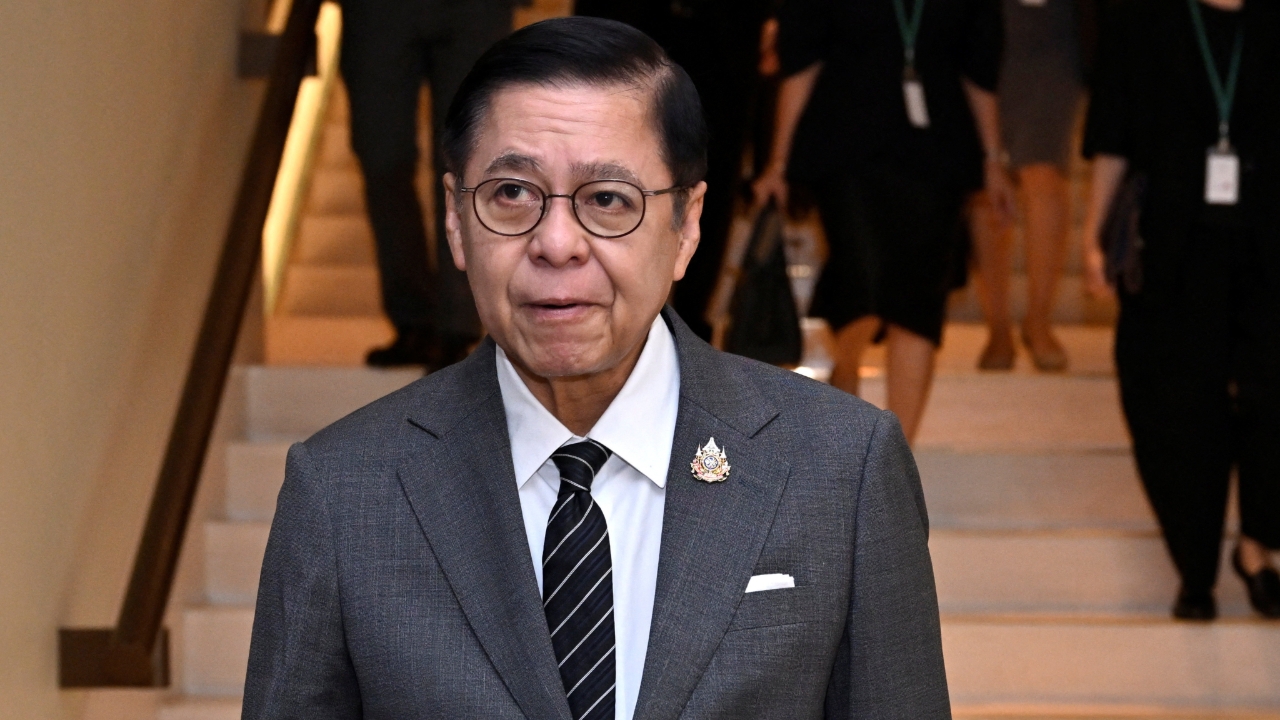
Thailand's Foreign Minister opened the first UNCLOS Conciliation Commission meeting, affirming commitment to proceed with maritime boundary reconciliation with Cambodia and criticizing Cambodia for adopting a victim stance in the dispute.
On Tuesday, 15 Sep 2026 GMT+7, the Ministry of Foreign Affairs of the Kingdom of Thailand issued an opening statement by Deputy Prime Minister and Foreign Minister Sihasak Puangketkaew at the inaugural meeting of the Thailand-Cambodia Conciliation Commission under the UNCLOS framework.
Sihasak said, “Honorable Chair, Conciliation Commission members, and Cambodian delegates, I am deeply honored to represent Thailand. I come with a clear goal: to seek a solution on maritime boundary delimitation that protects our rights and enables Thailand and Cambodia to move forward as neighbors.”
“First, I would like to address the overall context of Thailand-Cambodia relations, which I believe is highly relevant to today's meeting.”
“We need to understand the surrounding circumstances and sequence of events that have brought us here to Singapore. The essence of this process lies in the clear difference between the approaches chosen by Thailand and Cambodia to manage their issues.”
“Thailand has always believed that differences between neighbors should be resolved through dialogue. Our approach has consistently been to maintain communication channels, restore mutual trust, and seek sustainable solutions through bilateral negotiations.”
“Cambodia, however, has chosen a different approach. Cambodia often claims to respect international law and portrays Thailand as disregarding it. Yet, Cambodia’s claims serve its own interests and are contradictory.”
“We should recall events leading to the conflict: when Cambodia deliberately leaked private phone conversations between our leaders; when Cambodian rockets fell and killed innocent Thai civilians; when Thai soldiers lost legs to landmines laid by Cambodia. At those times, where was respect for international law?”
“I emphasize that Thailand has steadfastly upheld international law. We adhere to international conventions and will strongly protect our rights.”
“For Thailand, international law and diplomacy form a complementary foundation for maintaining peaceful international relations. Law provides the framework, while diplomacy is the tool neighbors use to build trust and reach accepted and sustainable solutions.”
“This issue is especially important now, as relations between our two countries are at a challenging juncture. Conflicts have eroded trust and caused significant harm to the peoples on both sides.”
“If we truly want a sustainable resolution, we need to rebuild trust. Therefore, Thailand has pushed for discussions and practical approaches to foster the necessary confidence to handle increasingly difficult issues.”
“At the ASEAN summit in Cebu earlier this year, our leaders reaffirmed their commitment to gradually restore relations.”
“When I met Deputy Prime Minister Prak Sokhonn in New York in May, I proposed practical, gradual measures to build confidence and enable us to confidently move forward on our differences.”
“Regrettably, Cambodia has never genuinely embraced this diplomatic approach. From Thailand’s perspective, this reflects Cambodia’s ongoing concerning behavior.”
“Instead of fully and sincerely engaging in bilateral talks, Cambodia repeatedly maligns Thailand with falsehoods, distorting facts and making baseless accusations almost daily, including on international platforms. Cambodia plays the victim role, confident in its moral superiority and to create an image of legitimacy.”
“We cannot deny that domestic politics influences Cambodia’s behavior. For Thailand, bilateral relations and the well-being of both peoples should not be bargaining chips for short-term political gain.”
“This has been Cambodia’s approach consistently, causing serious repercussions: stirring public sentiment, increasing tensions, and hardening stances, which make rapprochement and relationship restoration more difficult.”
“Thailand’s consistent approach is to combine clear legal mechanisms with diplomacy to build trust. Diplomacy should not become a contest of superiority seeking one-sided gains.”
“Honorable Chair and Commission members, our task ahead requires a correct understanding of the background leading us here. I will briefly explain Thailand’s decision to terminate the 2001 MOU.”
“Cambodia claims that Thailand’s cancellation of the MOU left Cambodia no choice but to start this conciliation process. This claim is untrue.”
“The fact is, in 25 years, we only held two official meetings, showing clearly that the MOU failed to produce concrete progress. Thailand thus chose to restart negotiations.”
“Cambodia’s recent ratification of UNCLOS should have provided an ideal opportunity to resume negotiations on a more stable legal basis.”
“Thailand clearly proposed this approach, and I personally suggested to Cambodia that we start maritime boundary talks, which would promote relations and pave the way to resolve other pending issues.”
“I also proposed that if we cannot reach agreement within six months, we could enter a joint conciliation process.”
“Therefore, Cambodia’s claim that it had no other option but to start this process after Thailand canceled the MOU is a complete distortion of facts.”
“Cambodia had other options but chose to close that door, for reasons difficult to understand. Honorable Chair, to reach resolution, we need clarity on the scope of issues this Commission will consider.”
“For Thailand, this process concerns only maritime boundary delimitation between Thailand and Cambodia in the Gulf of Thailand. Thailand reiterates that its maritime boundaries follow the Royal Decree dated 18 May 1973. We seek nothing beyond protecting our sovereignty, sovereign rights, and lawful entitlements under international law.”
“I emphasize that this conciliation process does not involve sovereignty over land territory, including Koh Kut Island. Thailand rejects the continental shelf line unilaterally claimed by Cambodia in 1972, which lacks legal basis.”
“Honorable Chair and Commission members, Thailand joins this conciliation process sincerely, aware of its obligations under UNCLOS and confident in the Commission’s neutrality and expertise.”
“Thailand is ready to participate constructively, aiming to achieve fair results through negotiation. With the Commission’s support, conciliation can help both parties find common ground, narrow legal differences, and negotiate forward.”
“We believe that with the Commission’s guidance, both parties can achieve fair, practical, and sustainable maritime boundary delimitation.”
“Thailand remains open to dialogue because ultimately, our two countries share the duty to earnestly and sincerely seek ways to move forward.”
“Honorable Chair, Commission members, and Cambodian delegates, as we begin this process today, we must recognize that its development and outcome will significantly impact future Thailand-Cambodia relations.”
“This process is not zero-sum diplomacy where there are absolute winners and losers. I reiterate Thailand’s full commitment to international law and to firmly protect our sovereignty and maritime rights.”
“I reaffirm Thailand’s dedication to peace and prosperity alongside our neighboring countries.”
“This commitment is evident from past cooperation with like-minded countries to bring peace to Cambodia and help it rebuild a nation for its people.”
“Thailand is committed to the path of peace. Progress requires political will from both sides. We have emphasized this repeatedly. Cambodia must choose its path, and we hope Cambodia will have the political will to walk alongside us.”
“Because after this process concludes, Thailand and Cambodia will remain neighbors for a long time. Our duty is to ensure that what we leave to future generations enables them to benefit from peace and prosperity between our countries.”
“Thailand is ready to do its part, and we hope Cambodia will do the same. Thank you, Honorable Chair.”
Follow international news:https://www.thairath.co.th/news/foreign
Source:mfa.go.th