

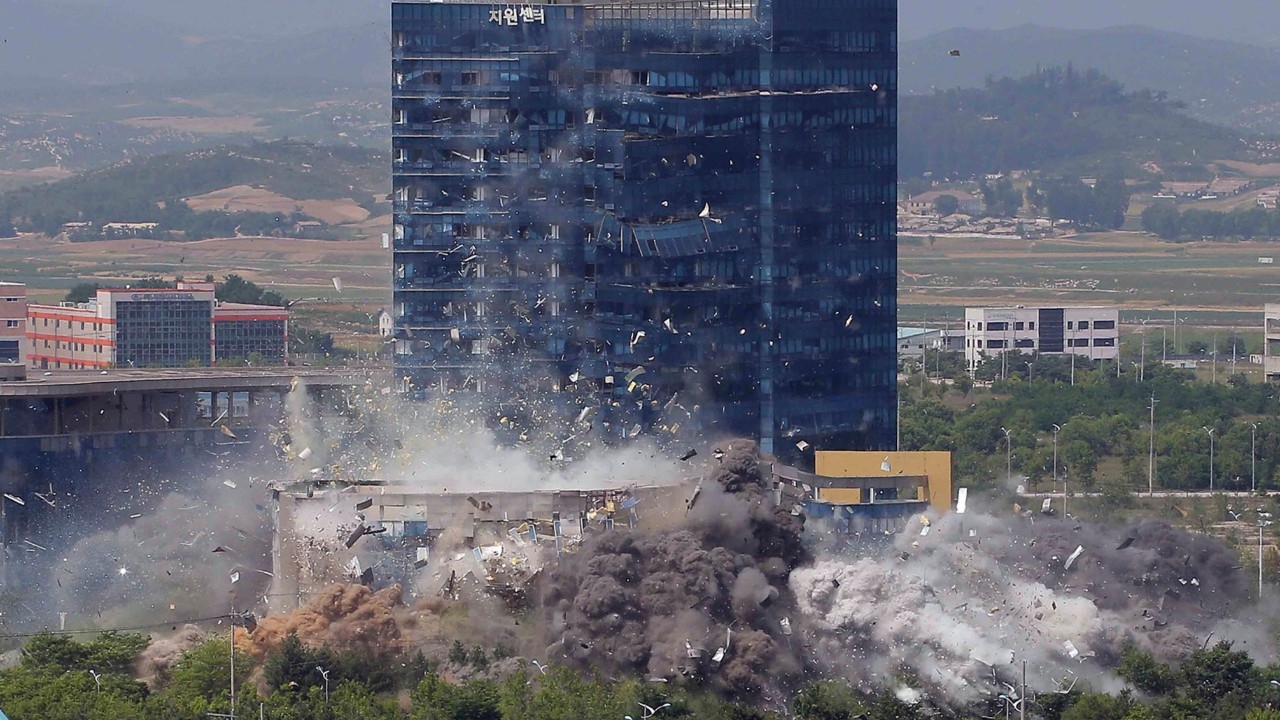
The Seoul Central District Court in South Korea has ordered North Korea to pay the South Korean government 44,626,410,722 won, approximately 1.085 billion baht, in compensation for the bombing that destroyed the inter-Korean Joint Liaison Office building in Kaesong, north of the border, in June 2020.
The verdict came about three years and three months after South Korea first filed the lawsuit against North Korea in June 2023. The court ordered full compensation as requested by the plaintiff but did not disclose the reasons behind the judgment.
The inter-Korean Joint Liaison Office opened in Kaesong in September 2018 to promote exchanges and cooperation between the two Koreas, amid reconciliation efforts following the April summit that year between South Korean President Moon Jae-in and North Korean leader Kim Jong-un.
The office suspended operations in January 2020 due to COVID-19 concerns, before North Korea destroyed the building with explosives on 16 June that year to protest South Korea's inability to stop defectors from sending anti-Pyongyang leaflets across the border via balloons.
South Korea's Ministry of Unification, responsible for North Korea-related affairs, filed the damage claim in June 2023, marking the first civil legal action by the South Korean government against Pyongyang.
The ministry assessed damages at 10.25 billion won for the liaison office building itself and 34.45 billion won for the adjacent support building, which was also heavily damaged by the blast.
The trial proceeded without any North Korean representatives participating. Although South Korea won the case, significant obstacles remain in collecting payment, as Seoul has no direct legal means to enforce compensation from Pyongyang, similar to previous civil cases involving North Korea.
South Korea's Ministry of Unification stated it respects the court’s ruling and urged a return to inter-Korean diplomacy so that issues between the two sides can be resolved through dialogue and cooperation. North Korean government media have yet to comment on the verdict.
The bombing occurred after diplomatic efforts between North Korea and the United States over the nuclear program stalled. Prior to that, Kim Jong-un and former President Moon Jae-in met three times in 2018, with Moon playing a key role in facilitating the first summit between Kim and U.S. President Donald Trump in June that year.
However, negotiations broke down after the second summit between Trump and Kim in Hanoi, Vietnam, in 2019, when the U.S. rejected North Korea’s demand for significant sanctions relief in exchange for partial denuclearization.
Following this, North Korea ended meaningful diplomatic ties with South Korea, and Kim Jong-un declared South Korea its "most hostile enemy," while expanding nuclear and missile capabilities and strengthening relations with Russia and China.
In recent years, North Korea has deployed thousands of troops and substantial weaponry to support Russia in the Ukraine war. Meanwhile, former President Trump expressed interest in resuming talks with Kim during a potential second term, but Pyongyang has not responded, demanding the U.S. lift nuclear disarmament conditions before negotiations resume.
Under President Yoon Suk-yeol, who took office last year, South Korea has signaled a more conciliatory approach and called for renewed talks with North Korea. However, Pyongyang has yet to respond to these overtures.
This ruling comes amid ongoing tensions between the two Koreas, despite Seoul's efforts to restart negotiations and restore cooperation between the sides.