

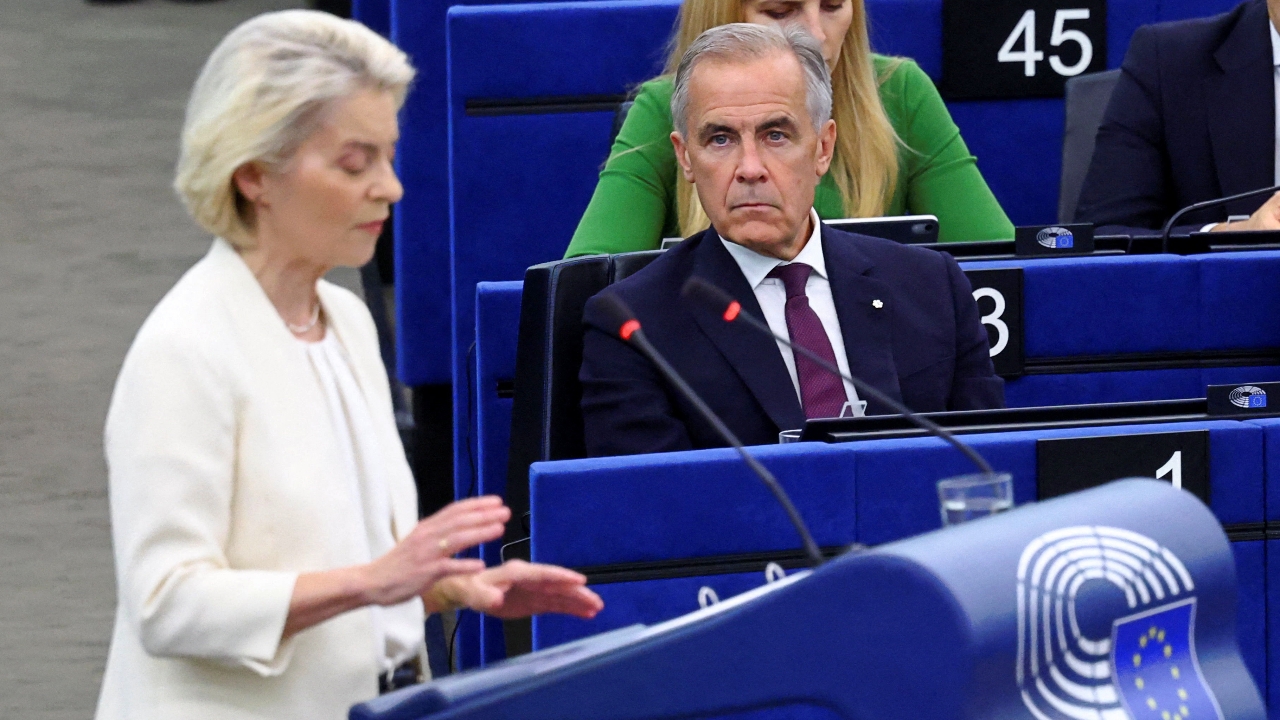
The President of the European Commission revealed that the European Union is ready to pave the way for Canada to become the group's first "associate member," despite this status not being defined in EU treaties. Meanwhile, Prime Minister Mark Carney is preparing to address the European Parliament amid tense Canada-US relations caused by US President Donald Trump's tariff measures.
Ursula von der Leyen, President of the European Commission, announced during her annual policy speech to the European Parliament in Strasbourg, France, that the European Union (EU) wants to open the way for Canada to become the EU's first "associate member," marking a major shift since this status is not established in EU treaties.
Von der Leyen spoke directly to Canadian Prime Minister Mark Carney, who was seated in the front row of the European Parliament, saying she wishes to work with Carney to make Canada the EU's first associate member. Carney received a standing ovation from Members of the European Parliament and is scheduled to deliver a speech to the Parliament on Thursday.
Von der Leyen stated that this partnership is a strategic option for Europe and a response to divisions in the international rules-based system. She said the EU and Canada share common views on key issues ranging from artificial intelligence, climate change, the Arctic, to geopolitics, including cooperation on Ukraine, defense, critical raw materials, and supply chains.
She emphasized that most importantly, Europe and Canada both believe in democracy. She proposed elevating relations through a comprehensive cooperation framework, building upon their free trade agreement (CETA) toward what she called a "partnership for the future," aimed at creating a zone of shared prosperity and economic security.
The proposed cooperation would cover advanced manufacturing, technology, defense industry, the Arctic, energy, critical minerals, batteries, artificial intelligence, quantum computing, cybersecurity, and economic security.
Von der Leyen also said the EU and Canada will collaborate on smart manufacturing, build a technology alliance, connect defense industry bases, and promote the Arctic as a key joint cooperation project. She stressed that the partnership "is not aimed against anyone" but to strengthen each other and seeks to raise relations with Canada to the highest possible level.
Earlier that same week, Carney said Canada wants to build a "distinctive partnership" with the EU but does not seek full EU membership. This stance comes amid significant tensions in Canada-US relations after failed trade negotiations last month, which led to retaliatory tariffs between the two countries.
Trump's tariff measures, along with repeated mentions of the idea of making Canada the 51st US state, have pushed the Canadian government to strengthen economic and security ties with Europe. Carney called for Canada to reduce its trade dependence on the US and build closer relations with Europe.
Canada has imposed retaliatory tariffs against the US and rejected trade conditions that Carney viewed as potentially undermining the country's sovereignty.
Meanwhile, the EU took a different approach in negotiations with the US government, reaching a trade agreement that capped US tariffs at 15 percent on most EU exports, while Europe agreed to remove tariffs on industrial goods from the US.
These differences emerged amid Carney's efforts to promote relations with Europe. Previously, in January at the World Economic Forum in Davos, Switzerland, he called on middle powers to cooperate to increase leverage amid intensifying great power competition.
Carney stated at that time that if countries negotiate bilaterally with a more powerful great power, they do so from a disadvantaged position and must accept terms set by the stronger party, questioning whether accepting such terms can be considered sovereignty.
Carney's Davos speech, which spoke about cooperation among middle powers and US economic pressure tactics, prompted a personal response from Trump. Von der Leyen's current proposal may further heighten tensions between the US and Canada.
The EU's proposal to grant Canada "associate member" status represents a new approach, as the EU has traditionally not supported flexible membership statuses. EU members have also reacted cautiously to Germany's proposal last May to grant Ukraine associate membership as a step toward full EU membership.
. . .Reuters/Associated Press