

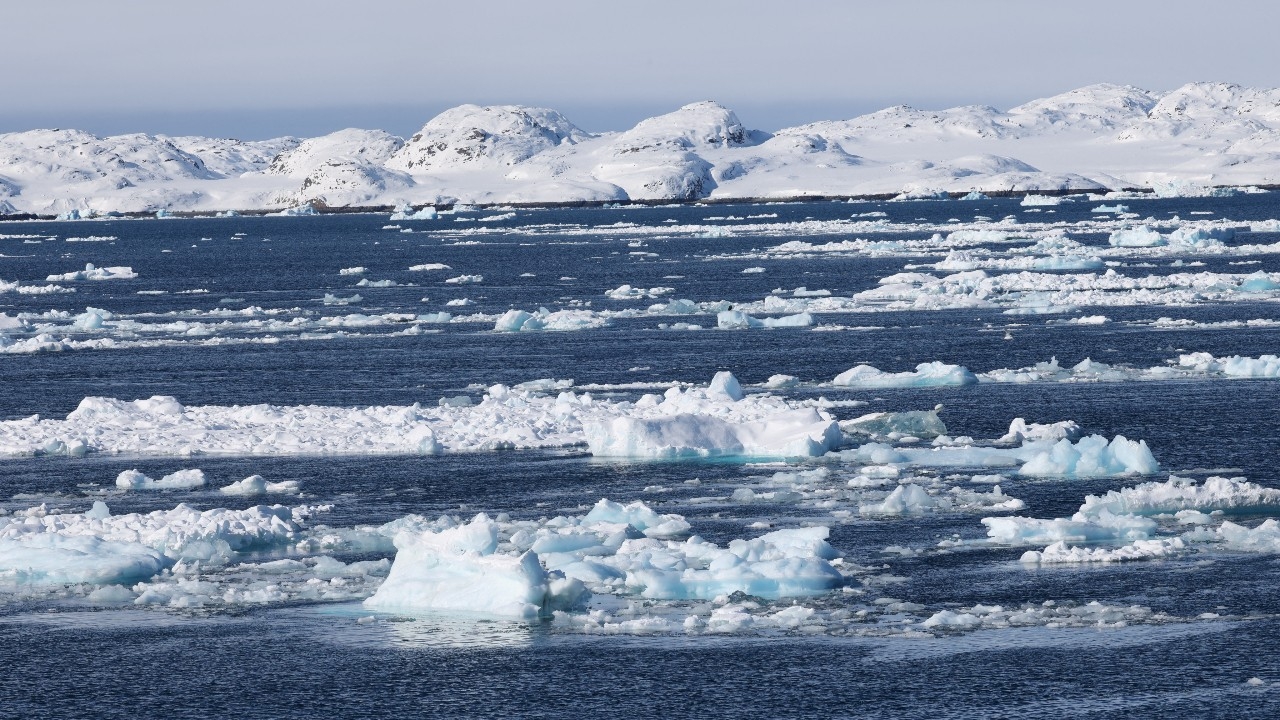
Recent research reveals that glaciers in Greenland and Antarctica have melted approximately 12.5 trillion tons since 1979, equivalent to ice that could cover the entire United States with a thickness of about 1.5 meters.
A study published in the journal Scientific Data states that since 1979, glaciers and ice sheets in Greenland and Antarctica have lost about 12.5 trillion tons—or 11.3 trillion metric tons—of ice. This vast amount is equivalent to ice that could cover the entire mainland United States with a thickness of roughly 1.5 meters.
International researchers note that the melting is accelerating due to climate change. Approximately five-sixths of the ice loss is not directly from warmer air but from warmer ocean waters eroding the ice sheets from below and the sides, causing glaciers to flow into the ocean more rapidly.
Eric Rignot, an ice scientist at the University of California, Irvine, and a co-author of the study, said the ice sheets are melting rapidly, and the loss of polar ice is raising global sea levels, increasing the vulnerability of coastal areas.
Satellite data analysis shows that all the melted ice has converted into nearly 3 trillion gallons—or about 11.3 trillion liters—of water, contributing to a global sea level rise of approximately 3.1 centimeters since 1979, in addition to other climate change factors causing sea level increases.
Ines Otosaka, an ice scientist at Northumbria University and lead researcher, said that although a one-centimeter rise in sea level may seem small, each additional centimeter puts an extra 2 to 3 million people at risk of flooding at least once a year.
Meanwhile, the Jakobshavn Glacier in Greenland, one of the fastest-changing glaciers, is retreating at a maximum rate of about 50 meters per day.
The acceleration of melting became especially pronounced during the 2010s.
The research team noted that during the 1970s, 1980s, and into the 1990s, the ice sheets remained relatively stable before melting began to increase and accelerate notably in the 2010s.
Although data from 2020 to 2023 indicated a temporary slowdown in ice loss, researchers say this was due to short-term weather variability and does not indicate a change in the long-term trend. Monitoring after 2023 shows the ice loss trend has accelerated again.
Researchers also warn that changes in ice sheets may lag behind global temperature rises by several decades. This means that even if humanity stops global warming, ice loss and its impact on sea levels may continue for decades.
:SourceAP
Click to read related news aboutInternational news