

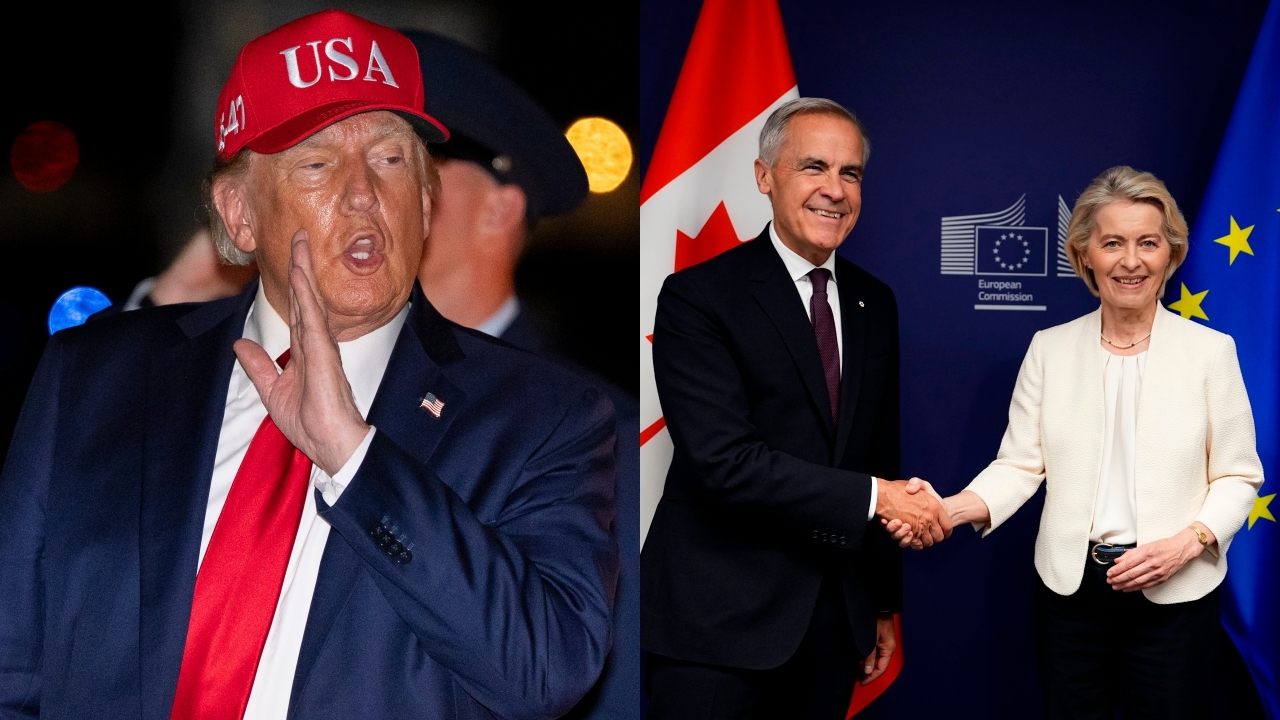
U.S. President Donald Trump criticized the European Union's proposal to allow Canada to become the group's first "associate member" as "laughable," threatening to impose high tariffs on European goods or possibly suspend some trade if he views this move as unfriendly to the U.S. Meanwhile, the EU and Canada are advancing cooperation in trade, technology, energy, and defense.
U.S. President Donald Trump threatened trade measures against the European Union after Ursula von der Leyen, President of the European Commission, proposed Canada as the EU's first "associate member." Trump called the proposal "laughable" and warned it could be seen as an act hostile to the U.S.
Trump told reporters while traveling to North Carolina on 16 September that if the EU goes ahead with this and he perceives it as unfriendly, the U.S. might impose very high tariffs or halt trade with Europe on many products. He added that if the EU's intentions are good, there is no problem, but if not, the U.S. will impose very high tariffs on European goods.
The EU proposal was made during Ursula von der Leyen's annual State of the Union address at the European Parliament in Strasbourg, France, with Canadian Prime Minister Mark Carney also in attendance.
Von der Leyen said she wants to open the way for Canada to become the EU's first associate member and proposed elevating the relationship from trade cooperation to a "partnership for the future," covering cooperation in advanced manufacturing, technology, defense industry, energy, critical minerals, batteries, artificial intelligence, cybersecurity, economic security, and cooperation in the Arctic region.
Currently, the EU, which has 27 member countries, has never officially had an "associate member" status. While the EU maintains close economic relations and agreements with non-member countries like Norway, Iceland, and Switzerland, details about the scope of Canada's associate membership, including its relationship with the EU single market, still require further definition.
This move comes amid rising tensions between Canada and the U.S., after the Trump administration imposed tariffs on Canadian goods, and Trump repeatedly mentioned the idea of making Canada the 51st U.S. state. Meanwhile, Prime Minister Carney previously said Canada seeks to build a "distinctive partnership" with the EU to diversify economic ties and reduce dependence on the U.S.
The Canadian government has expressed support for closer relations with Europe, viewing enhanced cooperation as a means to strengthen Canadian sovereignty. Trade relations between Canada and the EU already include the Comprehensive Economic and Trade Agreement (CETA).
Beyond economics, Canada is also expanding security cooperation. The Carney government officially announced Canada's application to join the Joint Expeditionary Force (JEF), a military cooperation led by the United Kingdom, consisting of 10 NATO European countries, to enhance rapid crisis response capabilities.
Meanwhile, Benjamin Haddad, France's Minister for European Affairs, rejected U.S. claims of authority to block the EU's geopolitical decisions, stating that Europe's political and geopolitical direction is for Europe to decide, and the EU has the right to strengthen ties with Canada.
Carney is scheduled to address the European Parliament on 17 September amid close attention to how Canada will proceed with its EU relationship. Details of the "associate member" status remain unresolved and are expected to be further discussed between Canada and the EU at a summit in October.