

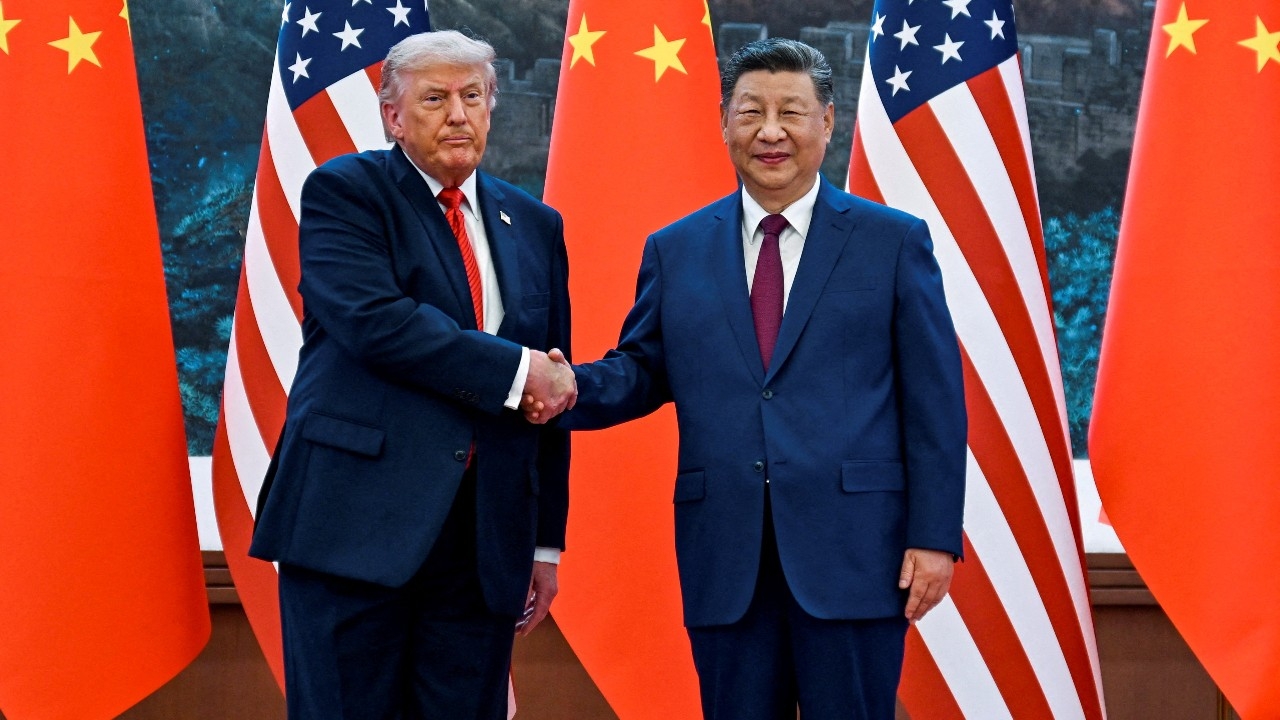
The Chinese government has confirmed that President Xi Jinping will visit the United States from 23 to 25 September to meet President Donald Trump. Key issues expected to be covered include trade, technology, artificial intelligence, Taiwan, and China's role in the Iran conflict, while both sides watch closely to see if the trade war can be resolved.
The Chinese government confirmed that President Xi Jinping will visit the United States from 23 to 25 September at the invitation of President Donald Trump, marking the second meeting between the two leaders within six months.
China's Ministry of Foreign Affairs stated that Xi Jinping and Trump will hold in-depth talks on key aspects of China-U.S. relations as well as global peace and development, emphasizing that China will work with the United States to promote stable strategic relations, strengthen dialogue and cooperation, and properly manage differences.
The U.S. side said Trump will personally welcome Xi Jinping at Andrews Air Force Base before their talks the next day. Trump told reporters aboard Air Force One on Sunday that he plans to discuss "virtually every issue" with the Chinese leader.
The most important issue at this meeting is trade relations, which remain under an agreement designed to avoid escalation of the tariff war between the two countries, although both sides have yet to reach a long-term deal.
A Reuters report indicated that the meeting on 24 September may focus on whether the leaders will signal an extension of the trade war truce agreed last year, while analysts believe Xi Jinping is not in a position to rush concessions and may only seek to maintain trade stability to give China time to handle ongoing economic and strategic pressures.
Ahead of the leaders' meeting, U.S. Treasury Secretary Janet Yellen and Chinese Vice Premier He Lifeng, a key economic and trade negotiator, met in New York to discuss AI security, trade, and rare earth minerals. These talks aim to pave the way for agreements on AI regulation and non-sensitive trade goods.
However, this outlook contrasts with Trump's stance upon returning to the White House in 2025, when he announced a tax policy to address the trade deficit with China, viewing trade with China as damaging to the U.S. economy.
At the same time, China continues to face slowing domestic consumption and a prolonged real estate crisis, although its export sector is still growing steadily, pushing China toward a trade surplus exceeding 1 trillion U.S. dollars with the world for the second consecutive year.
Meanwhile, a delegation of Chinese business leaders from major companies plans to accompany Xi Jinping to Washington, D.C., potentially including executives from BYD, CATL, and Xiaomi, some of which are currently under U.S. regulatory scrutiny or restrictions.
Besides trade, Taiwan is likely another key topic in this meeting. China regards Taiwan as part of its territory, while the U.S. maintains security relations and arms sales to Taiwan. Trump revealed that Xi Jinping asked multiple questions about Taiwan during their May meeting in Beijing, including U.S. arms sales and America's commitment to Taiwan's defense.
Trump described the $14 billion arms package to Taiwan under consideration as a "bargaining chip" with China, raising concerns in Taiwan and Japan that this issue might be linked to economic negotiations between the U.S. and China.
One possible negotiation point could be China increasing purchases of Boeing aircraft and U.S. agricultural products, along with cooperation to block fentanyl precursors, a key issue for the U.S. government.
Another important issue for the U.S. is China's role in the Iran conflict. The U.S. views China as one of the few countries with enough economic and diplomatic influence to pressure Iran to end its conflict.
However, China has yet to indicate it will apply pressure at the level the U.S. desires. Reuters previously reported that China continues to export billions of dollars in goods to Iran via channels alleged to circumvent U.S. sanctions, although China's Ministry of Foreign Affairs said it is unaware of such programs.
The U.S. has threatened sanctions on countries doing business with Iran, though so far these measures have not been applied to China, which remains one of Iran's largest trading partners.
Analysts see the Trump administration's efforts to maintain stable relations with China as reflecting both sides' desire to avoid further conflict, while the U.S. manages the Iran conflict and China seeks time to strengthen its domestic economy to prepare for future uncertainties.