

Meta, the owner of the major social media platform, announced its success in cooperating with the Singapore Police Force throughout this year. It has managed to remove over 3.7 million fake accounts, pages, and "empty pages" used as infrastructure by scam gangs, cutting off their operations before they cause harm to the public.
Meta, the provider of Facebook and Instagram, stated it has removed or restricted access to more than 3.7 million accounts, pages, and content related to fraudsters this year. This was done with support from the Singapore Police Force (SPF) under a two-year intelligence-sharing partnership. Meta said this cooperation enabled investigative teams to identify and dismantle entire scam networks instead of dealing only with individually reported accounts.
From January to June, Meta took action against more than 113,000 accounts and pages involved in scams and fraud on Facebook and Instagram, mostly related to investment scams that often use high-return offers or guaranteed profits to lure victims. The company said that police data allowed it to act on five times more assets than the number of reports received.
Meta revealed that in July, it addressed over 3.6 million accounts and pages, with approximately 3.64 million being so-called "empty pages". These are pages without content or serious use but created and prepared as infrastructure for fraudsters to activate in future scam campaigns.
The company explained that such pages may appear empty and harmless since they have no ads or content violating rules, but they can be quickly used once scammers begin operations. Meta views these empty pages as a new form of scam channel detected through its partnership with Singapore police.
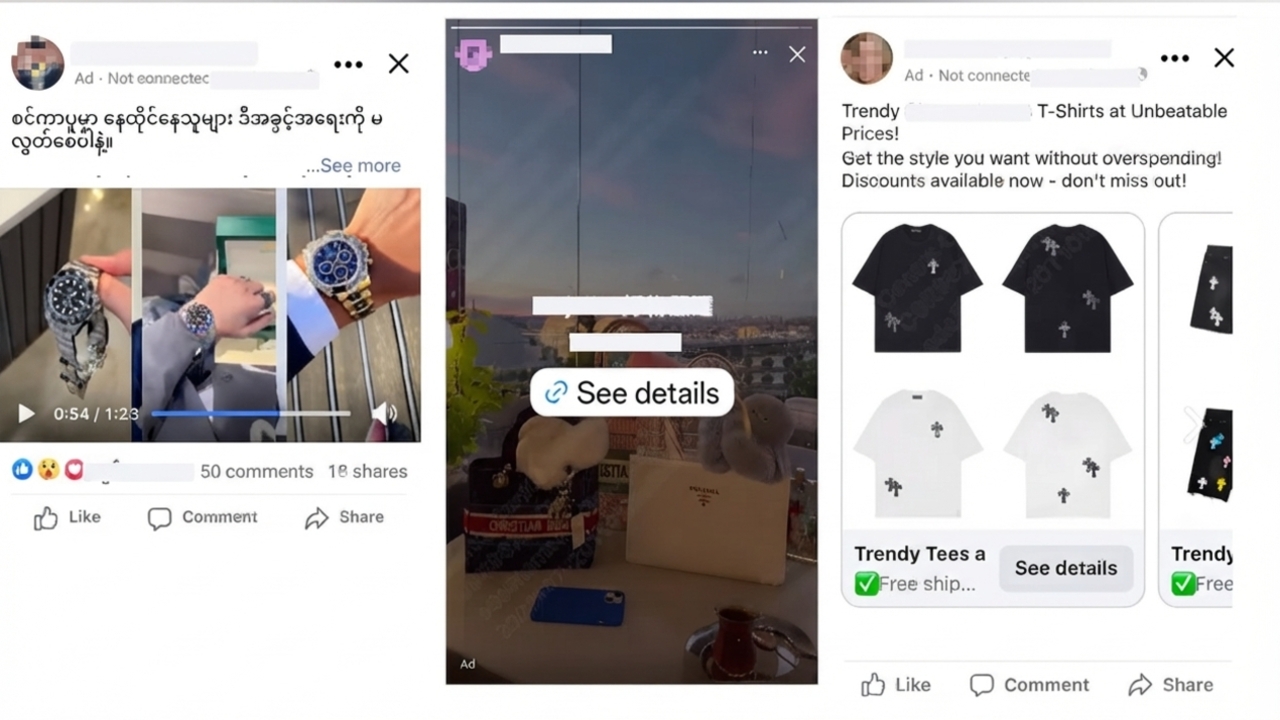
Additionally, in June, Meta and the Singapore Police jointly conducted operations to block e-commerce scams ahead of the school holiday period, when many families seek travel deals. They took action against more than 33,600 related accounts and pages.
The content handled included misleading product pricing, fake promotions of well-known brands, exaggerated product claims, and pressure tactics urging consumers to make quick purchases by claiming limited stock availability.
Clara Koh, Meta's Southeast Asia public policy director, said that fraudsters now operate on an industrial scale, using artificial intelligence (AI) to create numerous fake profiles, generate fake images, and write harmful code.
She stated that Meta continues to invest in developing protective systems across its platforms and accelerates the detection of scam content violating policies, especially before users encounter such content.
Daryl Poon, Meta's regional director for law enforcement coordination in Asia Pacific, said that fraudsters exploit the fact that no single organization can see the entire scam network. However, cooperation with Singapore Police allows the company to detect threats that might otherwise go unnoticed and dismantle networks widely before they reach many victims.
Justin Wong, commander of the Singapore Police's Cyber Command, said that tackling complex scam networks requires collaboration among law enforcement agencies, private organizations, and international partners.
He noted that exchanging signals and data about scams enables partner companies to act against the criminal infrastructure behind scams. Recent operations demonstrate the effectiveness of police and private sector cooperation in cutting off channels used by fraudsters to deceive Singaporeans.
Meta also stated that its data previously helped Singapore Police arrest seven men last year suspected of involvement in a transnational illegal online gambling network.
Beyond enforcement, Meta, Singapore Police, and the National Crime Prevention Council (NCPC) jointly launched an educational program under the "One Step Ahead" campaign to encourage the use of security measures such as two-factor authentication and Passkeys for Facebook and Instagram, along with device alert features on WhatsApp.
The campaign also promotes the ScamShield website, which provides information on scam types and online protection methods. Meta disclosed that the program has reached approximately 1.6 million people in Singapore.
The company emphasized that scams are a global problem crossing platforms, apps, and national borders. It stressed that rapid information sharing and coordinated actions among agencies are key strategies to combat organized crime networks.