

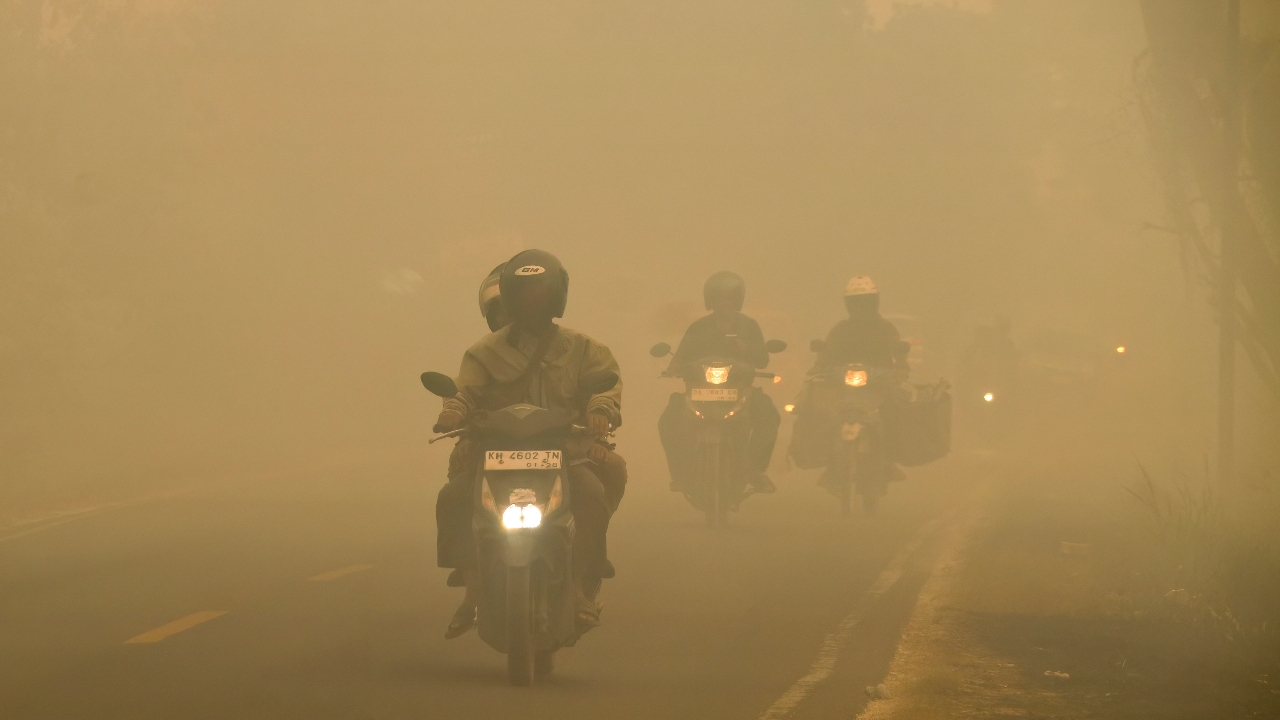
Indonesia's Ministry of Health revealed that over 174,000 cases of acute respiratory infections have been reported in areas affected by forest fires and land burning from August to 21 September. Among these, nearly 40,000 are young children. Toxic haze covers many parts of Indonesia as well as neighboring countries such as Malaysia, Singapore, and the Philippines.
The Indonesian Ministry of Health reported 174,694 cases of acute respiratory infection (ARI) in regions impacted by forest and land fires between August and 21 September. Of these cases, more than 40,000 are young children.
These figures were gathered from seven provinces affected by the haze and represent an increase from over 113,000 cases reported on 9 September, highlighting the health impact on the population amid prolonged forest fires lasting several weeks.
Forest fires on the islands of Borneo, Sumatra, and Papua have caused haze to blanket many areas of Indonesia, a country with more than 280 million people, as well as neighboring nations like Malaysia and Singapore. This has led to air quality indexes in many locations dropping to hazardous levels.
Then Suyanti, an official from Indonesia's Ministry of Health, stated that the haze contains various pollutants, including fine particulate matter PM2.5, which is smaller than human hair and can penetrate the respiratory system, increasing the risk of infections and other health problems.
The Ministry of Health has dispatched aid to affected areas, including oxygen concentrators, face masks, and oxygen tanks, and has advised the public to reduce outdoor activities when air quality deteriorates, wear masks, and stay well hydrated.
Indonesia regularly faces forest fires during the dry season, typically from July to October. However, this year the situation has worsened due to the El Niño phenomenon, expected to be the strongest since records began about 40 years ago.
The Nusantara Atlas fire monitoring platform detected approximately 734,000 hotspots nationwide as of 23 September, exceeding the severe fire season of 2019 by more than 30%. Since the start of the year, at least 895,657 hectares (nearly 5.6 million rai) have burned—almost six times the size of Greater London.
The Indonesian government has mobilized over 54,000 personnel and dozens of aircraft to conduct water-dropping operations to extinguish fires on Borneo and Sumatra. However, the vast area and difficult peatland terrain complicate firefighting efforts.
Teddy Indra Wijaya, Secretary of the Indonesian Cabinet, said that officials continue to work both from the air and on the ground to extinguish fires, reduce smoke impact, and protect the public from threats posed by forest and land fires.
The forest fire crisis has forced some schools to suspend classes, and hospitals across Indonesia have reported increased admissions. The number of respiratory patients linked to the fires more than doubled from 50,891 on 1 September to 113,336 by 9 September, according to Ministry of Health data.
The impact extends to wildlife, particularly the critically endangered orangutans. The Indonesian Wildlife Conservation Foundation released images of an orangutan struggling on the ground in an oil palm plantation in West Kalimantan, one of the hardest-hit areas. The animal was found by farmers, rescued, treated for oxygen deficiency, but later died.
Last week, indigenous groups and civil society in West Kalimantan filed a class-action lawsuit against the central and local governments, accusing them of neglecting their duties in managing the spreading forest fires. The groups’ lawyer stated that the recurring annual haze reflects failures in disaster prevention and risk management.
In recent weeks, Indonesia has conducted multiple cloud seeding operations, some with cooperation from members of the Japan Self-Defense Forces, who arrived on Borneo earlier this month to assist firefighting efforts.
Cloud seeding involves stimulating existing clouds to produce rain by dispersing salt crystals or silver iodide into the clouds. However, meteorologists remain divided on the effectiveness of this method.
Malaysia's Sarawak state, one of the regions outside Indonesia severely affected by haze, conducted a five-day cloud seeding campaign earlier this month. Besides addressing the haze, the operation aimed to raise water levels in several hydropower dams ahead of the anticipated severe dry season in October.
Douglas Unggah Embas, Deputy Chief Minister of Sarawak, warned that October may bring hotter and drier conditions, emphasizing the need to maximize dam water levels before the weather worsens.
Meanwhile, haze from the forest fires has drifted as far as parts of the Philippines, where local authorities have urged residents to stay indoors as much as possible. Singapore has begun issuing daily haze alerts to inform the public about air quality and health precautions.