

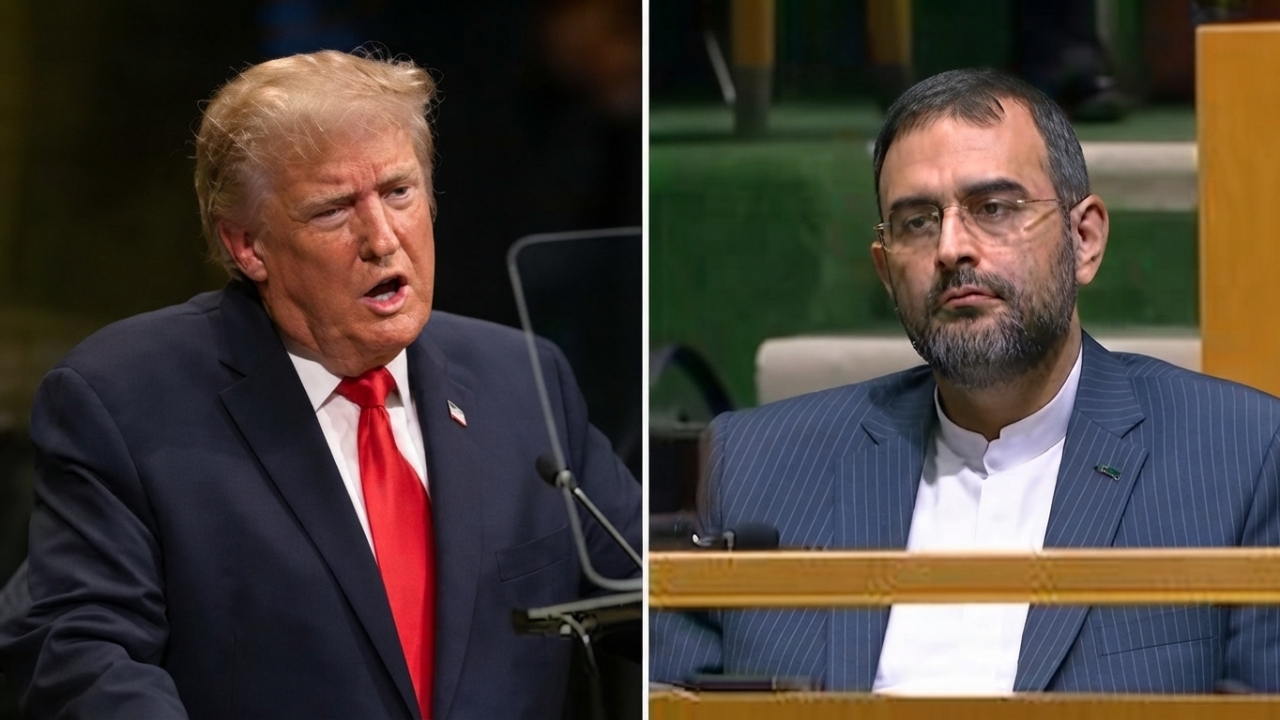
President Donald Trump revealed that U.S. and Iranian representatives met for about three hours on the sidelines of the United Nations General Assembly in New York, following his UN speech warning that the U.S. might "destroy" the Islamic Republic of Iran if an agreement to end the nearly seven-month conflict was not reached.
Trump said that Steve Witkoff, the U.S. special envoy, and Jared Kushner, his representative, met with Iranian officials. He described the meeting as positive but did not disclose much about the Iranian participants or the substance of the talks, saying only that it was "a very good meeting" and acknowledging that the Iranian officials involved were "not the highest level" but considered a step forward.
Witkoff stated on X that the discussions were conducted through intermediaries who traveled between the U.S. and Iranian delegations throughout the day, expressing hope that these efforts would lead to constructive outcomes and progress.
This development follows a months-long pause in U.S.-Iran contacts since a ceasefire agreement brokered by mediators ended in June. Previously, negotiators from both sides met with intermediaries from Qatar and Pakistan in Doha in July to indirectly discuss ending the conflict.
Earlier that day, U.S. Secretary of State Marco Rubio said Trump was open to meeting with Iranian President Masoud Pesechkian during the UN General Assembly, emphasizing that dialogue with adversaries is essential for resolving issues, even if agreement on all points is unlikely.
In his UN General Assembly speech, Trump stated he faced a major decision on whether to proceed with a deal with Iran or take further military measures, warning that if no agreement is reached, he might swiftly "destroy the Islamic Republic."
Trump also called on Iran to fully open the Strait of Hormuz and return to negotiations to end the war, while Iran dismissed his remarks as propaganda, with its military declaring readiness to retaliate if further attacks occur.
The nearly seven-month war between the U.S. and Iran has impacted regional security and the economy, including global energy markets, especially oil transit through the Strait of Hormuz, with oil prices remaining high due to supply concerns and shipping route security.
After his speech, Trump conducted several diplomatic engagements, meeting with leaders and senior officials from Gulf Cooperation Council (GCC) member states—Bahrain, Kuwait, Oman, Qatar, Saudi Arabia, and the United Arab Emirates—as well as Jordan, to discuss approaches regarding the Iran conflict.
Additionally, Trump met with leaders including the UK’s Andy Burnham, Japanese Prime Minister Sanae Takaichi, South Korean President Lee Jae-myung, Ukrainian President Volodymyr Zelenskyy, and acting Venezuelan President Delcy Rodriguez.
Trump also signed a new security agreement with Danish Prime Minister Mette Frederiksen and Greenland’s Prime Minister Jens-Frederik Nielsen. The agreement confirmed Greenland remains a Danish territory, but the U.S. will proceed with expanding military capacity and infrastructure there, including constructing two large military bases.
Trump addressed the Russia-Ukraine war, affirming his desire for a swift end to the conflict while expressing frustration at its prolongation, noting he had previously predicted the war could have ended during the first day of his second term.
Trump also mentioned new U.S. sanctions legislation against Russia that he signed the previous week, allowing tariffs up to 100% on imports of oil or natural gas from the top five countries importing from Russia. However, he has not yet enforced these measures, stating that the U.S. is prepared to use them if necessary to end the fighting.
/sourceAssociated Press