

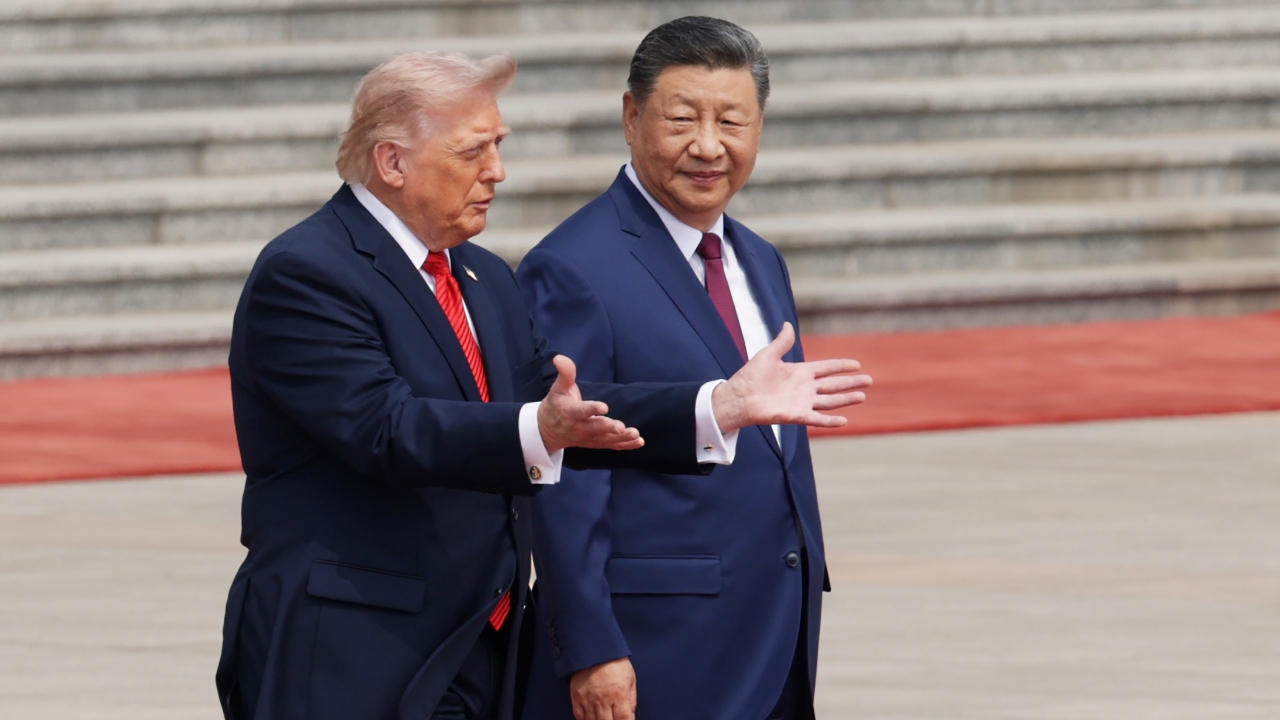
Insider sources reveal that China's President Xi Jinping plans to raise the Taiwan issue and pressure U.S. President Donald Trump during his U.S. visit to stop arms sales to Taiwan based on the 1982 joint communiqué. China may offer assistance in pressuring over the Middle East war in exchange, while Taiwan confirms close coordination with the U.S. to push forward planned arms deliveries.
China’s President Xi Jinping is expected to pressure U.S. President Donald Trump to halt arms sales to Taiwan during his visit to Washington this week, possibly citing the 1982 U.S.-China joint communiqué as justification, three sources familiar with pre-summit U.S.-China discussions told Reuters, requesting anonymity due to the sensitivity of the matter.
Under the 1982 joint communiqué, the U.S. expressed its intention to gradually reduce arms sales to Taiwan and stated it did not intend to supply weapons to Taiwan long-term. However, the accompanying memorandum from then-President Ronald Reagan noted that the U.S.'s willingness to reduce arms sales depended entirely on China’s continued commitment to resolving differences with Taiwan peacefully.
China regards Taiwan, governed democratically, as Chinese territory and has consistently demanded that the U.S. cease arms sales to Taiwan. Meanwhile, Taiwan rejects China’s sovereignty claims, affirming that Taiwan’s future should be determined by its own people.
Although the U.S. and Taiwan have no formal diplomatic relations, U.S. law requires providing Taiwan with necessary means for self-defense. The U.S. policy adheres to the “One China” principle, without officially recognizing Taiwan’s sovereignty, acknowledging China’s position that Taiwan is part of China without endorsing that stance.
Sources indicate that China may demand not only that the U.S. stop approving new arms sales to Taiwan but also suspend deliveries of previously ordered weapons. China might offer assistance in pressuring Iran regarding the Middle East conflict as a reciprocal gesture.
One source said Xi Jinping may emphasize to Trump that Taiwan is provocative and the root cause of instability in U.S.-China relations, including altering the status quo in the Taiwan Strait. However, these allegations reflect China’s perspective, according to the source.
China has significantly increased military activities around Taiwan over the past five years, including live missile exercises, with Chinese forces operating near Taiwan almost daily. China has never renounced using force to unify Taiwan with the mainland.
China’s Foreign Ministry stated that China "strongly opposes" U.S. arms sales to Taiwan and regards adherence to the three joint communiqués and previous U.S. commitments on Taiwan as "necessary conditions" for stable and positive U.S.-China relations.
Last December, the Trump administration approved an arms sales package to Taiwan worth about 11 billion U.S. dollars (approximately 390 billion baht), the largest ever approved. Another package valued around 14 billion dollars (about 450 billion baht) has been suspended for several months.
After a summit with Xi Jinping in Beijing last May, Trump said he was still delaying that package and called the arms sales a "very good bargaining chip," while U.S. weapons manufacturers have been affected by the delays.
White House officials said Trump plans to decide on the new arms package soon, noting that during his first presidential term, Trump approved more arms sales to Taiwan than any other U.S. president in history, and in his second term, he approved within the first year more than the total four-year sales under President Joe Biden.
Under the "Six Assurances" given by the U.S. to Taiwan in 1982, publicly disclosed in 2020, the U.S. did not set a timeline for ending arms sales to Taiwan nor agreed to consult China before such sales.
Taiwan stated it will continue close coordination with the U.S. to push forward planned arms sales and deliveries. Deputy Defense Ministry spokesperson Chiao Fu-chun told reporters in Tainan that maintaining security and stability in the Indo-Pacific region is a "shared interest among democracies," adding that the U.S. government and Congress have consistently supported Taiwan’s self-defense capabilities.
He said Taiwan will maintain close contact with the U.S. Department of Defense and proceed with planned arms deliveries. Taiwanese Premier Su Tseng-chang expressed strong confidence in the future of Taiwan-U.S. relations.
Xi Jinping is scheduled to arrive in Washington on 23 September, with official talks with Trump set for Thursday, 24 September. His visit to the U.S. National Archives is planned for Friday, 25 September, where sources say he may again raise the 1982 joint communiqué issue.