

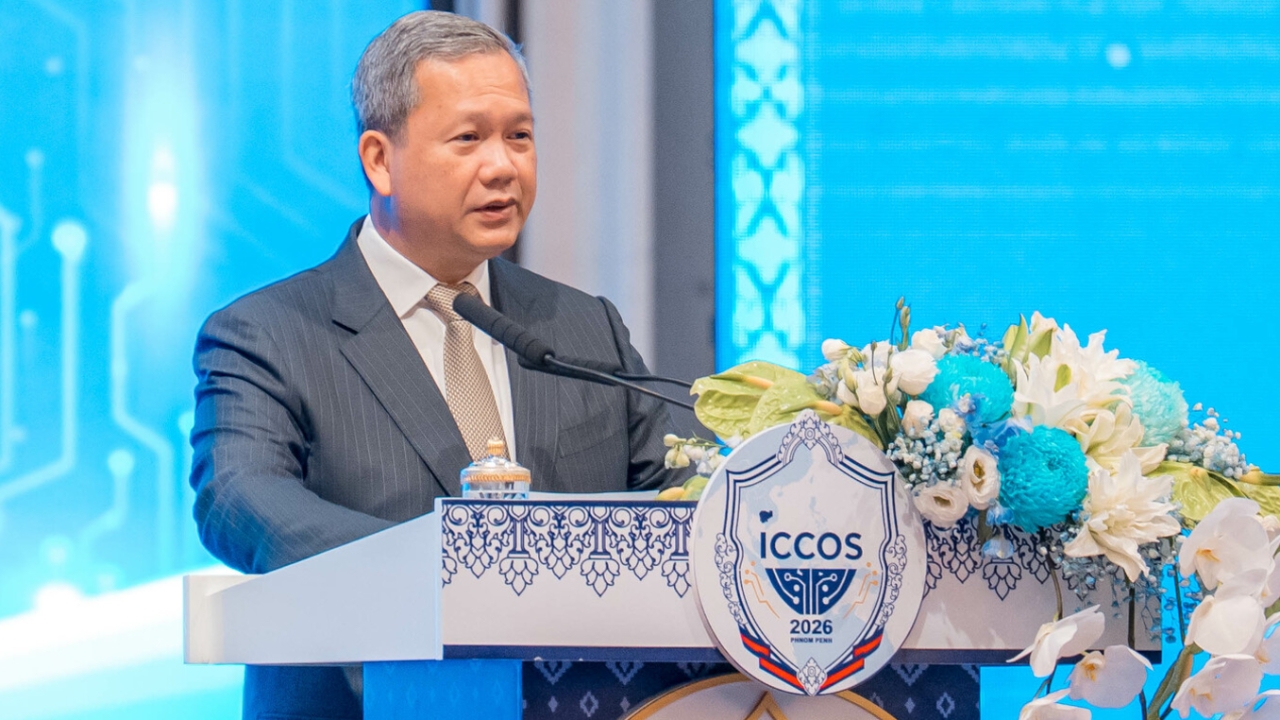
Prime Minister Hun Manet declared that Cambodia will not allow the country to serve as an operational base or “safe haven” for call center gangs, reaffirming a serious policy to combat cybercrime. He stated Cambodia has “completely dismantled all small-scale call center gangs and online fraudsters.”Tags: [Cambodia, cybercrime, call center gangs, law enforcement] Authorities reported that from July 2025 to 31 August 2026, they have frozen over 300 million U.S. dollars in bank accounts linked to fraud gangs and filed 446 cases involving 3,927 suspects for prosecution.Tags: [fraud, financial crime, prosecution, Cambodia]
Speaking as chair of the International Conference on Combating Online Scams (ICCOS-2026) held in Phnom Penh on 23-24 September under the theme “Collaborating to Cut Off and Eliminate Online Scams,” Cambodian Prime Minister Hun Manet announced that Cambodia will not be a “safe haven” for online scams and affirmed the government’s firm commitment to crackdown on transnational criminal networks.Tags: [international conference, online scams, Cambodia, cybercrime]
Hun Manet stated that Cambodia wants to clearly show its stance that the country will not be a safe haven for online scam operations. He emphasized that addressing transnational cybercrime requires strong leadership, efficient governance, and the courage to tackle systemic vulnerabilities and complex problems directly.Tags: [government policy, cybercrime, leadership, Cambodia]
The Cambodian Prime Minister confirmed the government’s policy of “zero tolerance for online scams, with no exceptions and no retreat,” adding that law enforcement is an ongoing national security mission rather than merely a public relations campaign.Tags: [zero tolerance policy, law enforcement, national security, Cambodia]
Hun Manet announced, “Currently, there are no remaining online scam operation bases” within Cambodia’s sovereign territory. He added that government measures aim not only to dismantle existing criminal networks but also to prevent their reestablishment and to restore international confidence in the economy, investment climate, tourism, and public safety.Tags: [scam operations, dismantling, prevention, Cambodia economy]
However, Hun Manet warned that criminal networks might adapt by splitting into smaller, more dispersed groups to evade crackdowns and potentially target Cambodian citizens directly. He called on relevant agencies and the international community to enhance cooperation in addressing these challenges.Tags: [criminal adaptation, law enforcement cooperation, Cambodia]
Southeast Asia, particularly Cambodia and Myanmar, has become a key hub for transnational criminal networks conducting online scams, involving both voluntary participants and human trafficking victims forced to work in scam operation sites.Tags: [Southeast Asia, human trafficking, online scams, criminal networks]
Scam methods range from creating fake relationships to trick victims into transferring money, to enticing investments in cryptocurrency or fraudulent schemes, causing losses worth billions of dollars annually.Tags: [scam methods, cryptocurrency fraud, financial losses]
The Cambodian government confirmed that online scam problems do not originate from Cambodia nor are they confined to its borders. The influx of such networks partly relates to the growth of online gambling and casino businesses before transnational criminals adapted their operations to exploit real estate, regulatory gaps, and cross-border telecommunications networks.Tags: [origin of scams, gambling industry, regulatory gaps, Cambodia]
Meanwhile, some researchers indicate that after crackdowns, some scam gangs relocate to smaller, less visible sites. There are allegations that certain centers received advance notice before raids.Tags: [research findings, scam relocation, raid allegations]
Data from Cambodia’s Special Task Force to Combat Online Scams (CCOS) shows that from July 2025 to 31 August 2026, authorities have frozen over 300 million U.S. dollars in bank accounts linked to online scam crimes.Tags: [financial seizure, CCOS, Cambodia]
During the same period, 446 cases involving 3,927 suspects were submitted to the courts. Additionally, authorities prosecuted 15 government officials implicated in online scam activities across four cases, including a deputy prosecutor, deputy director of immigration, deputy commander of Phnom Penh municipal police, a former foreign ministry director-general, as well as police and military officers.Tags: [legal cases, government corruption, Cambodia]
Reports state that specialized law enforcement officers inspected 832 suspected sites and conducted raids at 663 locations, successfully seizing control of 86 large scam operation centers. Legal processes are underway to confiscate assets from these sites.Tags: [law enforcement raids, asset seizure, Cambodia]
Earlier, the Cambodian government reported that nationwide crackdowns over the past year have examined numerous sites, including those related to casino businesses and online scam networks, with many suspects brought to justice.Tags: [nationwide crackdown, casinos, prosecution, Cambodia]
Delphine Chance, regional representative of the United Nations Office on Drugs and Crime (UNODC), praised Cambodia’s efforts but warned that further actions are needed at national, regional, and international levels.Tags: [UNODC, international cooperation, Cambodia]
Yang Weilin, Deputy Minister of China’s Ministry of Public Security, commended Cambodia-China cooperation, stating no country can tackle this issue alone. However, he cautioned that the international community must recognize that the underlying conditions enabling telecom-based fraud have not yet been fully eliminated.Tags: [China, international cooperation, telecom fraud]
Meanwhile, Stephen Flores of the U.S. Federal Bureau of Investigation (FBI) emphasized that law enforcement cooperation must be based on trust and shared responsibility in combating crime.Tags: [FBI, law enforcement cooperation, trust]
U.S. data indicates that in 2025 alone, transnational criminal organizations in Southeast Asia defrauded Americans of at least 18.2 billion U.S. dollars through technology-enabled scams. Analysts warn that protection networks involving influential figures, financial infrastructure, and scam operation sites remain, potentially allowing operators to relocate or regroup.Tags: [U.S. data, Southeast Asia, financial fraud, criminal networks]
The ICCOS-2026 international conference on combating online scams was held in Phnom Penh on 23-24 September, with representatives from over 20 countries—including China, the United States, ASEAN nations—as well as Interpol, UNODC, and the Lancang-Mekong Law Enforcement and Security Cooperation Center (LMLECC) participating.Tags: [ICCOS-2026, international conference, Cambodia]
The main objectives of the conference were to understand the evolution of online scam networks, strengthen international cooperation and coordination, and exchange experiences and best practices in disrupting transnational criminal networks.Tags: [conference goals, international cooperation, cybercrime]
Organizers also anticipate endorsing the “Phnom Penh Declaration on Combating Online Scams” on 24 September, demonstrating the shared commitment of countries to cut off and eliminate online scam networks, a transnational crime requiring international collaboration.Tags: [Phnom Penh Declaration, international commitment, cybercrime]