

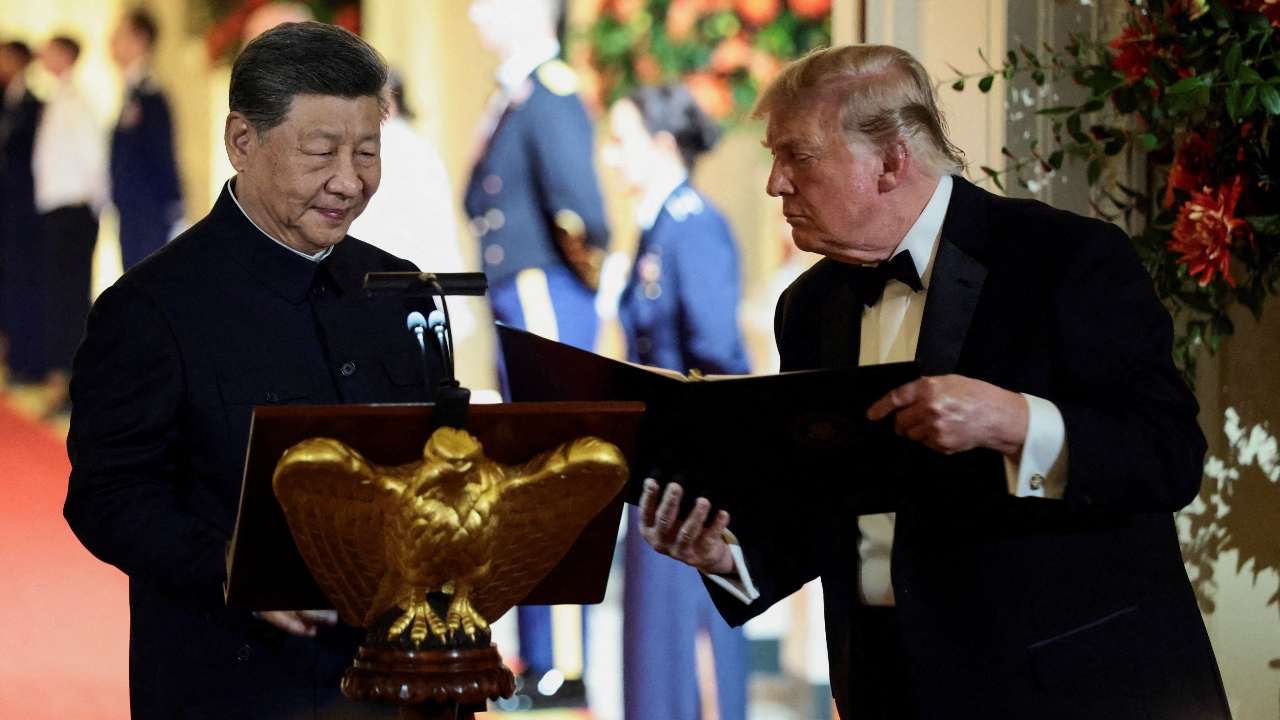
An inside look at the US-China leaders' talks reveals five main outcomes: extended trade agreements, the Taiwan issue, military confrontation risks, and differing views on AI management.
A summary of the discussion between Donald Trump and Xi Jinping at the White House highlights key issues reflecting both cooperation and differences between the US and China, focusing on five main points to watch.
1. The US and China extend the trade agreement but only as a temporary truce.
The US and China agreed to extend their trade truce by another two months after the original agreement, which helped end the trade war last year, was set to expire in November.
US Treasury Secretary Scott Bessent stated that the extension allows more time for economic talks but does not yet establish a long-term deal to resolve major conflicts.
Outstanding issues for further negotiation include tariff rates, China's purchase of US agricultural products, supply of rare earth minerals, and technology restrictions.
Bessent noted China is following the original deal by purchasing 25 million tons of US soybeans but has yet to meet the $17 billion target for other agricultural goods. US officials also say China's delivery of rare earth minerals remains below agreed levels.
For businesses, the extension eases short-term tariff pressures but uncertainty remains as key issues await further negotiation rounds.
2. Trump gives Xi Jinping a grand welcome.
Xi Jinping's visit to the White House was an opportunity for Trump to present Washington as he wished.
After Xi once showed Trump Ming Dynasty temples and walled gardens in Beijing rarely open to foreigners, Trump reciprocated with a colorful welcome ceremony.
US troops wore historical wigs and tricorne hats, marching with music in the Rose Garden, recently redesigned to resemble a golf course favored by Trump.
During two days of ceremonies, fighter jets and bombers flew overhead while Trump toured Xi around the White House, showing Marine One helicopter, the newly renovated south lawn, and a large helicopter pad adorned with the presidential seal.
When asked about policy talks with Xi, Trump gave few details, saying only that he liked good granite and called the meeting "great."
3. Xi Jinping urges the US to handle Taiwan issue with caution.
Taiwan remained a key discussion topic, with Xi calling on the US to manage Taiwan-related matters carefully, according to Chinese state media.
Chinese reports also said Xi hoped the US would oppose Taiwan's independence—stronger language than the US's previous stance of not supporting Taiwan's formal independence.
However, there was no sign the Trump administration planned to change its wording, and the White House did not immediately release details about this part of the talks.
4. The 'Thucydides Trap' risk of US-China military confrontation.
Xi brought up the 'Thucydides Trap' theory, which explains how rising powers competing with established ones may lead to conflict or war.
He said this risk can be overcome, emphasizing that both the US and China benefit from cooperation and only lose from confrontation.
The Chinese leader also called for regular military talks and improved crisis prevention mechanisms to reduce misunderstandings or clashes.
Trump referenced the shared history between the two countries, citing US-China cooperation during the war against Japan as an example, and said they could accomplish much by working together on shared interests.
5. US and China remain divided on AI.
Another important topic was artificial intelligence (AI), where the two leaders held differing views.
Trump, who has called AI 'superintelligence' (SI), stated on social media that he wants AI development to proceed without new restrictions and seeks oversight from the US Department of Justice, noting China has a similar approach.
Xi said that as leaders in AI, both countries have the potential and responsibility to develop and manage AI for human benefit, stressing AI development must remain under human control and aim to benefit the public.
The White House dinner honoring Xi also included prominent figures in technology and AI, such as Alphabet CEO Sundar Pichai, OpenAI CEO Sam Altman, and Nvidia founder Jensen Huang.
Source:channelnewsasia
Click to read related newsInternational news