

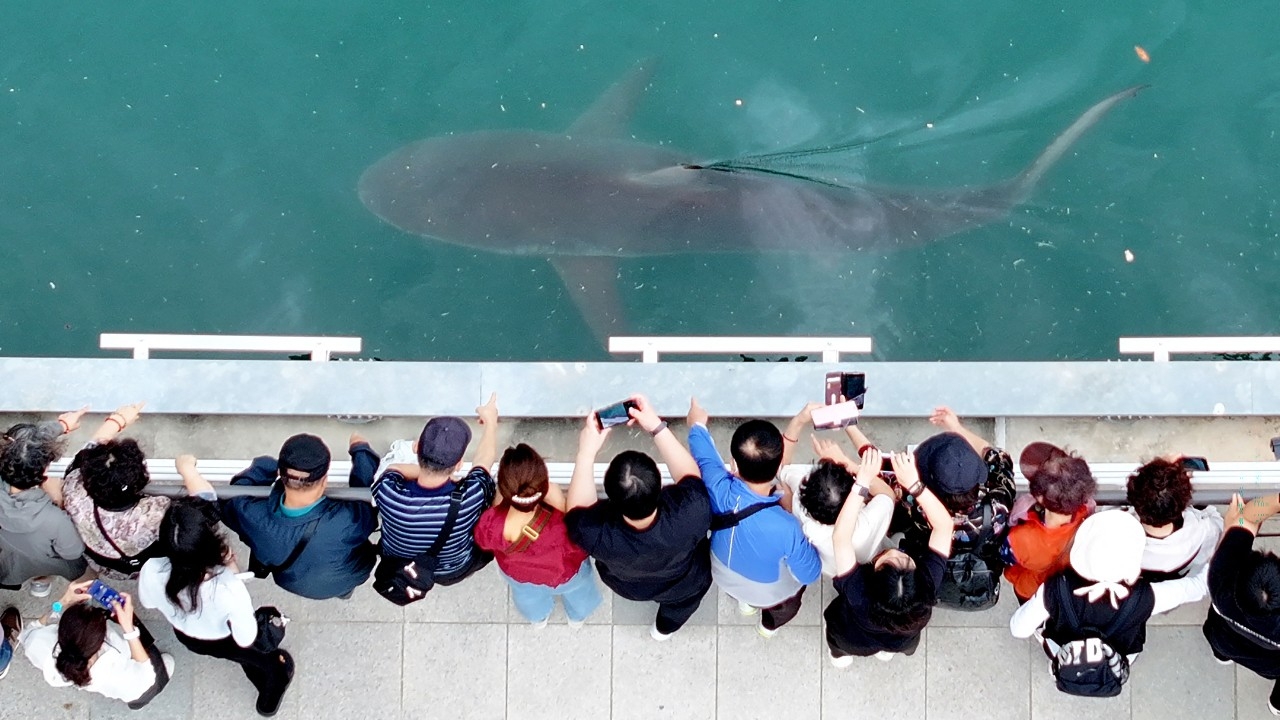
A 3.5-meter-long shark lost in the artificial waterway near Busan's North Port has gone viral in South Korea, attracting over half a million tourists and being appointed as the city's honorary promotional ambassador. Meanwhile, scientists warn that the shark's appearance in this area may reflect the impact of rising sea temperatures.
The shark lost in the artificial waterway near North Port in Busan, southeastern South Korea, has become a famous animal attracting large crowds after locals named it "Bukanggi," after the Korean name for North Port.
This shark, believed to be a bonnethead, measures about 3.5 meters and appeared in the artificial waterway in mid-September, remaining there for over 12 days. Coastal guards attempted to use water jets from boats to push it back to the sea but were unsuccessful.
The surge of interest has drawn many visitors; during the Chuseok holiday alone, more than 483,000 people visited the area, with total attendance since September 19 surpassing 560,000.
Bukanggi's popularity has also boosted local businesses. Convenience stores near the port reported increased sales, and sales of shark-shaped ice cream bars rose nearly 30%. Busan Mayor Jeon Jae-su thanked the shark for enhancing the city's reputation, noting such publicity could be worth "several trillion won."
Busan also appointed Bukanggi as the city's "honorary promotional ambassador" after it received 91% support in a symbolic vote.
The popularity wave even affected the stock market, with shares of The Pinkfong Company, the studio behind the viral song "Baby Shark," temporarily rising more than 7% amid interest linked to the shark.
However, scientists and environmental groups caution against viewing Bukanggi merely as a tourist attraction, as its presence may signal changes in the marine ecosystem.
Kim Jin-gu, a world-renowned fisheries professor at Pukyong National University, said shark sightings in South Korean waters are unusual and may be related to rising sea temperatures, causing sharks to move closer to the coast.
Meanwhile, Choi Yoon, an emeritus professor of marine biology and shark expert at Kunsan National University, explained that as sea temperatures rise, the fish that sharks feed on may move north, leading sharks to follow their prey. Bukanggi may have wandered into the waterway while chasing prey and then been unable to find its way back to the sea.
Data from South Korea's National Fisheries Science Institute shows that the average sea temperature off the coast of Gijang, Busan, in 2024 is about 1.2 degrees Celsius higher than in 2000. This warming contributes to the northward movement and habitat expansion of subtropical fish species.
Experts also note that the artificial waterway in the park near North Port is narrow and shallow, unlike the open sea where sharks naturally live. Sharks trapped in confined areas often swim along the edges in circles, a behavior seen in Bukanggi, which may make it harder for it to find an exit.
On Tuesday (29 Sep), coastal guards and fire rescue teams again tried to push the shark back to the sea using high-pressure water pumps from rescue boats to create noise and bubbles to guide it toward the exit. However, the operation was halted after 3 p.m. as the shark did not leave the area.
Officials are concerned about the shark’s health due to prolonged confinement and plan to use special nets in a new attempt to return Bukanggi to the sea on Friday.
At the same time, environmental groups urge Busan to use this incident to review waterfront management. The Busan Environmental Movement Federation said the waterfront park was designed mainly for human use, involving land reclamation and artificial structures that may prevent marine animals from easily returning to the sea.
The environmental groups suggest Busan systematically consider water circulation and marine animal movement pathways to develop waterfront areas that balance public use with the long-term survival of marine life.
There have also been rumors on social media about another shark sighting in the area, including AI-generated images claimed to be "Bukanggi's offspring." However, Busan officials confirmed no additional sharks have been found since Bukanggi’s arrival.
Bukanggi's story has made it one of the most talked-about animals in South Korea, following the case of "Nekku," a wolf cub that escaped from a zoo in April and lived outside for nine days before being recaptured.