

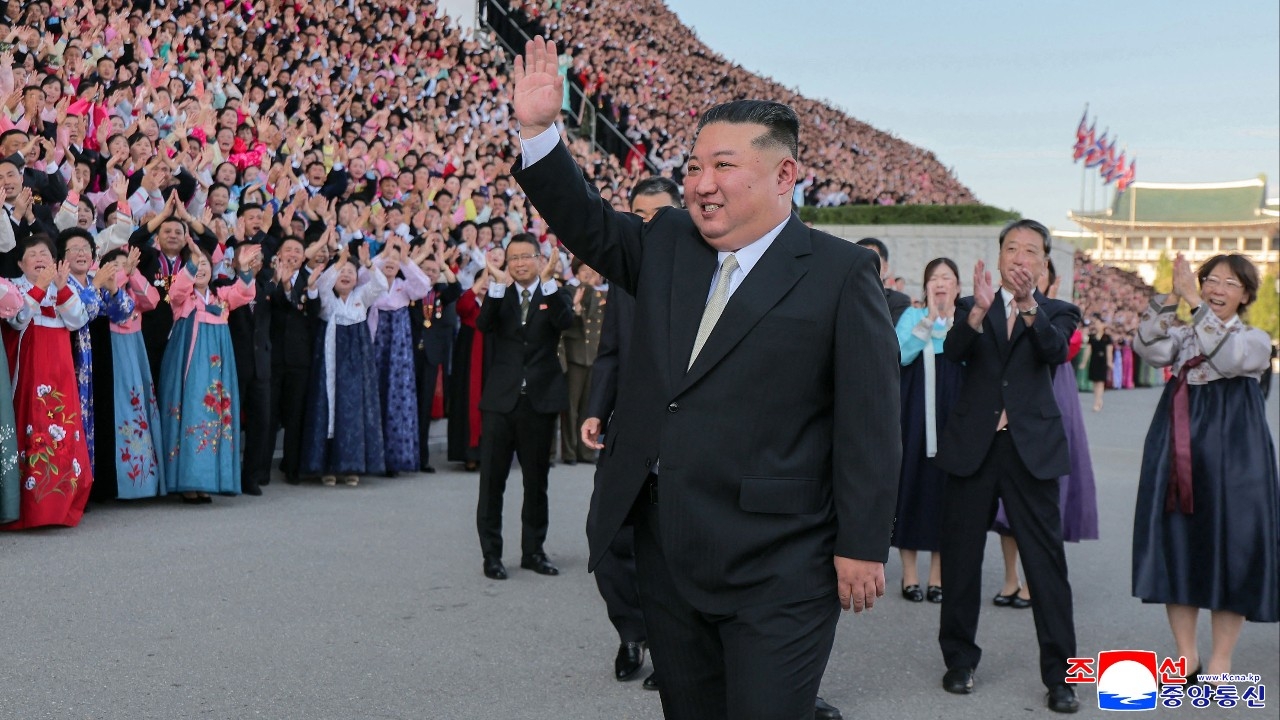
South Korea's National Intelligence Service (NIS) has assessed the health of North Korean leader Kim Jong Un as severely obese, weighing over 140 kilograms, and categorized as high risk for cardiovascular disease, though no abnormal health signs have been observed. Meanwhile, his daughter Kim Ju Ae has steadily increased her public roles, appearing at events 30 times this year.
The NIS revealed that in its latest assessment, Kim Jong Un weighs more than 140 kilograms and is classified as severely obese, placing him in a high-risk group for heart and vascular diseases.
Yoon Gon-Young and Yoo Young-Ha, members of South Korea's parliamentary Intelligence Committee, disclosed this information following a committee meeting, noting that despite Kim Jong Un's high cardiovascular risk, he remains physically active, including running up stairs during a destroyer inspection without any movement abnormalities.
The NIS stated that Kim Jong Un is under close care by his personal medical team, and continuous health monitoring has found no clear abnormal health indicators. However, as a heavy smoker with long-term overweight issues, his health remains a focus internationally, as sudden death could raise questions about succession and North Korea’s stability, a nuclear-armed state.
Concerns about Kim Jong Un's health intensified in 2020 when he missed the public ceremony commemorating the birthday of Kim Il Sung, the country’s founder and his grandfather, disappearing from public view for about 20 days, sparking rumors of serious illness following surgery.
Kim Jong Il, Kim Jong Un’s father, and Kim Il Sung, his grandfather, both struggled with obesity and heavy smoking, and both died from heart attacks.
Paul Smart, head chef at Hanoi’s Metropole Hotel who worked with Kim Jong Un’s personal chef during the 2019 U.S.-North Korea summit, revealed that the North Korean leader favored expensive dishes and luxury ingredients like caviar, lobster, and foie gras, with his personal chef noting his taste for costly, lavish food.
Meanwhile, the NIS assessed the role of Kim Ju Ae, Kim Jong Un’s daughter, stating she is about 160 centimeters tall, weighs over 50 kilograms, and dresses in women's suits and high heels to project a more mature image.
The NIS said Kim Ju Ae’s role is expanding from military activities to civilian, political, and diplomatic affairs. She has appeared publicly 30 times this year, the highest number since she emerged as an important figure in North Korea.
In January, Kim Ju Ae was positioned centrally during a visit to Kumsusan Palace and made her first appearance at Victory Day events and revolutionary martyrs’ memorial ceremonies marking national liberation anniversaries. South Korea’s intelligence views this as a sign of her rising status as a designated successor.
Regarding the two North Korean soldiers captured as prisoners of war in the Russia-Ukraine conflict and later sent to South Korea, the NIS said Ukraine publicized this to garner support in South Korea for increased assistance to Ukraine, including weapon supplies.
The NIS noted that although it is unclear whether leaders of the two countries directly agreed on the matter, discussions occurred through various channels including foreign ministers and embassy coordination with Ukraine’s Foreign Ministry. South Korea expressed strong displeasure to Ukraine on 27 September, demanding clarification and an official apology, which Ukraine has yet to provide.
South Korean intelligence added that Ukraine requested secrecy from the beginning about the prisoner transfer due to concerns it might negatively impact prisoner exchange negotiations with Russia, including exchanges via third countries. The two North Korean prisoners arrived in South Korea in mid-September, are generally healthy, and have repeatedly affirmed their voluntary choice to come to South Korea.
Regarding the landmine incident in the Demilitarized Zone (DMZ), which North Korea accused of being staged, the NIS assesses that statements by Kim Yo Jong, Kim Jong Un’s sister, aim to deny North Korea’s involvement, with her remarks being relatively cautious. She warned that any shots fired at North Korean troops would be met with immediate, strong retaliation and indicated increased tactical responses near South Korea’s 21st Infantry Division opposite the DMZ.
On the possibility of North Korea-U.S. talks, the NIS estimates about a 50% chance of discussions occurring before or after the Asia-Pacific Economic Cooperation (APEC) summit, noting Pyongyang’s desire not to miss this opportunity. Reports indicate North Korean officials abroad have been instructed to exercise caution in information sharing, with officials responsible for U.S. affairs actively engaged.
The NIS also noted that North Korea’s emphasis on the personal relationship between Kim Jong Un and U.S. President Donald Trump, along with avoidance of direct criticism of Trump, may reflect Pyongyang’s intent to preserve diplomatic channels.
Regarding military cooperation between North Korea and Russia, the NIS reported approximately 9,000 North Korean soldiers are currently deployed to secure the border area of Russia’s Kursk region. No signs of additional troop deployments have been observed, though the situation is closely monitored.
South Korean intelligence further stated that Russia is helping enhance North Korea’s military capabilities by transferring modern warfare weapon technologies but remains cautious about sharing advanced technologies such as intercontinental ballistic missiles (ICBMs) and nuclear-powered submarines. Additionally, guided missile exports from North Korea were detected over the past year, a development the NIS is closely tracking.
. . .AFP/Chosun Ilbo/JoongAng Ilbo