

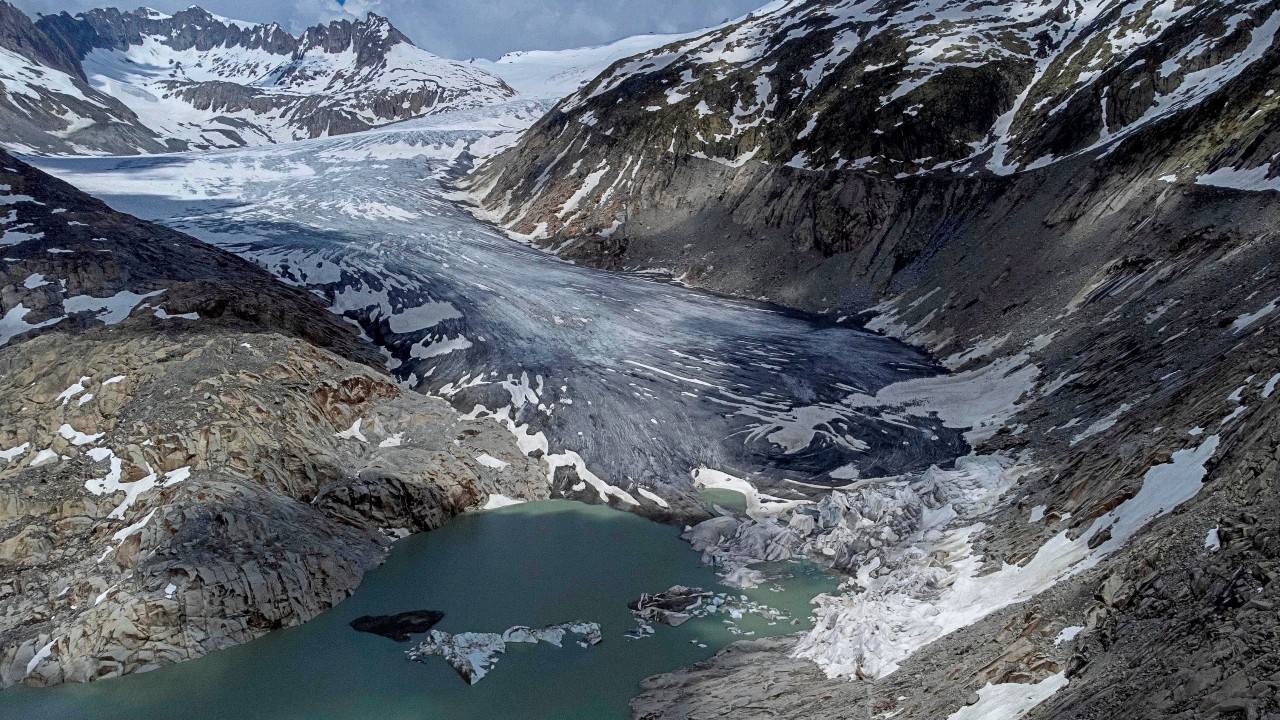
Swiss glaciers lost 5.5% of their ice volume in 2026, marking the second largest annual decrease since records began. Scientists attribute this mainly to heatwaves and reduced winter snowfall and warn that Alpine glaciers may not survive long term under such climatic conditions.
Switzerland, home to the largest volume of glaciers in the Alps, experienced a 5.5% loss in glacier ice volume in 2026. This represents the second largest annual proportional decline since data collection started, caused by multiple heatwaves combined with below-normal winter snowfall, according to scientists.
The Swiss Glacier Monitoring Network (GLAMOS) and the Swiss Science Institute reported that the glaciers in the Alps "have no chance of long-term survival" if these weather patterns persist.
Matthias Huss, GLAMOS director and professor of glaciology, stated that current global warming can be fully linked to climate changes caused by human activities. Without greenhouse gas emissions or fossil fuel use by humans, the current level of warming would not exist.
Data shows that Switzerland’s glacier volume has declined by nearly one-fifth over the past five years, highlighting an accelerating and sustained melting trend. The year 2022 saw the greatest ice loss on record, due to high summer temperatures, low winter snowfall, and red dust from the Sahara desert blowing onto the glaciers, darkening the ice surface and increasing heat absorption.
Huss explained that winter snow is crucial for glaciers for two reasons: first, snow covers and protects older ice beneath from melting—the longer the snow cover lasts, the more it slows ice loss. Second, snow serves as a source for new ice accumulation; more snow increases the likelihood that some will remain at high altitudes and compact into new ice.
Although the total ice volume lost this year was less than in 2003, the proportion lost was higher because the current total glacier volume is only about one-third of what it was 23 years ago. In 2003, Swiss glaciers lost approximately 3.5% of their total volume, whereas this year the loss increased to 5.5%.
The rapid melting has had a significant impact on Switzerland’s water resources. Between July and September, glaciers lost about 2.2 trillion liters of ice as meltwater—equivalent to roughly four times the annual water use of Switzerland’s 9.1 million population.
The effects extend beyond Switzerland’s borders, as the country is known as the "Water Tower of Europe," serving as a key source for major continental rivers including the Danube, Po, Rhine, and Rhône.
Switzerland also heavily relies on hydropower, with over half of its electricity generated from hydroelectric plants. Therefore, changes in water volume from glacier melt and shrinkage are critical for the ecosystem as well as water and energy security.
Scientists report that glacier melt this year has been severe, with average glacier thickness decreasing by about 2.5 to 4 meters (8 to 13 feet), and some glacier termini losing up to 10 meters (33 feet) of ice.
Expert teams conducted field studies to measure water flow from glaciers and examined crevasses caused by water currents within ice layers. In some areas, red dye was poured into streams to track water pathways and flow within the glacier systems.
Glaciers Allalin, Clariden, Rhône, and Aletsch experienced very high levels of melting this year. The Aletsch Glacier, the largest in the Alps, was among the areas with historically significant ice loss.
Scientists warn that rapid glacier melting is not limited to the Alps but is part of a global trend. Global warming has destabilized steep regions in the Himalayas, causing landslides and severe floods, while satellite images show significant shrinkage of glaciers in Greenland and Antarctica over recent decades.
/sourceAssociated Press