

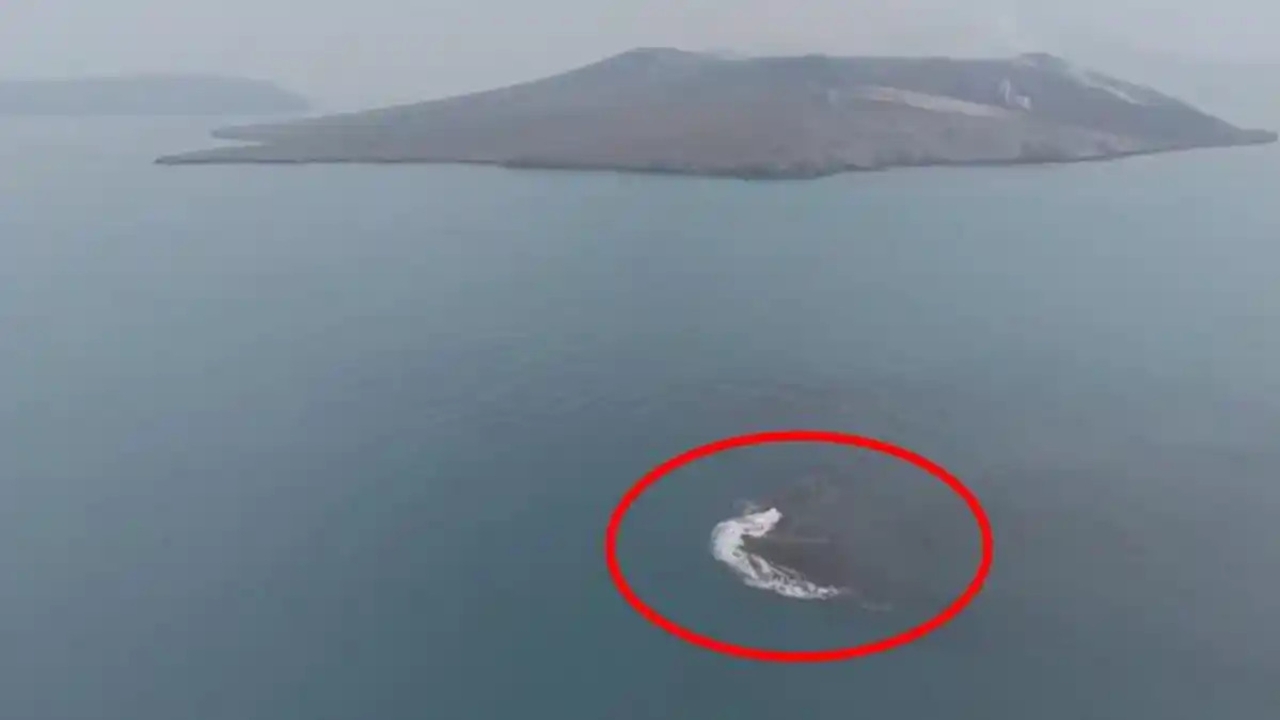
Indonesia's Geological Agency confirmed the discovery of two new islands emerging off the coast of the Anak Krakatoa volcano after a continuous 25-hour eruption in early September. This marks the first formation of new islands within the submarine volcanic crater in nearly 100 years since Anak Krakatoa permanently formed above sea level in 1930.
The Geological Agency under Indonesia's Ministry of Energy and Mineral Resources detected two new islands off the coast of Anak Krakatoa volcano in the Sunda Strait, between Java and Sumatra islands, following approximately 25 hours of continuous eruptions from 4 to 6 September 2026.
The agency reported one new island lies about 760 meters northwest of Anak Krakatoa's coast, while the other is approximately 495 meters to the southeast. Both islands align almost in a straight line, with the main volcanic crater situated between them. Confirmation came from reports by sailors and volunteers, as well as Sentinel satellite images up to 23 September.
Officials preliminarily assessed that the continuous eruption caused relatively fluid magma to rise through a northwest-southeast fault line, accumulating into two mound-like islands. However, it remains unclear whether these are new volcanic craters or merely volcanic materials deposited in shallow waters.
This new land formation is significant because no other separate islands have formed within the original volcanic caldera since Anak Krakatoa permanently emerged above sea level in 1930, 96 years ago. Anak Krakatoa, or the "child of Krakatoa," arose after the massive 1883 eruption of Krakatoa volcano, which destroyed much of the original island and killed over 36,000 people. The explosion was heard nearly 5,000 kilometers away and affected global climate.
Anak Krakatoa became active again in July after more than two years of dormancy, leading to a major eruption in September. This increased the island's area by about 32.8 hectares due to lava flows and accumulation of volcanic materials.
However, experts warn that the two new islands might not be permanent, as volcanic areas near sea level are highly dynamic due to erosion, sea waves, and deposition from eruptions. Anak Krakatoa underwent multiple cycles before becoming a full island. Its first clearly visible underwater eruptions began in late 1927, with volcanic material appearing above water in 1928, then disappearing underwater repeatedly until the island was fully formed in 1930.
The Geological Agency stated that after lowering Anak Krakatoa's alert level from 3 to 2 on 21 September, they established new hazard zones: prohibiting public and tourist access within 2 kilometers of the main volcanic crater and within 1 kilometer of the two new islands. Residents along the coasts of Banten and Lampung provinces were advised to follow official information and avoid believing rumors about tsunamis.