

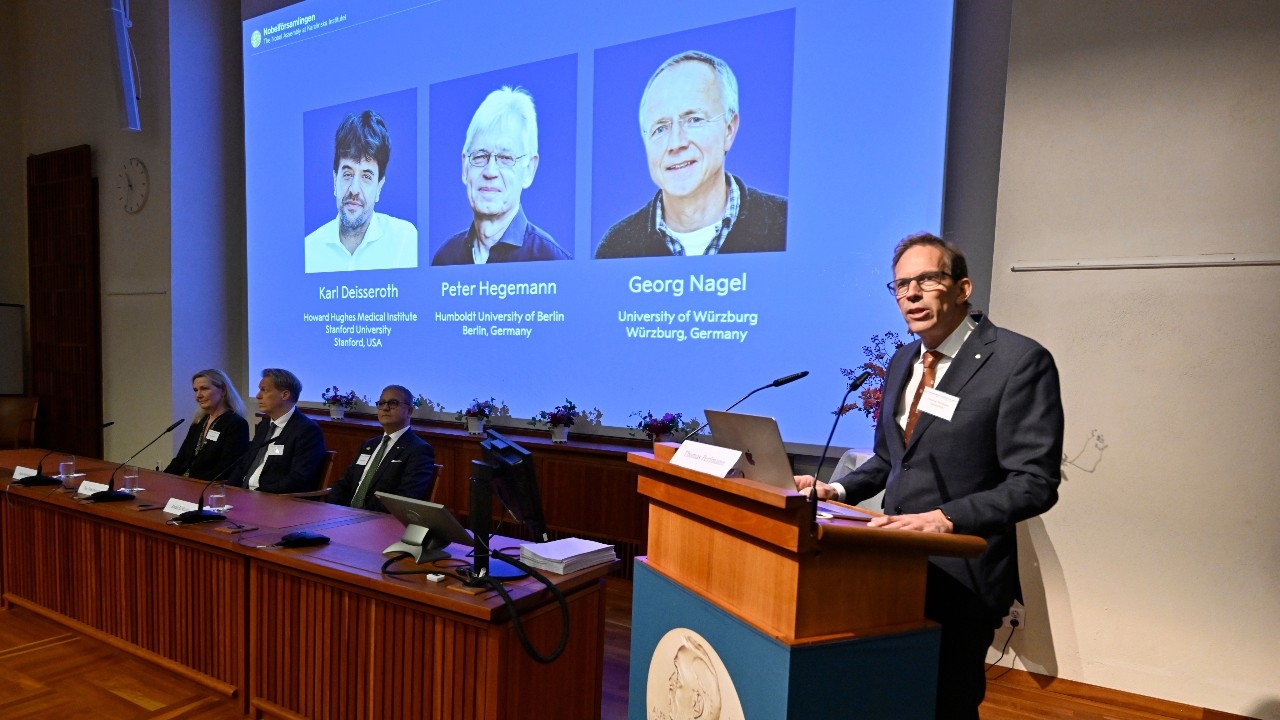
The Nobel Assembly at the Karolinska Institute in Sweden announced the 2026 Nobel Prize in Medicine to Karl Deisseroth, Peter Hegemann, and Georg Nagel for discovering light-controlled ion channels and developing "optogenetics," which enables scientists to precisely control and study living brain neurons.
The Nobel Assembly at the Karolinska Institute awarded the 2026 Nobel Prize in Physiology or Medicine to three scientists: Karl Deisseroth from the Howard Hughes Medical Institute and Stanford University, USA; Peter Hegemann from Humboldt University of Berlin, Germany; and Georg Nagel from the University of Würzburg, Germany.
All three received the prize for "discoveries related to light-controlled ion channels and optogenetics," a technique that allows scientists to study how living brain neurons contribute to memory, sensation, and behavior.
This discovery marks a foundational breakthrough in modern neuroscience, enabling researchers to control neuron activity with light and directly study the link between neural circuits and brain function.
The discovery began with Peter Hegemann’s curiosity about how Chlamydomonas, a single-celled alga, swims toward light sources.
In the early 2000s, Hegemann and Georg Nagel identified a protein called channelrhodopsin on the algae's cell surface with remarkable properties.
When exposed to blue light, this protein opens channels allowing charged ions into the cell, creating electrical signals. Scientists found that inserting this protein into any cell made that cell responsive to light. This led to the idea that the protein could serve as a “switch” controlling cell activity with light.
Karl Deisseroth introduced the gene encoding channelrhodopsin into neurons of experimental mice, then used blue light to stimulate these cells, inducing nerve signals. He published this key work in 2005, and two years later successfully demonstrated light-controlled “switches” working in live mouse brains. This technique, called optogenetics, quickly spread worldwide among researchers.
Scientists use optogenetics to study neural circuits involved in specific memory, sensation, and behavior functions, including those related to neurological and psychiatric diseases.
Before optogenetics, scientists could only identify brain regions linked to certain functions but could not precisely prove cause-and-effect relationships, leaving understanding of the brain incomplete and uncertain.
Per Svenningsson, chair of the Nobel Committee for Physiology or Medicine, said optogenetics allows scientists to map brain function at a level once considered a dream.
Currently, researchers apply this technique to study restoring vision in people with visual impairments, hoping knowledge from light-controlled neurons will lead to future treatments.
The Nobel Assembly stated that optogenetics has profoundly transformed human understanding of the brain, and ongoing research based on this technique continues to yield new discoveries to unravel one of humanity’s greatest mysteries: how our complex brain functions.